Clinical Knowledge › Neurology › Peripheral nerve disorders
Charcot–Marie–Tooth disease
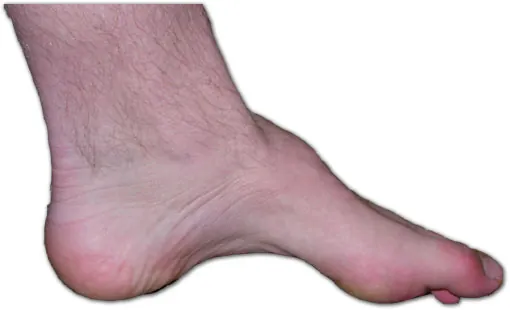
Charcot–Marie–Tooth disease (CMT), or hereditary motor and sensory neuropathy, is the commonest inherited neuromuscular disorder, affecting about 1 in 2500 people. It is a group of genetically heterogeneous, slowly progressive, length-dependent neuropathies. CMT1 is demyelinating with uniform slowing of conduction velocity (median motor velocity below 38 m/s) and most often results from duplication of PMP22 on chromosome 17p (CMT1A); CMT2 is axonal with near-normal velocities (MFN2 is a common cause); CMTX1 (GJB1, connexin 32) is X-linked with intermediate velocities. Symptoms begin in childhood or early adulthood with tripping, foot drop, high-arched feet, hammer toes and distal wasting of the legs, giving an 'inverted champagne bottle' appearance, later followed by hand weakness. Reflexes are reduced and sensory loss is mild. Diagnosis rests on family history, nerve conduction studies and genetic testing. There is no disease-modifying treatment: management is physiotherapy, orthoses, orthopaedic surgery, avoidance of neurotoxic drugs (especially vincristine) and genetic counselling. Life expectancy is normal.
Patient case, mechanism, investigations, management, flashcards and exam-style questions.Open the lesson →
Key facts
- Commonest inherited neuropathy (about 1 in 2500); usually autosomal dominant
- CMT1A, due to PMP22 duplication on 17p11.2, is the commonest subtype overall
- CMT1 = demyelinating, uniform slowing (median motor velocity below 38 m/s); CMT2 = axonal, velocity above 38 m/s with low amplitudes
- CMTX1 (GJB1/connexin 32) is the second commonest; affected males more severe, intermediate velocities
- PMP22 deletion causes hereditary neuropathy with liability to pressure palsies (HNPP)
- Signs: pes cavus, hammer toes, distal leg wasting ('inverted champagne bottle'), foot drop with steppage gait, areflexia, mild distal sensory loss
- Uniform slowing distinguishes inherited from acquired demyelination (patchy slowing and conduction block)
- Vincristine can cause severe, rapid neuropathy in CMT and should be avoided; no disease-modifying therapy is approved
Differential diagnosis
| Condition | Clues | Key test |
|---|---|---|
| CIDP | Acquired, proximal and distal weakness, patchy slowing with conduction block | NCS pattern; CSF protein; treatment response |
| Distal hereditary motor neuropathy | Pure motor distal weakness, normal sensory responses | NCS: normal SNAPs; gene panel |
| Friedreich ataxia | Ataxia, dysarthria, pes cavus, cardiomyopathy, extensor plantars | FXN GAA repeat |
| Hereditary neuropathy with liability to pressure palsies | Recurrent painless palsies at compression sites | PMP22 deletion |
| Distal myopathy | Distal weakness with normal sensation and NCS | CK, EMG myopathic, muscle MRI |
| Spinal cord tethering or dysraphism | Unilateral pes cavus, bladder symptoms, back stigmata | MRI lumbar spine |
| Hereditary TTR amyloidosis | Adult onset, autonomic failure, carpal tunnel, cardiomyopathy | TTR gene testing (treatable) |
Exam pearls
Guideline
No single international treatment guideline; practice follows expert consensus on genetic testing and management of inherited neuropathies (2019–2025 reviews), the CMT neuropathy score (CMTNS) for outcome assessment, and drug-safety guidance on neurotoxic medicines
References
- Pareyson D, Marchesi C. Diagnosis, natural history, and management of Charcot–Marie–Tooth disease. Lancet Neurol 2009.
- Rossor AM, Polke JM, Houlden H, Reilly MM. Clinical implications of genetic advances in Charcot–Marie–Tooth disease. Nat Rev Neurol 2013.
- Saporta AS, Sottile SL, Miller LJ, et al.. Charcot–Marie–Tooth disease subtypes and genetic testing strategies. Ann Neurol 2011.
- Ropper AH, Samuels MA, Klein JP, Prasad S.. Adams and Victor's Principles of Neurology. 2023.
- Papadakis MA, Rabow MW, McQuaid KR, eds.. CURRENT Medical Diagnosis & Treatment 2026. 2026.
- Murphy SM, Herrmann DN, McDermott MP, et al.. Reliability of the CMT neuropathy score (second version) in Charcot–Marie–Tooth disease. J Peripher Nerv Syst 2011.
Related topics
By Dr Khalid Seidi (B.Sc., M.D.) · MedEd World Clinical Knowledge library. Original teaching content checked against current guidelines (November 2026); confirm the latest local guidance before clinical use. Not a substitute for clinical judgement.