Clinical Knowledge › Neurology › Peripheral nerve disorders
Meralgia paraesthetica
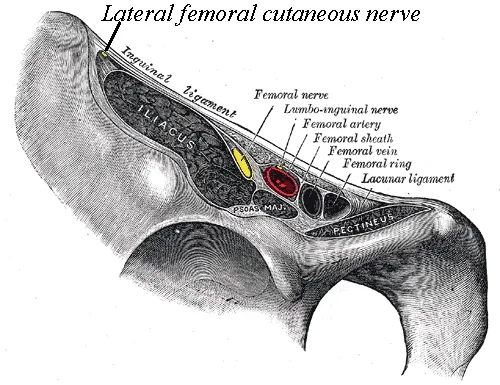
Meralgia paraesthetica is a mononeuropathy of the lateral femoral cutaneous nerve of the thigh, a purely sensory branch of the lumbar plexus (L2–L3), usually caused by compression or stretching where the nerve passes under or through the inguinal ligament close to the anterior superior iliac spine. It causes burning pain, tingling, numbness and hypersensitivity over the anterolateral thigh, often worse on standing or walking and eased by sitting or hip flexion. Strength, reflexes and the rest of the neurological examination are normal, which separates it from L2–L3 radiculopathy, femoral neuropathy and lumbar plexopathy. Risk factors include obesity, pregnancy, tight belts, trousers or body armour, diabetes, recent weight change, prolonged prone positioning or hip surgery and iliac crest bone grafting. The diagnosis is clinical; a diagnostic local anaesthetic nerve block can confirm it, ultrasound can show nerve swelling, and abdominal or pelvic imaging is needed only with red flags such as weakness, weight loss or suspected retroperitoneal mass. Most cases improve with removal of the compressive cause, weight loss, reassurance and topical or oral neuropathic pain treatment; ultrasound-guided injection or surgery is reserved for persistent cases.
Patient case, mechanism, investigations, management, flashcards and exam-style questions.Open the lesson →
Key facts
- Lateral femoral cutaneous nerve (L2–L3) is purely sensory
- Compression at the inguinal ligament near the anterior superior iliac spine
- Burning, numbness and tingling over the anterolateral thigh; never below the knee
- No weakness, normal knee reflex: distinguishes it from L3 radiculopathy and femoral neuropathy
- Risk factors: obesity, pregnancy, tight belts or clothing, diabetes, weight change, surgery positioning, iliac crest bone graft
- Diagnosis is clinical; local anaesthetic nerve block is diagnostic and therapeutic
- Red flags (weakness, reflex loss, weight loss, abdominal mass) need imaging of the pelvis and lumbar spine
- Most resolve with conservative care; injection or surgical decompression or neurectomy for refractory cases
Differential diagnosis
| Condition | Clues | Key test |
|---|---|---|
| L2–L3 radiculopathy | Back pain, weak hip flexion or knee extension, reduced knee reflex | MRI lumbar spine |
| Femoral neuropathy | Weak knee extension, absent knee jerk, anteromedial thigh and medial leg numbness | NCS and EMG; CT for iliopsoas haematoma |
| Lumbosacral plexopathy (diabetic amyotrophy) | Severe thigh pain, weakness, weight loss | EMG; MRI plexus |
| Retroperitoneal mass or haematoma | Anticoagulation, weight loss, abdominal or flank pain | CT or MRI abdomen and pelvis |
| Hip osteoarthritis or trochanteric bursitis | Mechanical pain, tenderness over trochanter, no sensory loss | Examination; hip X-ray |
| Herpes zoster (pre-eruptive) | Burning dermatomal pain followed by vesicles | Clinical; rash appears |
Exam pearls
Guideline
No disease-specific international guideline; management follows the Cochrane systematic review of treatment for meralgia paraesthetica (2012) and NICE CG173 neuropathic pain (updated 2020)
References
- Khalil N, Nicotra A, Rakowicz W. Treatment for meralgia paraesthetica. Cochrane Database Syst Rev 2012.
- National Institute for Health and Care Excellence. Neuropathic pain in adults: pharmacological management in non-specialist settings (CG173). NICE 2020.
- van Slobbe AM, Bohnen AM, Bernsen RM, Koes BW, Bierma-Zeinstra SM. Incidence rates and determinants in meralgia paresthetica in general practice. J Neurol 2004.
- Ropper AH, Samuels MA, Klein JP, Prasad S.. Adams and Victor's Principles of Neurology. 2023.
- Standring S, ed.. Gray's Anatomy: The Anatomical Basis of Clinical Practice. 2020.
- Papadakis MA, Rabow MW, McQuaid KR, eds.. CURRENT Medical Diagnosis & Treatment 2026. 2026.
Related topics
By Dr Khalid Seidi (B.Sc., M.D.) · MedEd World Clinical Knowledge library. Original teaching content checked against current guidelines (November 2026); confirm the latest local guidance before clinical use. Not a substitute for clinical judgement.