Clinical Knowledge › Neurology › Peripheral nerve disorders
Radial nerve palsy
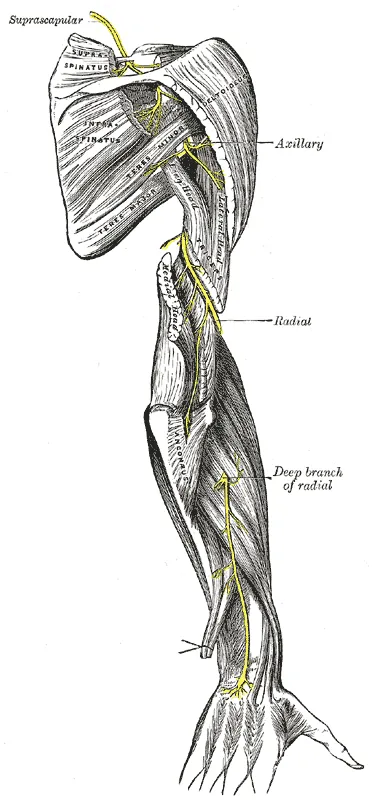
Radial nerve palsy is weakness of the muscles supplied by the radial nerve, which carries C5–T1 fibres from the posterior cord of the brachial plexus to the triceps, brachioradialis and all the wrist and finger extensors. The site determines the picture. Compression in the axilla (crutches) weakens triceps as well as the forearm extensors. The commonest lesion is at the spiral groove of the humerus, caused by humeral shaft fractures or prolonged pressure while deeply asleep or intoxicated ('Saturday night palsy'): this produces wrist and finger drop, weak brachioradialis and sensory loss over the dorsum of the first web space, with triceps spared. Posterior interosseous nerve lesions at the supinator cause finger drop and radial deviation on wrist extension without sensory loss, and superficial radial nerve compression (tight handcuffs or watch straps) causes only numbness. Distinguish radial palsy from C7 radiculopathy, stroke and lead neuropathy. Nerve conduction studies and EMG confirm the site and severity. Most compressive and fracture-associated palsies are neurapraxia or axonotmesis and recover with a cock-up wrist splint and physiotherapy; nerves that do not recover are explored, and tendon transfers restore function when needed.
Patient case, mechanism, investigations, management, flashcards and exam-style questions.Open the lesson →
Key facts
- Radial nerve: posterior cord (C5–T1); supplies triceps, anconeus, brachioradialis, wrist and finger extensors, supinator
- Spiral groove lesion (humeral shaft fracture, Saturday night palsy): wrist drop, finger drop, weak brachioradialis, triceps spared
- Axillary lesion (crutch palsy): triceps also weak and triceps reflex lost
- Posterior interosseous nerve lesion: finger drop, radial deviation on wrist extension (ECRL spared), no sensory loss
- Superficial radial nerve (cheiralgia paraesthetica): numbness over dorsal radial hand only
- Sensory loss: dorsum of first web space (anatomical snuffbox area)
- Apparent weakness of finger abduction in wrist drop disappears when the wrist is passively extended; test interossei with the hand flat
- Most humeral shaft-associated palsies recover spontaneously (about 70–90%); explore if no recovery after 3–6 months or for open injury
Differential diagnosis
| Condition | Clues | Key test |
|---|---|---|
| C7 radiculopathy | Neck pain, weak triceps and wrist flexors (FCR), reduced triceps reflex, brachioradialis normal | MRI cervical spine; EMG paraspinals |
| Stroke (cortical hand) | UMN signs, sudden onset, other cortical signs, brisk reflexes | CT or MRI brain |
| Posterior cord brachial plexopathy | Deltoid (axillary nerve) also weak | NCS and EMG; MRI plexus |
| Lead neuropathy | Bilateral wrist drop, anaemia with basophilic stippling, abdominal pain | Blood lead level |
| Multifocal motor neuropathy | Painless asymmetric weakness, conduction block, no sensory loss | NCS; anti-GM1 IgM |
| Extensor tendon rupture (rheumatoid arthritis) | Sudden loss of finger extension, normal tenodesis | Examination; ultrasound |
Exam pearls
Guideline
No international guideline specific to radial palsy; management follows orthopaedic and hand-surgery consensus on humeral shaft fractures with radial nerve palsy (systematic reviews 2005–2024) and electrodiagnostic practice guidance
References
- Shao YC, Harwood P, Grotz MR, Limb D, Giannoudis PV. Radial nerve palsy associated with fractures of the shaft of the humerus: a systematic review. J Bone Joint Surg Br 2005.
- Ljungquist KL, Martineau P, Allan C. Radial nerve injuries. J Hand Surg Am 2015.
- American Association of Neuromuscular & Electrodiagnostic Medicine. Proper performance and interpretation of electrodiagnostic studies (position statement). AANEM 2014.
- Ropper AH, Samuels MA, Klein JP, Prasad S.. Adams and Victor's Principles of Neurology. 2023.
- Standring S, ed.. Gray's Anatomy: The Anatomical Basis of Clinical Practice. 2020.
- Papadakis MA, Rabow MW, McQuaid KR, eds.. CURRENT Medical Diagnosis & Treatment 2026. 2026.
Related topics
By Dr Khalid Seidi (B.Sc., M.D.) · MedEd World Clinical Knowledge library. Original teaching content checked against current guidelines (November 2026); confirm the latest local guidance before clinical use. Not a substitute for clinical judgement.