Clinical Knowledge › Neurology › Peripheral nerve disorders
Peripheral neuropathy: classification and causes
Peripheral neuropathy is disease of the peripheral nerves, affecting motor, sensory or autonomic fibres. Classifying it answers four questions: the pattern (symmetrical length-dependent polyneuropathy, mononeuropathy, mononeuritis multiplex, polyradiculoneuropathy or neuronopathy), the fibres involved (large or small, sensory, motor or autonomic), the pathology (axonal or demyelinating, acquired or inherited) and the tempo (acute, subacute or chronic). Distal symmetrical sensorimotor axonal polyneuropathy is by far the commonest pattern; diabetes is the leading cause worldwide, followed by alcohol, B12 deficiency, drugs (chemotherapy, isoniazid, metronidazole), chronic kidney disease, hypothyroidism, paraproteinaemia, HIV and leprosy, with hereditary neuropathies such as Charcot–Marie–Tooth disease important in young patients. Acute or rapidly progressive, asymmetrical, motor-predominant or proximal neuropathies suggest Guillain–Barré syndrome, CIDP, vasculitis or paraneoplastic disease and need urgent work-up. Glucose or HbA1c, B12, serum protein electrophoresis with immunofixation, renal, liver and thyroid tests are first-line; nerve conduction studies define axonal versus demyelinating disease. Treatment addresses the cause, neuropathic pain and foot protection.
Patient case, mechanism, investigations, management, flashcards and exam-style questions.Open the lesson →
Key facts
- Commonest pattern: distal symmetrical, length-dependent sensorimotor axonal polyneuropathy ('glove and stocking')
- Diabetes is the commonest cause worldwide; up to a quarter of cases remain idiopathic (chronic idiopathic axonal polyneuropathy)
- Highest-yield screening tests: fasting glucose or HbA1c (± glucose tolerance test), B12 with methylmalonic acid, serum protein electrophoresis with immunofixation
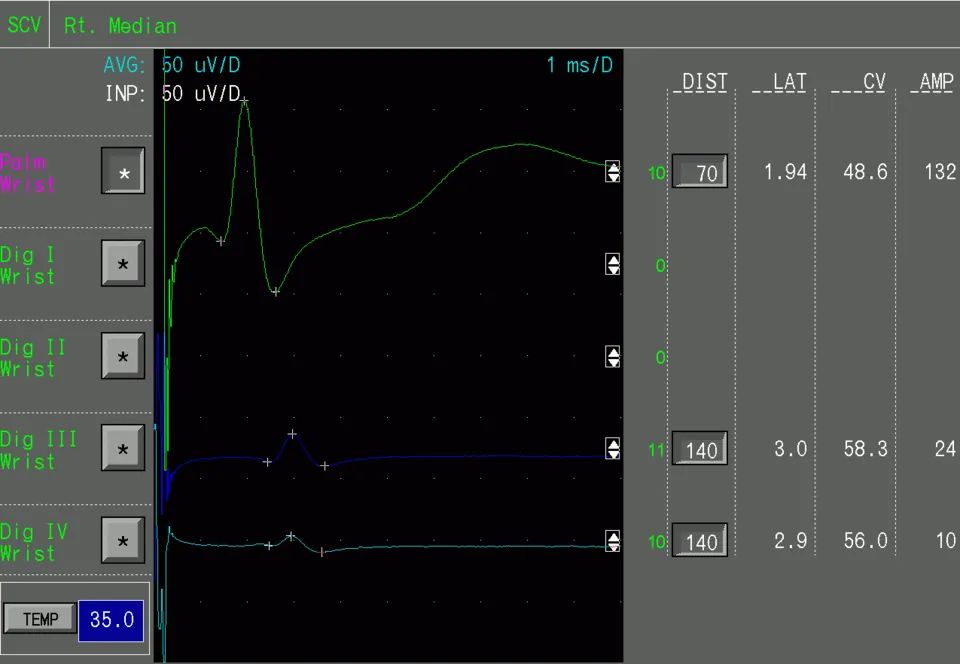
- Nerve conduction studies distinguish axonal (low amplitudes) from demyelinating (slow velocities, prolonged latencies, conduction block) neuropathy
- Small-fibre neuropathy causes burning pain with normal NCS; diagnose with skin biopsy for intraepidermal nerve fibre density
- Acquired demyelinating neuropathies (GBS, CIDP) are treatable with immunotherapy; uniform demyelination suggests hereditary disease
- Red flags: acute onset, asymmetry, proximal or motor-predominant weakness, autonomic failure, weight loss
- First-line neuropathic pain drugs: amitriptyline, duloxetine, gabapentin or pregabalin
Differential diagnosis
| Condition | Clues | Key test |
|---|---|---|
| Myelopathy (B12 deficiency, cervical myelopathy) | UMN signs, sensory level, sphincter disturbance | MRI spine; B12 |
| Radiculopathy or cauda equina | Dermatomal pain, back pain, saddle anaesthesia, asymmetrical | MRI lumbar spine |
| Myopathy | Proximal weakness, normal sensation and reflexes early | CK, EMG |
| Neuromuscular junction disorder | Fatigable weakness, ptosis, diplopia, normal sensation | AChR antibodies, repetitive stimulation |
| Motor neurone disease | Wasting, fasciculations, mixed UMN and LMN signs, no sensory loss | EMG widespread denervation |
| Peripheral vascular disease | Claudication, absent pulses, cold feet | Ankle–brachial index |
| Functional sensory disturbance | Inconsistent, non-anatomical distribution | Normal examination and NCS |
Exam pearls
Guideline
AAN/AANEM/AAPM&R practice parameter on laboratory and genetic testing in distal symmetric polyneuropathy (2009, reaffirmed), AAN 2022 painful diabetic neuropathy guideline, ADA Standards of Care in Diabetes 2026 and NICE CG173 neuropathic pain (updated 2020)
References
- England JD, Gronseth GS, Franklin G, et al.. Practice parameter: evaluation of distal symmetric polyneuropathy: role of laboratory and genetic testing (an evidence-based review). Neurology 2009.
- Price R, Smith D, Franklin G, et al.. Oral and topical treatment of painful diabetic polyneuropathy: practice guideline update summary. Neurology 2022.
- American Diabetes Association. Standards of Care in Diabetes—2026: retinopathy, neuropathy and foot care. Diabetes Care 2026.
- National Institute for Health and Care Excellence. Neuropathic pain in adults: pharmacological management in non-specialist settings (CG173). NICE 2020.
- Ropper AH, Samuels MA, Klein JP, Prasad S.. Adams and Victor's Principles of Neurology. 2023.
- Papadakis MA, Rabow MW, McQuaid KR, eds.. CURRENT Medical Diagnosis & Treatment 2026. 2026.
Related topics
By Dr Khalid Seidi (B.Sc., M.D.) · MedEd World Clinical Knowledge library. Original teaching content checked against current guidelines (November 2026); confirm the latest local guidance before clinical use. Not a substitute for clinical judgement.