Clinical Knowledge › Internal medicine › Infectious diseases › Fungal infections
Coccidioidomycosis
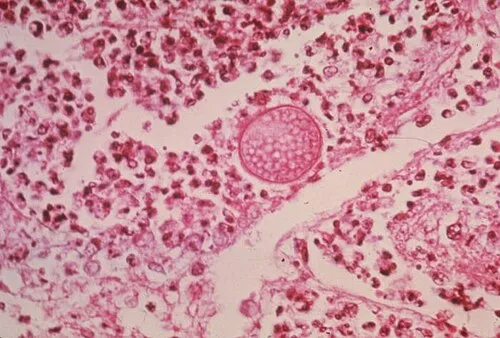
Coccidioidomycosis ('valley fever') is infection with the dimorphic fungi Coccidioides immitis and C. posadasii, found in desert soil of the south-western USA (Arizona, California's San Joaquin Valley), northern Mexico and parts of Central and South America. Arthroconidia carried in dust are inhaled and transform in tissue into large spherules filled with endospores. About 60% of infections are silent. The rest cause a subacute pneumonia 1–3 weeks after exposure with fever, cough, pleuritic pain and marked fatigue, often with erythema nodosum, arthralgia and eosinophilia. Residual nodules and thin-walled cavities are common. Fewer than 1% disseminate, to skin, bone, joints or meninges; risk is higher with HIV, transplantation, TNF inhibitors, late pregnancy, diabetes and people of African or Filipino ancestry. Diagnosis is by serology, culture and histology. Uncomplicated pneumonia is often observed without antifungals; fluconazole or itraconazole treat significant disease, amphotericin B severe disease, and meningitis needs lifelong azole therapy.
Patient case, mechanism, investigations, management, flashcards and exam-style questions.Open the lesson →
Key facts
- Coccidioides lives in desert soil of the south-western USA, northern Mexico and parts of Central and South America; dust storms, construction and earthquakes raise exposure
- Mould phase produces highly infectious barrel-shaped arthroconidia; tissue phase is a large spherule (about 20–100 µm) containing endospores
- About 60% of infections are asymptomatic; primary pneumonia appears 1–3 weeks after exposure
- Erythema nodosum, arthralgia ('desert rheumatism') and eosinophilia accompany primary infection and signal a good immune response
- Dissemination (under 1%) is more likely with HIV, transplantation, TNF inhibitors, pregnancy (third trimester and postpartum), diabetes and African or Filipino ancestry
- Complement fixation titres rise with disease extent; a high titre (for example 1:16 or more) suggests more severe or disseminated disease
- Coccidioidal meningitis requires lifelong azole therapy, usually high-dose fluconazole (teaching dose; check local formulary)
- Cultures are a serious laboratory hazard: always warn the laboratory when coccidioidomycosis is suspected
Differential diagnosis
| Condition | Clues | Key test |
|---|---|---|
| Community-acquired bacterial pneumonia | Abrupt onset, lobar consolidation, response to antibiotics | Cultures, urinary antigens; coccidioidal serology negative |
| Pulmonary tuberculosis | Upper-lobe cavity, chronic cough, TB risk | Sputum AFB smear, NAAT and culture |
| Sarcoidosis | Hilar nodes and erythema nodosum without exposure | Non-caseating granulomas; negative serology |
| Lung cancer | Solitary nodule in a smoker | PET-CT, biopsy; spherules on histology indicate cocci granuloma |
| Histoplasmosis or blastomycosis | Other endemic geography, different yeasts | Antigen, serology and morphology |
| Tuberculous meningitis | Basal meningitis with hydrocephalus and lymphocytic CSF | CSF AFB, Xpert; CSF coccidioidal CF antibody |
Exam pearls
Guideline
IDSA clinical practice guideline for the treatment of coccidioidomycosis (2016), with the ECMM/ISHAM/ASM global guideline for the endemic mycoses (2021)
References
- Galgiani JN, Ampel NM, Blair JE, et al.. 2016 Infectious Diseases Society of America (IDSA) clinical practice guideline for the treatment of coccidioidomycosis. Clin Infect Dis 2016.
- Thompson GR 3rd, Le T, Chindamporn A, et al.. Global guideline for the diagnosis and management of the endemic mycoses: an initiative of the European Confederation of Medical Mycology in cooperation with the International Society for Human and Animal Mycology. Lancet Infect Dis 2021.
- Donovan FM, Ampel NM, Thompson GR. Coccidioidomycosis. Infect Dis Clin North Am 2025.
- Mazi PB, Sahrmann JM, Olsen MA, et al.. The geographic distribution of dimorphic mycoses in the United States for the modern era. Clin Infect Dis 2023.
- Bennett JE, Dolin R, Blaser MJ, eds.. Mandell, Douglas, and Bennett's Principles and Practice of Infectious Diseases. 2020.
- Penman ID, Ralston SH, Strachan MWJ, Hobson RP, eds.. Davidson's Principles and Practice of Medicine. 2022.
Related topics
By Dr Khalid Seidi (B.Sc., M.D.) · MedEd World Clinical Knowledge library. Original teaching content checked against current guidelines (November 2026); confirm the latest local guidance before clinical use. Not a substitute for clinical judgement.