Clinical Knowledge › Internal medicine › Infectious diseases › Fungal infections
Histoplasmosis
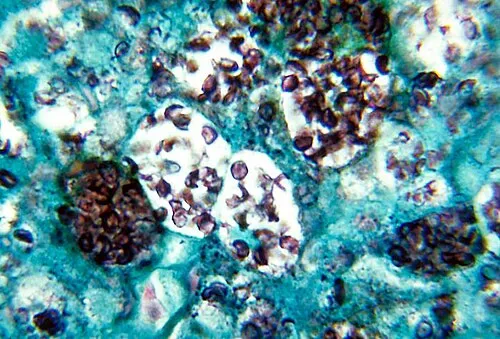
Histoplasmosis is infection with the thermally dimorphic fungus Histoplasma capsulatum, a mould in soil rich in bird and bat droppings that becomes small (2–4 µm) yeasts inside macrophages. It is endemic in the Ohio and Mississippi valleys, Latin America, Africa and Asia; caves, chicken coops and demolition are classic exposures. Most infections are silent. Heavy exposure causes acute pneumonia with hilar lymphadenopathy, sometimes with erythema nodosum; underlying emphysema predisposes to chronic cavitary disease that mimics tuberculosis. Fibrosing mediastinitis and broncholithiasis are late complications. In advanced HIV (CD4 below 150 cells/µL), on TNF inhibitors or after transplant, progressive disseminated histoplasmosis causes fever, weight loss, hepatosplenomegaly, pancytopenia, oral ulcers, adrenal insufficiency and septic shock. Antigen, serology, histology and culture establish the diagnosis. Mild disease in healthy hosts needs no treatment; itraconazole treats moderate or chronic disease, and liposomal amphotericin B is used for severe or disseminated disease.
Patient case, mechanism, investigations, management, flashcards and exam-style questions.Open the lesson →
Key facts
- Histoplasma capsulatum is a dimorphic fungus: mould with tuberculate macroconidia in soil, small 2–4 µm oval yeasts inside macrophages in tissue
- Exposure: bat guano (caves), bird or chicken droppings, demolition and excavation in the Ohio and Mississippi valleys, Latin America, Africa and Asia
- More than 90% of infections are asymptomatic or mild; heavy inoculum causes acute pneumonia with hilar or mediastinal lymphadenopathy
- Progressive disseminated histoplasmosis occurs with advanced HIV (CD4 below 150 cells/µL), TNF inhibitors, transplantation and corticosteroids
- Histoplasma antigen in urine and serum is the most sensitive test for disseminated disease and is used to monitor response
- Disseminated disease: fever, weight loss, hepatosplenomegaly, pancytopenia, raised LDH and ferritin, oral ulcers and adrenal insufficiency
- Itraconazole is the oral drug of choice (check levels); liposomal amphotericin B 3 mg/kg/day is used for severe or disseminated disease (teaching dose; check local formulary)
- Fibrosing mediastinitis is an excessive fibrotic response that does not respond to antifungals
Differential diagnosis
| Condition | Clues | Key test |
|---|---|---|
| Pulmonary tuberculosis | Upper-lobe cavity, night sweats, TB contact or endemic origin | Sputum AFB smear, NAAT and culture |
| Sarcoidosis | Bilateral hilar lymphadenopathy, erythema nodosum, no exposure history | Non-caseating granulomas; negative fungal tests |
| Lymphoma | Mediastinal mass, B symptoms, lymphadenopathy elsewhere | Biopsy with immunohistochemistry |
| Blastomycosis | Overlapping geography; skin and bone lesions | Large yeasts with broad-based buds; antigen cross-reacts |
| Visceral leishmaniasis | Fever, splenomegaly and pancytopenia in endemic areas | Amastigotes with kinetoplast on marrow; rK39 test |
| Talaromycosis | Advanced HIV in South-East Asia, umbilicated skin papules | Yeasts dividing by fission with central septum; culture |
| Community-acquired bacterial pneumonia | Abrupt fever, lobar consolidation, raised neutrophils | Response to antibiotics; cultures |
Exam pearls
Guideline
IDSA histoplasmosis clinical practice guideline update (2025, published in parts) with IDSA histoplasmosis guideline (2007), PAHO/WHO guidelines for disseminated histoplasmosis in people living with HIV (2020) and the ECMM/ISHAM global endemic mycoses guideline (2021)
References
- Arnold SR, Spec A, Baddley JW, et al.. 2025 clinical practice guideline update by the Infectious Diseases Society of America on histoplasmosis: treatment of asymptomatic Histoplasma pulmonary nodules (histoplasmomas) and mild or moderate acute pulmonary histoplasmosis in adults, children, and pregnant people. Clin Infect Dis 2025.
- Wheat LJ, Freifeld AG, Kleiman MB, et al.. Clinical practice guidelines for the management of patients with histoplasmosis: 2007 update by the Infectious Diseases Society of America. Clin Infect Dis 2007.
- Pan American Health Organization / World Health Organization. Guidelines for diagnosing and managing disseminated histoplasmosis among people living with HIV. 2020.
- Thompson GR 3rd, Le T, Chindamporn A, et al.. Global guideline for the diagnosis and management of the endemic mycoses: an initiative of the European Confederation of Medical Mycology in cooperation with the International Society for Human and Animal Mycology. Lancet Infect Dis 2021.
- Eichenberger EM, Little JS, Baddley JW. Histoplasmosis. Infect Dis Clin North Am 2025.
- Pasqualotto AC, Lana DD, Godoy CSM, et al.. Single high dose of liposomal amphotericin B in human immunodeficiency virus/AIDS-related disseminated histoplasmosis: a randomized trial. Clin Infect Dis 2023.
Related topics
By Dr Khalid Seidi (B.Sc., M.D.) · MedEd World Clinical Knowledge library. Original teaching content checked against current guidelines (November 2026); confirm the latest local guidance before clinical use. Not a substitute for clinical judgement.