Clinical Knowledge › Internal medicine › Infectious diseases › Fungal infections
Invasive and mucocutaneous candidiasis
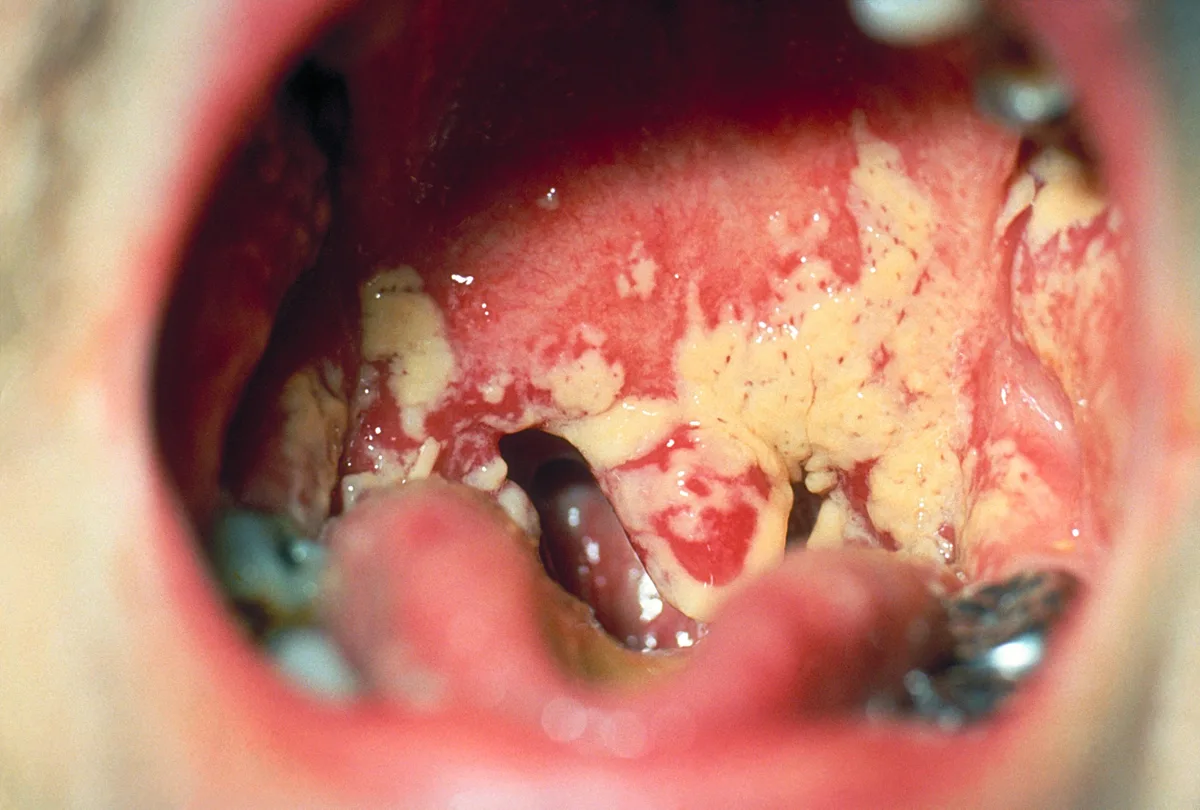
Candida species are commensal yeasts of the mouth, gut, vagina and skin that cause disease when local defences or immunity fail. Mucocutaneous candidiasis (oral thrush, oesophagitis, vulvovaginal candidiasis, intertrigo, paronychia) follows antibiotics, inhaled or systemic steroids, diabetes, dentures, pregnancy or impaired T-cell immunity such as HIV; it is diagnosed clinically and treated with topical azoles or nystatin, or oral fluconazole for oesophageal or severe disease. Invasive candidiasis (candidaemia and deep-seated infection) is a healthcare-associated infection of critically ill patients with central venous catheters, parenteral nutrition, broad-spectrum antibiotics, abdominal surgery or neutropenia, with mortality of 30–40%. Every positive blood culture for Candida needs treatment: an echinocandin first line, removal of the central line, repeat cultures until clear, an eye examination and at least 14 days of therapy after the first negative culture, stepping down to fluconazole when stable and susceptible. Azole-resistant species, including Candida auris, are rising.
Patient case, mechanism, investigations, management, flashcards and exam-style questions.Open the lesson →
Key facts
- Candida albicans causes most infections, but non-albicans species (N. glabratus, C. parapsilosis, C. tropicalis, P. kudriavzevii [C. krusei], C. auris) are rising
- Mucocutaneous candidiasis reflects local or T-cell defects (HIV, steroids, diabetes, antibiotics); invasive candidiasis reflects breached barriers and neutropenia
- Candida in a blood culture is never a contaminant: treat every episode
- Echinocandins (caspofungin, micafungin, anidulafungin, rezafungin) are first line for candidaemia; step down to fluconazole after 5–7 days if stable, cultures clear and isolate susceptible
- Remove central venous catheters early, repeat blood cultures until negative, and treat for 14 days after the first negative culture
- Examine the eyes (dilated fundoscopy) to detect Candida endophthalmitis, which changes drug choice and duration
- Pichia kudriavzevii (C. krusei) is intrinsically fluconazole-resistant; N. glabratus often has reduced azole susceptibility; C. auris is often multidrug-resistant and spreads in hospitals
- Candida in urine or sputum usually represents colonisation and rarely needs treatment
Differential diagnosis
| Condition | Clues | Key test |
|---|---|---|
| Oral hairy leukoplakia | White corrugated plaques on the lateral tongue that do not scrape off | Clinical; EBV on biopsy |
| Oral lichen planus | Lacy white striae on buccal mucosa, bilateral | Biopsy if uncertain |
| HSV or CMV oesophagitis | Odynophagia in HIV without response to fluconazole | Endoscopy with biopsy and PCR |
| Bacterial vaginosis | Thin grey fishy-smelling discharge, pH above 4.5 | Microscopy: clue cells; Amsel criteria |
| Trichomoniasis | Frothy yellow-green discharge, strawberry cervix | NAAT for Trichomonas vaginalis |
| Bacterial line sepsis | Fever with central line, Gram-positive cocci | Blood cultures from line and periphery |
| Hepatosplenic abscesses of other cause | Fever after neutropenia recovery with liver lesions | Biopsy and culture; beta-D-glucan |
Exam pearls
Guideline
Global guideline for the diagnosis and management of candidiasis (ECMM with ISHAM and ASM, 2025); IDSA Clinical Practice Guideline for the Management of Candidiasis (2016 update); BASHH national guideline for vulvovaginal candidiasis (2019)
References
- Cornely OA, Sprute R, Bassetti M, et al.. Global guideline for the diagnosis and management of candidiasis: an initiative of the ECMM in cooperation with ISHAM and ASM. Lancet Infect Dis 2025.
- Pappas PG, Kauffman CA, Andes DR, et al.. Clinical practice guideline for the management of candidiasis: 2016 update by the Infectious Diseases Society of America. Clin Infect Dis 2016.
- Kullberg BJ, Arendrup MC. Invasive candidiasis. N Engl J Med 2015.
- Pappas PG, Lionakis MS, Arendrup MC, Ostrosky-Zeichner L, Kullberg BJ. Invasive candidiasis. Nat Rev Dis Primers 2018.
- Thompson GR, Soriano A, Cornely OA, et al.. Rezafungin versus caspofungin for treatment of candidaemia and invasive candidiasis (ReSTORE): a multicentre, double-blind, double-dummy, randomised phase 3 trial. Lancet 2023.
- Saxon C, Edwards A, Rautemaa-Richardson R, et al.. British Association for Sexual Health and HIV national guideline for the management of vulvovaginal candidiasis (2019). Int J STD AIDS 2020.
Related topics
By Dr Khalid Seidi (B.Sc., M.D.) · MedEd World Clinical Knowledge library. Original teaching content checked against current guidelines (November 2026); confirm the latest local guidance before clinical use. Not a substitute for clinical judgement.