Clinical Knowledge › Anaesthesiology › Perioperative complications and emergencies
Dental and eye injuries under anaesthesia
Dental and eye injuries are among the commonest preventable harms of anaesthesia and frequent causes of complaints and claims. Dental damage occurs in roughly 1 in 2000 general anaesthetics, mostly to the upper incisors during laryngoscopy or when a patient bites on an airway device at emergence; poor dentition, crowns, bridges, loose teeth and difficult intubation multiply the risk. The anaesthetic priority after any dental injury is to find every fragment, because a missing tooth may have been aspirated. Corneal abrasion is the commonest ocular injury: the eyelids of an anaesthetised patient often fail to close, tear production and the blink reflex are lost, and the cornea dries or is scratched by drapes, masks or the patient's own hand in recovery. Rare but devastating perioperative visual loss follows ischaemic optic neuropathy or central retinal artery occlusion, typically after long prone spine or cardiac surgery. Prevention is simple: assess and document teeth, warn at-risk patients, protect teeth, tape the eyes closed immediately after induction and keep pressure off the globe.
Patient case, mechanism, investigations, management, flashcards and exam-style questions.Open the lesson →
Key facts
- Dental injury affects about 1 in 2000 anaesthetics; maxillary central incisors are most often injured
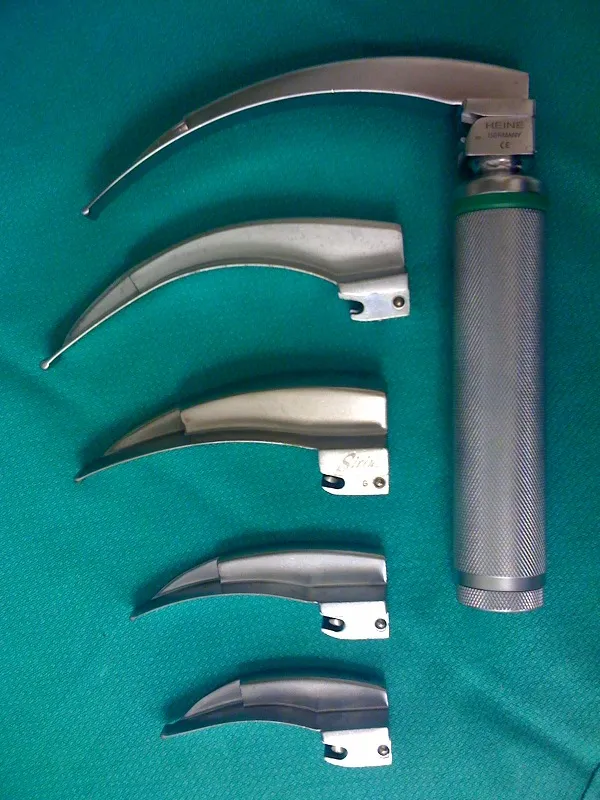
- Main moments of risk: direct laryngoscopy (teeth used as a fulcrum) and emergence, when the patient bites on an oropharyngeal airway or supraglottic device
- Risk factors: periodontal disease, caries, crowns, bridges, veneers, implants, isolated teeth, loose primary teeth in children and difficult laryngoscopy
- A tooth or fragment that cannot be found must be assumed aspirated: chest X-ray and, if seen, bronchoscopic retrieval
- An avulsed permanent tooth is handled by the crown and replanted as soon as possible or stored in milk or saline; primary teeth are never replanted
- Corneal abrasion is the commonest perioperative eye injury, typically under 1 in 1000 anaesthetics with eye protection; it causes pain, watering and photophobia in recovery
- Tape both eyelids closed immediately after loss of consciousness, before laryngoscopy, and add padding or goggles in the prone position
- Perioperative visual loss after prone spine surgery is usually posterior ischaemic optic neuropathy; central retinal artery occlusion follows direct pressure on the globe
Differential diagnosis
| Condition | Clues | Key test |
|---|---|---|
| Corneal abrasion | Gritty pain, watering and photophobia in recovery; normal acuity or mild blur | Fluorescein stain under blue light |
| Chemical keratitis from skin preparation | Burning pain, red eye after facial or head surgery with chlorhexidine or alcohol | History of prep near the eye; pH; fluorescein |
| Acute angle-closure glaucoma | Severe pain, headache, vomiting, fixed mid-dilated pupil, hazy cornea | Intraocular pressure measurement; gonioscopy |
| Posterior ischaemic optic neuropathy | Painless bilateral visual loss on waking after long prone spine surgery; initially normal fundi | Ophthalmology review; relative afferent pupillary defect; visual fields |
| Central retinal artery occlusion | Painless unilateral loss, periorbital oedema after external globe pressure; cherry-red spot | Fundoscopy |
| Cortical blindness | Bilateral loss with normal pupillary reflexes and fundi; often after cardiac surgery or hypotension | MRI brain |
| Ointment or residual mydriatic blur | Blurred vision that clears with blinking; no pain | Clinical; visual acuity normalises |
Exam pearls
Guideline
ASA Practice Advisory for Perioperative Visual Loss Associated with Spine Surgery (2019); Difficult Airway Society 2025 guidelines for unanticipated difficult tracheal intubation; IADT guidelines for traumatic dental injuries (2020)
References
- American Society of Anesthesiologists Task Force on Perioperative Visual Loss. Practice advisory for perioperative visual loss associated with spine surgery 2019. Anesthesiology 2019.
- Ahmad I, El-Boghdadly K, Iliff H, et al.. Difficult Airway Society 2025 guidelines for management of unanticipated difficult tracheal intubation in adults. Br J Anaesth 2026.
- Newland MC, Ellis SJ, Peters KR, et al.. Dental injury associated with anesthesia: a report of 161,687 anesthetics given over 14 years. J Clin Anesth 2007.
- Fouad AF, Abbott PV, Tsilingaridis G, et al.. International Association of Dental Traumatology guidelines for the management of traumatic dental injuries: 2. Avulsion of permanent teeth. Dent Traumatol 2020.
- Martin DP, Weingarten TN, Gunn PW, et al.. Performance improvement system and postoperative corneal injuries: incidence and risk factors. Anesthesiology 2009.
- Lamperti M, Romero CS, Guarracino F, et al.. Preoperative assessment of adults undergoing elective noncardiac surgery: updated guidelines from the European Society of Anaesthesiology and Intensive Care. Eur J Anaesthesiol 2025.
Related topics
By Dr Khalid Seidi (B.Sc., M.D.) · MedEd World Clinical Knowledge library. Original teaching content checked against current guidelines (November 2026); confirm the latest local guidance before clinical use. Not a substitute for clinical judgement.