Clinical Knowledge › Anaesthesiology › Perioperative complications and emergencies
Postoperative respiratory complications
Postoperative pulmonary complications (PPCs) are a group of respiratory events after surgery, including atelectasis, pneumonia, aspiration, bronchospasm, respiratory depression and respiratory failure. They occur after about 5–10% of major non-cardiac operations, are a leading cause of postoperative death, ICU admission and prolonged stay. Anaesthesia and surgery reduce functional residual capacity, impair diaphragm function, cough and mucociliary clearance and cause atelectasis; pain, opioids and residual neuromuscular block add hypoventilation and aspiration risk. Risk is predicted with the ARISCAT score (age, low preoperative SpO2, recent respiratory infection, anaemia, upper abdominal or thoracic incision, duration over 2 hours, emergency surgery). Prevention is a bundle: smoking cessation and prehabilitation, lung-protective ventilation, full reversal of neuromuscular block (TOF ratio at least 0.9), minimally invasive surgery, good regional analgesia, upright positioning and early mobilisation, with high-flow oxygen or CPAP for those who become hypoxaemic.
Patient case, mechanism, investigations, management, flashcards and exam-style questions.Open the lesson →
Key facts
- PPCs follow about 5–10% of major non-cardiac operations and up to 20–40% of upper abdominal and thoracic operations, depending on definition
- Strongest procedural risk factors: upper abdominal or thoracic incision, emergency surgery and duration longer than 2–3 hours
- Patient risk factors: age, COPD, smoking, heart failure, functional dependence, ASA 3 or above, OSA, low SpO2, recent respiratory infection and anaemia
- ARISCAT score: below 26 low risk, 26–44 intermediate, 45 or above high risk
- Upper abdominal surgery reduces vital capacity by up to 50–60% and FRC by about 30% for several days, mainly through diaphragm dysfunction and pain
- Lung-protective ventilation: tidal volume 6–8 mL/kg predicted body weight with PEEP; high PEEP with repeated recruitment did not reduce PPCs in PROVHILO
- Residual neuromuscular block (TOF ratio below 0.9) increases aspiration, hypoxaemia and pneumonia; quantitative monitoring is recommended (ESAIC 2023)
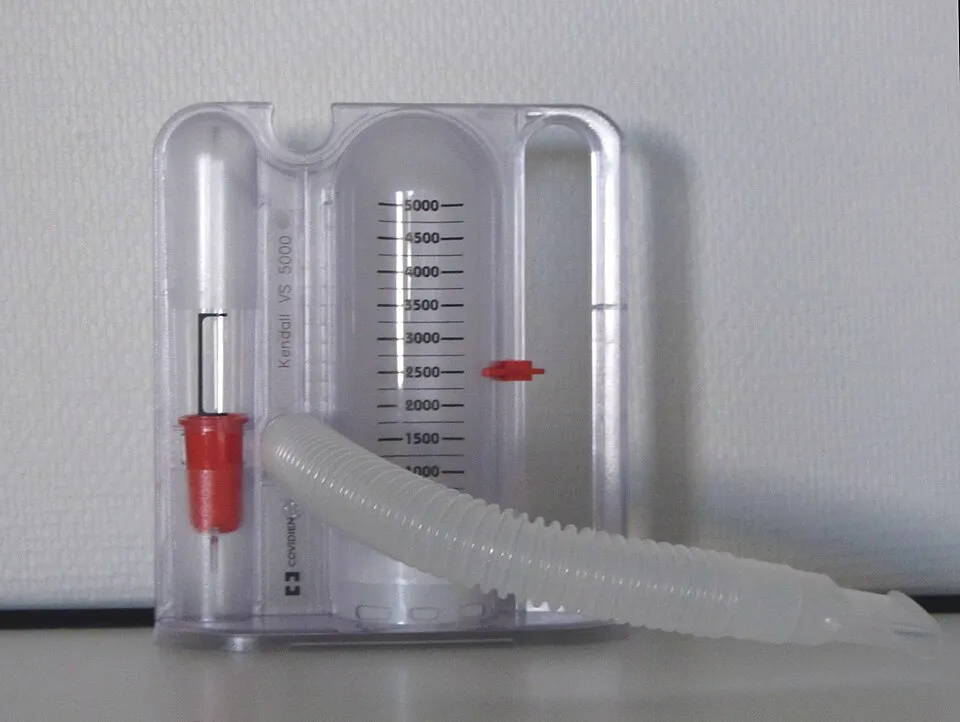
- Postoperative bundle: sit up, deep breathing and coughing, early mobilisation, oral care, effective analgesia, avoid routine nasogastric tubes
Differential diagnosis
| Condition | Clues | Key test |
|---|---|---|
| Atelectasis | Low-grade fever and mild hypoxaemia in first 24–48 hours with reduced basal breath sounds | Chest X-ray or lung ultrasound; improves with physiotherapy |
| Hospital-acquired pneumonia | Fever, purulent sputum, new infiltrate after 48 hours | Chest X-ray, sputum culture, CRP |
| Aspiration pneumonitis | Sudden hypoxaemia and wheeze after vomiting or regurgitation in a drowsy patient | Chest X-ray (right lower lobe) |
| Pulmonary embolism | Sudden breathlessness, tachycardia and pleuritic pain, often day 3 or later | CT pulmonary angiography |
| Opioid-induced respiratory depression | Drowsiness, slow breathing, pinpoint pupils, rising PaCO2 | Sedation score, respiratory rate, ABG; response to naloxone |
| Residual neuromuscular block | Weak, anxious patient in recovery with shallow breathing and poor cough | Quantitative train-of-four ratio below 0.9 |
| Cardiogenic pulmonary oedema | Orthopnoea, crackles, raised JVP after fluid loading or myocardial injury | Chest X-ray, BNP, troponin, echocardiography |
| Pneumothorax | Pleuritic pain and breathlessness after central line, nerve block or thoracic surgery | Chest X-ray or lung ultrasound |
Exam pearls
Guideline
ESAIC guideline on peri-operative management of neuromuscular blockade (2023), ERS guideline on high-flow nasal cannula (2022), Brazilian Society of Anesthesiology perioperative ventilation guideline (2026) and NICE NG180 perioperative care (2020)
References
- Miskovic A, Lumb AB. Postoperative pulmonary complications. Br J Anaesth 2017.
- Canet J, Gallart L, Gomar C, et al.. Prediction of postoperative pulmonary complications in a population-based surgical cohort. Anesthesiology 2010.
- Futier E, Constantin JM, Paugam-Burtz C, et al.. A trial of intraoperative low-tidal-volume ventilation in abdominal surgery. N Engl J Med 2013.
- PROVE Network Investigators; Hemmes SN, Gama de Abreu M, Pelosi P, Schultz MJ. High versus low positive end-expiratory pressure during general anaesthesia for open abdominal surgery (PROVHILO trial): a multicentre randomised controlled trial. Lancet 2014.
- Odor PM, Bampoe S, Gilhooly D, et al.. Perioperative interventions for prevention of postoperative pulmonary complications: systematic review and meta-analysis. BMJ 2020.
- Fuchs-Buder T, Romero CS, Lewald H, et al.. Peri-operative management of neuromuscular blockade: a guideline from the European Society of Anaesthesiology and Intensive Care. Eur J Anaesthesiol 2023.
Related topics
By Dr Khalid Seidi (B.Sc., M.D.) · MedEd World Clinical Knowledge library. Original teaching content checked against current guidelines (November 2026); confirm the latest local guidance before clinical use. Not a substitute for clinical judgement.