Clinical Knowledge › Surgery › Cardiothoracic surgery and neurosurgery
Extradural haematoma
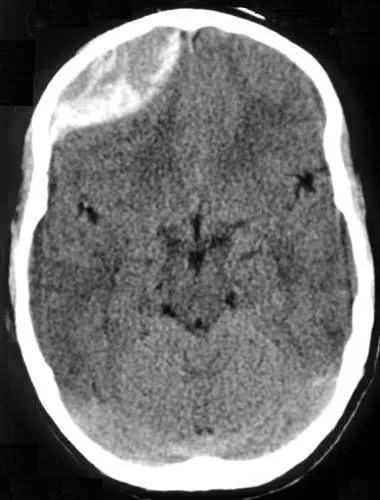
An extradural (epidural) haematoma is a collection of blood between the inner table of the skull and the dura. It typically follows a blow to the temple that fractures the squamous temporal bone and tears the middle meningeal artery, so it mostly affects young adults; it is rare in older people, whose dura is adherent. A minority of patients show the classic lucid interval: brief concussion, apparent recovery, then headache, vomiting, falling conscious level, an ipsilateral dilated pupil and contralateral weakness as the uncus herniates. Non-contrast CT shows a hyperdense biconvex (lens-shaped) collection that does not cross suture lines. Management follows ATLS and Brain Trauma Foundation principles: avoid hypoxia and hypotension, intubate if GCS is 8 or less, reverse anticoagulation and transfer urgently for craniotomy. Haematomas over 30 cm³, or any EDH with coma and anisocoria, need evacuation; small haematomas in alert patients can be observed with repeat CT. Outcomes are excellent with early surgery.
Patient case, mechanism, investigations, management, flashcards and exam-style questions.Open the lesson →
Key facts
- Blood between skull and dura, usually from a middle meningeal artery tear under a temporal (pterion) fracture
- Commonest in young adults and children over 2; rare after 60 because the dura is adherent to the skull
- Classic lucid interval occurs in only a minority (roughly one-fifth to one-half) of patients
- CT: hyperdense biconvex (lentiform) collection limited by skull sutures; a mixed-density 'swirl' suggests active bleeding
- Uncal herniation: ipsilateral fixed dilated pupil (oculomotor nerve) and contralateral hemiparesis; Cushing response is a late sign
- Brain Trauma Foundation: evacuate an EDH larger than 30 cm³ regardless of GCS; evacuate as soon as possible in coma (GCS under 9) with anisocoria
- Non-operative care is possible for EDH under 30 cm³, under 15 mm thick, midline shift under 5 mm, GCS above 8 and no focal deficit, with serial CT in a neurosurgical centre
- Mortality is low (under about 10%) with timely surgery and approaches zero in patients operated on before they lose consciousness
Differential diagnosis
| Condition | Clues | Key test |
|---|---|---|
| Acute subdural haematoma | Older patient, acceleration–deceleration, worse primary brain injury | CT: crescentic collection crossing sutures |
| Traumatic subarachnoid haemorrhage | Headache after trauma, blood in sulci | CT: blood in sulci and cisterns |
| Cerebral contusion / intracerebral haematoma | Frontal or temporal poles, coup–contrecoup | CT: intraparenchymal hyperdensity with oedema |
| Diffuse axonal injury | Coma from the moment of injury, CT out of proportion | MRI: grey–white junction and corpus callosum lesions |
| Alcohol or drug intoxication | Reduced GCS with smell of alcohol after a fall | Never attribute low GCS to alcohol: CT head |
| Post-traumatic seizure (postictal state) | Witnessed seizure, gradual improvement | CT to exclude haematoma; EEG if not improving |
Exam pearls
Guideline
Brain Trauma Foundation guidelines for the surgical management of TBI (2006) and severe TBI 4th edition (2016–2017), NICE NG232 Head injury (2023) and ATLS 11th edition (2025)
References
- Bullock MR, Chesnut R, Ghajar J, et al.. Surgical management of acute epidural hematomas. Neurosurgery 2006.
- Carney N, Totten AM, O'Reilly C, et al.. Guidelines for the management of severe traumatic brain injury, fourth edition. Neurosurgery 2017.
- National Institute for Health and Care Excellence. Head injury: assessment and early management (NG232). NICE guideline 2023.
- American College of Surgeons Committee on Trauma. Advanced Trauma Life Support (ATLS) Student Course Manual. 2025.
- CRASH-3 trial collaborators. Effects of tranexamic acid on death, disability, vascular occlusive events and other morbidities in patients with acute traumatic brain injury (CRASH-3): a randomised, placebo-controlled trial. Lancet 2019.
- Winn HR, ed.. Youmans and Winn Neurological Surgery. 2022.
Related topics
By Dr Khalid Seidi (B.Sc., M.D.) · MedEd World Clinical Knowledge library. Original teaching content checked against current guidelines (November 2026); confirm the latest local guidance before clinical use. Not a substitute for clinical judgement.