Clinical Knowledge › Surgery › Cardiothoracic surgery and neurosurgery
Valve replacement surgery
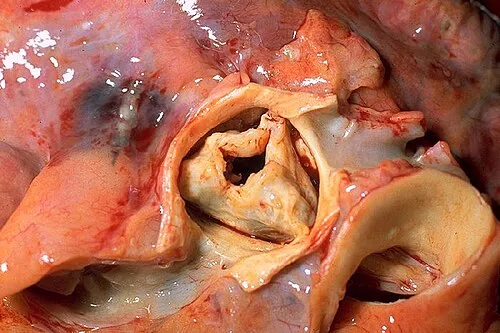
Valve replacement removes or excludes a diseased heart valve and substitutes a mechanical or biological prosthesis, either surgically on cardiopulmonary bypass (SAVR or mitral valve replacement) or by a catheter-delivered valve (transcatheter aortic valve implantation, TAVI). The commonest indication is symptomatic severe aortic stenosis; others are severe aortic or mitral regurgitation with symptoms or ventricular dysfunction, rheumatic mitral stenosis unsuitable for balloon valvotomy, and complicated infective endocarditis. A multidisciplinary Heart Team chooses between surgery and TAVI using age, surgical risk and anatomy; the 2025 ESC/EACTS guideline favours transfemoral TAVI from about 70 years. Mitral regurgitation from a degenerative leaflet is repaired rather than replaced whenever possible. Mechanical valves last a lifetime but need lifelong warfarin; bioprostheses avoid long-term anticoagulation but degenerate. Key complications are bleeding and tamponade, atrial fibrillation, stroke, heart block, prosthetic valve endocarditis and valve thrombosis.
Patient case, mechanism, investigations, management, flashcards and exam-style questions.Open the lesson →
Key facts
- Severe aortic stenosis: peak velocity at least 4 m/s, mean gradient at least 40 mmHg or valve area under 1.0 cm²; symptoms or LVEF below 50% are class I indications to intervene
- The Heart Team (cardiologist, cardiac surgeon, imaging specialist, anaesthetist) decides between SAVR and TAVI; the 2025 ESC/EACTS guideline favours transfemoral TAVI from age 70 and surgery in younger, low-risk patients
- Degenerative (primary) mitral regurgitation should be repaired rather than replaced when durable repair is likely
- Mechanical valves: durable but need lifelong warfarin (vitamin K antagonist); DOACs are contraindicated
- Bioprosthetic valves: no lifelong anticoagulation, but structural deterioration from about 10–15 years; preferred in older patients and those who cannot take warfarin
- Postoperative atrial fibrillation affects roughly a third of patients after cardiac surgery and is the commonest complication
- Complete heart block needing a permanent pacemaker is more frequent after TAVI (especially self-expanding valves) than after SAVR
- Prosthetic valves put patients in the highest-risk group for infective endocarditis: dental review before surgery and prophylaxis advice afterwards
Differential diagnosis
| Condition | Clues | Key test |
|---|---|---|
| Postoperative cardiac tamponade | Hypotension, rising CVP, falling drain output after sternotomy | Bedside echocardiography; urgent re-exploration |
| Prosthetic valve thrombosis | New dyspnoea or embolism with subtherapeutic INR; muffled mechanical clicks | TTE/TOE and cine-fluoroscopy of leaflet motion |
| Prosthetic valve endocarditis | Fever, new regurgitant murmur or paravalvular abscess | Three sets of blood cultures; TOE; PET-CT |
| Paravalvular leak | Haemolytic anaemia or new regurgitant murmur | TOE; LDH, haptoglobin, reticulocytes |
| Structural valve deterioration | Gradual dyspnoea years after a bioprosthesis | Serial TTE showing rising gradient or regurgitation |
| Patient–prosthesis mismatch | High gradients early after surgery with a small valve for body size | Indexed effective orifice area on echocardiography |
| Post-pericardiotomy syndrome | Fever, pleuritic pain and pericardial rub 1–6 weeks after surgery | ECG, echo for effusion; raised CRP |
Exam pearls
Guideline
2025 ESC/EACTS Guidelines for the management of valvular heart disease and 2020 ACC/AHA valvular heart disease guideline (with the 2023 ESC endocarditis guideline)
References
- Praz F, Borger MA, Lanz J, et al.. 2025 ESC/EACTS Guidelines for the management of valvular heart disease. Eur Heart J 2025.
- Otto CM, Nishimura RA, Bonow RO, et al.. 2020 ACC/AHA Guideline for the Management of Patients With Valvular Heart Disease. Circulation 2021.
- Mack MJ, Leon MB, Thourani VH, et al.. Transcatheter aortic-valve replacement with a balloon-expandable valve in low-risk patients. N Engl J Med 2019.
- Popma JJ, Deeb GM, Yakubov SJ, et al.. Transcatheter aortic-valve replacement with a self-expanding valve in low-risk patients. N Engl J Med 2019.
- Généreux P, Schwartz A, Oldemeyer JB, et al.. Transcatheter aortic-valve replacement for asymptomatic severe aortic stenosis. N Engl J Med 2025.
- Delgado V, Ajmone Marsan N, de Waha S, et al.. 2023 ESC Guidelines for the management of endocarditis. Eur Heart J 2023.
Related topics
By Dr Khalid Seidi (B.Sc., M.D.) · MedEd World Clinical Knowledge library. Original teaching content checked against current guidelines (November 2026); confirm the latest local guidance before clinical use. Not a substitute for clinical judgement.