Clinical Knowledge › Surgery › Cardiothoracic surgery and neurosurgery
Subdural haematoma
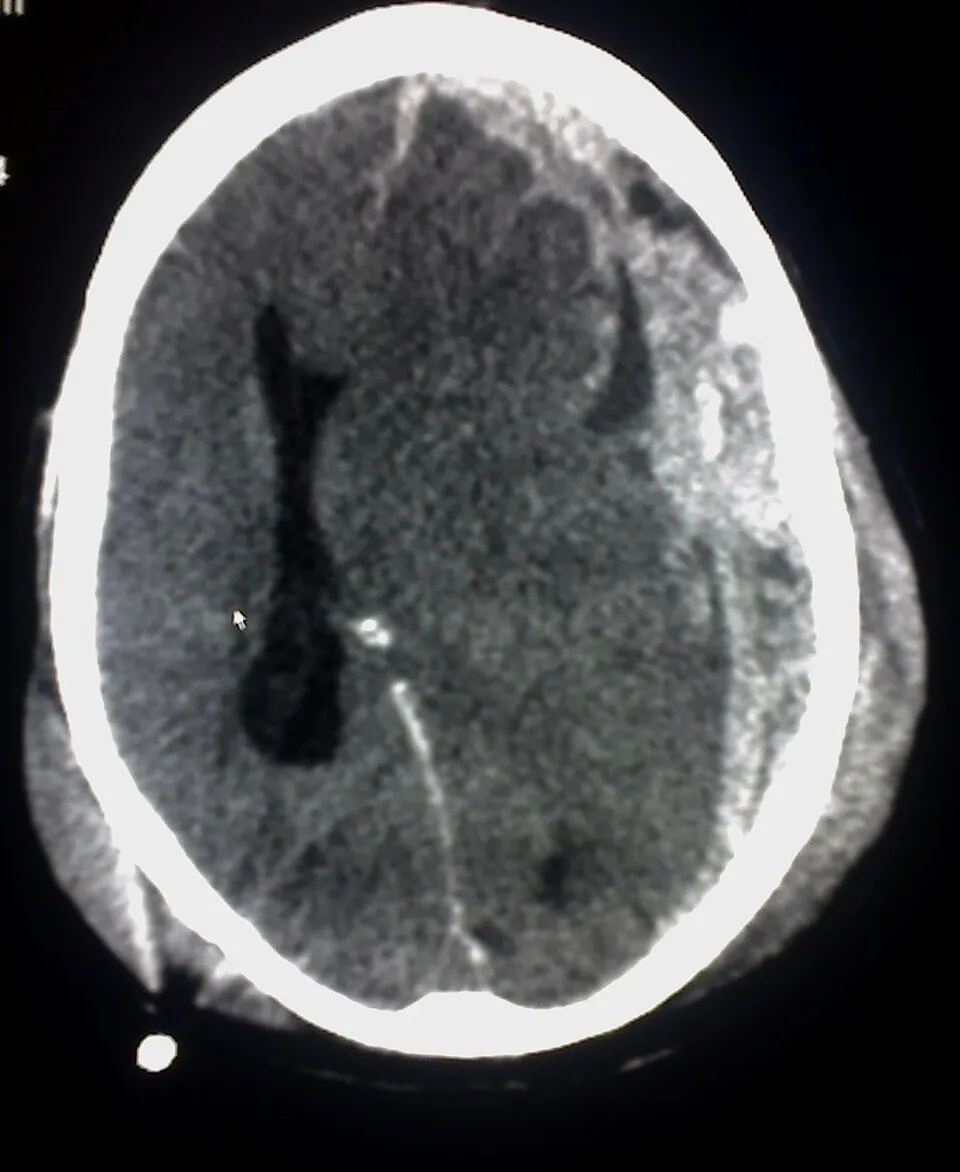
A subdural haematoma (SDH) is bleeding between the dura and the arachnoid, usually from torn bridging veins that cross the subdural space to the venous sinuses. Acute SDH follows significant head injury in young adults, or minor falls in older or anticoagulated people, and is often accompanied by severe underlying brain injury, so mortality is high. Chronic SDH develops over weeks, mainly in older adults with brain atrophy, alcohol misuse or antithrombotic drugs, often after a trivial or forgotten fall; it presents with headache, confusion, fluctuating drowsiness, falls or hemiparesis and is easily mistaken for dementia or stroke. CT shows a crescent-shaped collection that crosses suture lines: hyperdense when acute, isodense after 1–3 weeks and hypodense when chronic. Acute SDH thicker than 10 mm or with midline shift over 5 mm is evacuated by craniotomy. Symptomatic chronic SDH is drained through burr holes with a subdural drain, which halves recurrence; dexamethasone worsens outcomes, and middle meningeal artery embolisation reduces recurrence. Reversal of anticoagulation is urgent.
Patient case, mechanism, investigations, management, flashcards and exam-style questions.Open the lesson →
Key facts
- Blood between dura and arachnoid, usually from bridging veins; crescentic on CT and crosses suture lines but not the falx or tentorium
- Acute SDH: high-energy trauma in the young or minor falls in older or anticoagulated people; underlying brain injury drives the high mortality
- Chronic SDH: older adults, atrophy, alcohol, anticoagulants and antiplatelets; history of trauma absent in up to half
- CT density changes with age: hyperdense (acute), isodense (about 1–3 weeks, easily missed), hypodense (chronic)
- Brain Trauma Foundation: evacuate acute SDH thicker than 10 mm or with midline shift over 5 mm regardless of GCS
- Chronic SDH: burr-hole drainage with a subdural drain reduces recurrence from about a quarter to about a tenth
- Dexamethasone for chronic SDH led to worse functional outcomes in the Dex-CSDH trial and is not recommended
- Middle meningeal artery embolisation as an adjunct reduced recurrence or progression in 2024 randomised trials
Differential diagnosis
| Condition | Clues | Key test |
|---|---|---|
| Extradural haematoma | Young adult, temporal fracture, lucid interval | CT: biconvex collection limited by sutures |
| Dementia | Gradual cognitive decline without fluctuation or focal signs | CT head normal or atrophy only |
| Delirium from infection or drugs | Acute confusion, fever, new medicines | Septic screen; CT if falls or focal signs |
| Ischaemic stroke or TIA | Sudden focal deficit | CT/MRI with infarct pattern; no extra-axial collection |
| Subdural hygroma or empyema | CSF-density collection, or fever after sinusitis or surgery | MRI with diffusion; inflammatory markers |
| Brain tumour | Progressive headache and deficit | MRI with contrast showing intra-axial mass |
| Normal pressure hydrocephalus | Gait apraxia, urinary incontinence, cognitive decline | CT: ventriculomegaly without collection |
Exam pearls
Guideline
Brain Trauma Foundation guidelines for surgical management of acute SDH (2006) and severe TBI 4th edition (2016–2017), NICE NG232 Head injury (2023), with evidence from Dex-CSDH (2020), RESCUE-ASDH (2023) and middle meningeal artery embolisation trials (2024)
References
- Bullock MR, Chesnut R, Ghajar J, et al.. Surgical management of acute subdural hematomas. Neurosurgery 2006.
- Carney N, Totten AM, O'Reilly C, et al.. Guidelines for the management of severe traumatic brain injury, fourth edition. Neurosurgery 2017.
- National Institute for Health and Care Excellence. Head injury: assessment and early management (NG232). NICE guideline 2023.
- Santarius T, Kirkpatrick PJ, Ganesan D, et al.. Use of drains versus no drains after burr-hole evacuation of chronic subdural haematoma: a randomised controlled trial. Lancet 2009.
- Hutchinson PJ, Edlmann E, Bulters D, et al.. Trial of dexamethasone for chronic subdural hematoma. N Engl J Med 2020.
- Davies JM, Knopman J, Mokin M, et al.. Adjunctive middle meningeal artery embolization for subdural hematoma. N Engl J Med 2024.
Related topics
By Dr Khalid Seidi (B.Sc., M.D.) · MedEd World Clinical Knowledge library. Original teaching content checked against current guidelines (November 2026); confirm the latest local guidance before clinical use. Not a substitute for clinical judgement.