Clinical Knowledge › Surgery › Cardiothoracic surgery and neurosurgery
Raised intracranial pressure
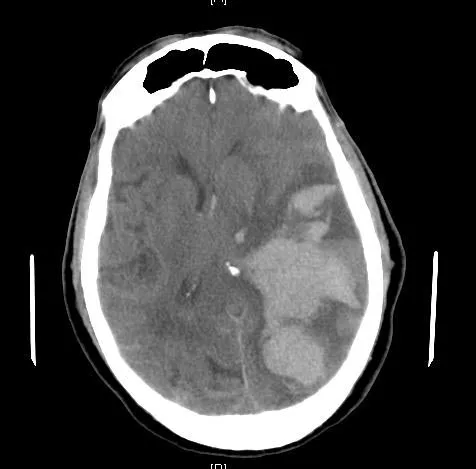
Raised intracranial pressure (ICP) is a sustained rise in the pressure inside the rigid skull above the normal adult range of about 5–15 mmHg; treatment thresholds in severe traumatic brain injury start at 22 mmHg. Because the skull cannot expand, any added volume (haematoma, tumour, oedema, blocked cerebrospinal fluid or venous congestion) is first buffered by displacing CSF and venous blood, after which small increases in volume cause steep rises in pressure (Monro–Kellie doctrine). Cerebral perfusion pressure (CPP = MAP − ICP) then falls, causing ischaemia, and pressure gradients push brain across the falx, tentorium or foramen magnum (herniation). Features include headache worse lying down, vomiting, papilloedema, falling GCS, a dilating pupil and, late, the Cushing response. CT is the first test; lumbar puncture must wait until mass effect is excluded. Management is tiered: airway, head-up positioning, normocapnia, sedation and osmotherapy, then CSF drainage through an external ventricular drain, evacuation of mass lesions and, for refractory pressure, decompressive craniectomy.
Patient case, mechanism, investigations, management, flashcards and exam-style questions.Open the lesson →
Key facts
- Normal adult ICP is about 5–15 mmHg lying flat; the Brain Trauma Foundation treats ICP above 22 mmHg in severe TBI
- CPP = MAP − ICP; aim for CPP 60–70 mmHg in adult severe TBI
- Monro–Kellie doctrine: brain + blood + CSF volume is fixed, so compensation is limited and the pressure–volume curve becomes steep
- Uncal herniation compresses the oculomotor nerve: ipsilateral fixed dilated pupil, then contralateral hemiparesis
- Cushing response (hypertension with wide pulse pressure, bradycardia, irregular breathing) is a late, pre-terminal sign of brainstem compression
- Non-contrast CT head is the first investigation; never perform lumbar puncture before excluding mass effect
- Tiered treatment: head up 30°, neutral neck, normocapnia, sedation, osmotherapy (mannitol or hypertonic saline), CSF drainage, surgery
- Dexamethasone helps vasogenic oedema around tumours and abscesses but is contraindicated in traumatic brain injury
Differential diagnosis
| Condition | Clues | Key test |
|---|---|---|
| Intracranial haematoma (extradural, subdural, intracerebral) | Head injury or anticoagulation; lucid interval in extradural | Non-contrast CT head |
| Brain tumour or metastasis with oedema | Progressive headache, seizures, focal deficit over weeks | Contrast MRI |
| Acute hydrocephalus | Headache, vomiting, upgaze palsy; after SAH or posterior fossa tumour | CT: dilated ventricles, periventricular lucency |
| Bacterial meningitis or brain abscess | Fever, neck stiffness, rash or known infective source | CT then LP if safe; blood cultures |
| Cerebral venous sinus thrombosis | Headache, seizures, papilloedema; pregnancy, oral contraceptive | CT or MR venography |
| Idiopathic intracranial hypertension | Young woman with obesity, papilloedema, normal imaging | MRI/MRV then LP opening pressure ≥25 cmH2O |
| Migraine | Recurrent, episodic, normal examination and fundi | Clinical; no papilloedema |
Exam pearls
Guideline
Brain Trauma Foundation Guidelines for the Management of Severe TBI, 4th edition (2016/2017), SIBICC consensus algorithm (2019), NICE NG232 Head injury (2023) and IIH consensus guidelines (2018)
References
- Carney N, Totten AM, O'Reilly C, et al.. Guidelines for the Management of Severe Traumatic Brain Injury, Fourth Edition. Neurosurgery 2017.
- Hawryluk GWJ, Aguilera S, Buki A, et al.. A management algorithm for patients with intracranial pressure monitoring: the Seattle International Severe Traumatic Brain Injury Consensus Conference (SIBICC). Intensive Care Med 2019.
- National Institute for Health and Care Excellence. Head injury: assessment and early management (NG232). NICE 2023.
- Hutchinson PJ, Kolias AG, Timofeev IS, et al.. Trial of decompressive craniectomy for traumatic intracranial hypertension. N Engl J Med 2016.
- Mollan SP, Davies B, Silver NC, et al.. Idiopathic intracranial hypertension: consensus guidelines on management. J Neurol Neurosurg Psychiatry 2018.
- American College of Surgeons Committee on Trauma. Advanced Trauma Life Support (ATLS) Student Course Manual, 11th edition. American College of Surgeons 2025.
Related topics
By Dr Khalid Seidi (B.Sc., M.D.) · MedEd World Clinical Knowledge library. Original teaching content checked against current guidelines (November 2026); confirm the latest local guidance before clinical use. Not a substitute for clinical judgement.