Clinical Knowledge › Neurology › Motor neurone, neuromuscular junction and muscle disorders
Facioscapulohumeral muscular dystrophy
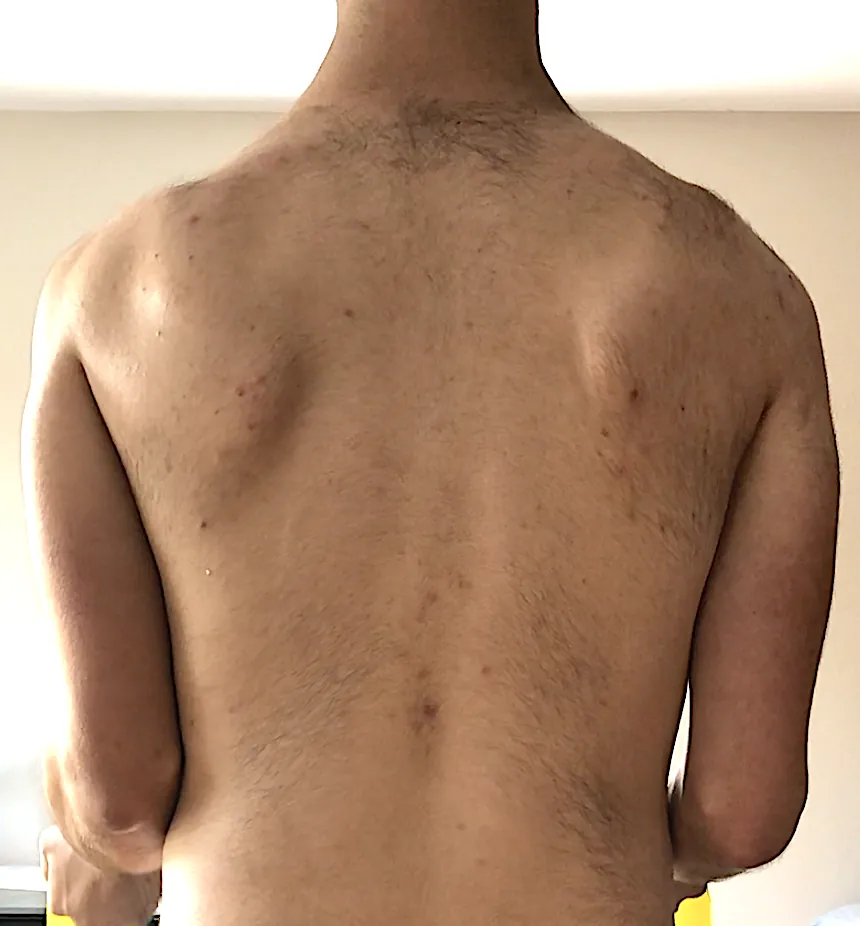
Facioscapulohumeral muscular dystrophy (FSHD) is one of the commonest muscular dystrophies, with a prevalence of roughly 1 in 8000–20 000. It is usually autosomal dominant. In FSHD1 (about 95%) contraction of the D4Z4 macrosatellite repeat array on chromosome 4q35 to 1–10 units, on a permissive 4qA haplotype, relaxes chromatin and allows toxic expression of the DUX4 gene in muscle; FSHD2 results from mutations in chromatin modifiers such as SMCHD1. The disease typically begins in adolescence or early adulthood with weakness of the face (inability to whistle, close the eyes tightly or drink through a straw), shoulder girdle (scapular winging and high-riding scapulae, difficulty raising the arms) and upper arms, with characteristic asymmetry and relative sparing of the deltoids and forearms. Later, abdominal muscles (Beevor sign), ankle dorsiflexors and hip girdle may be affected. Hearing loss and retinal vasculopathy occur in early-onset severe cases; cardiac and respiratory involvement is uncommon. Genetic testing confirms the diagnosis. No disease-modifying treatment is approved; management includes exercise, physiotherapy, orthoses, scapular fixation in selected patients, screening for hearing, retinal and respiratory complications, and genetic counselling.
Patient case, mechanism, investigations, management, flashcards and exam-style questions.Open the lesson →
Key facts
- Autosomal dominant; FSHD1 (about 95%) = D4Z4 repeat contraction at 4q35 on permissive 4qA allele; FSHD2 = SMCHD1 mutation
- Mechanism: epigenetic derepression of DUX4, toxic to skeletal muscle
- Onset usually in teens or 20s; marked variability even within families
- Facial weakness: cannot whistle, purse lips or bury eyelashes; transverse smile
- Scapular winging with high-riding scapulae; weak shoulder abduction despite relatively preserved deltoid
- Characteristic asymmetry; 'Popeye arms' (wasted upper arm, spared forearm), horizontal axillary folds
- Beevor sign (upward umbilical movement on neck flexion) from lower abdominal weakness; foot drop later
- CK normal or mildly raised; genetic testing confirms; screen hearing and retina in early-onset disease
Differential diagnosis
| Condition | Clues | Key test |
|---|---|---|
| Limb-girdle muscular dystrophy (for example calpainopathy) | Symmetric proximal weakness, usually no facial weakness, high CK | Gene panel; muscle MRI |
| Long thoracic nerve palsy | Unilateral winging after trauma or neuralgic amyotrophy, no facial weakness | EMG of serratus anterior |
| Myotonic dystrophy | Facial weakness with myotonia, cataracts, cardiac conduction disease | DMPK testing; EMG myotonia |
| Myasthenia gravis | Fatigable facial and proximal weakness, ptosis | AChR antibodies; RNS |
| Inflammatory myopathy | Subacute symmetric proximal weakness, high CK | CK, MRI, biopsy, myositis antibodies |
| Pompe disease (adult acid maltase deficiency) | Proximal and respiratory weakness, early diaphragm involvement | Dried blood spot acid alpha-glucosidase |
| Scapuloperoneal syndromes | Scapular and peroneal weakness without facial involvement | Genetic testing |
Exam pearls
Guideline
AAN evidence-based guideline summary: evaluation, diagnosis and management of FSHD (2015, reaffirmed), with international FSHD clinical trial and care recommendations (2019–2024)
References
- Tawil R, Kissel JT, Heatwole C, et al.. Evidence-based guideline summary: evaluation, diagnosis, and management of facioscapulohumeral muscular dystrophy. Neurology 2015.
- Mul K, Lassche S, Voermans NC, et al.. What's in a name? The clinical features of facioscapulohumeral muscular dystrophy. Pract Neurol 2016.
- Tihaya MS, Mul K, Balog J, et al.. Facioscapulohumeral muscular dystrophy: the road to targeted therapies. Nat Rev Neurol 2023.
- Wang LH, Tawil R. Facioscapulohumeral dystrophy. Curr Neurol Neurosci Rep 2016.
- Ropper AH, Samuels MA, Klein JP, Prasad S.. Adams and Victor's Principles of Neurology. 2023.
- Papadakis MA, Rabow MW, McQuaid KR, eds.. CURRENT Medical Diagnosis & Treatment 2026. 2026.
Related topics
By Dr Khalid Seidi (B.Sc., M.D.) · MedEd World Clinical Knowledge library. Original teaching content checked against current guidelines (November 2026); confirm the latest local guidance before clinical use. Not a substitute for clinical judgement.