Clinical Knowledge › Neurology › Motor neurone, neuromuscular junction and muscle disorders
Motor neurone disease (ALS)
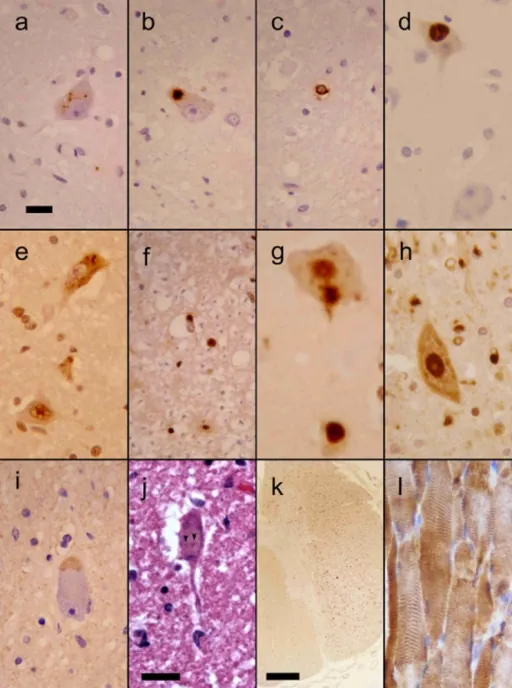
Motor neurone disease (MND) is a progressive neurodegenerative disorder of upper and lower motor neurones; amyotrophic lateral sclerosis (ALS), with mixed UMN and LMN signs, is the commonest form. Lifetime risk is about 1 in 300–400, with peak onset at 55–75 years. About 10% of cases are familial; C9orf72 hexanucleotide repeat expansion is the commonest genetic cause, followed by SOD1, TARDBP and FUS. Pathologically, TDP-43 aggregates are found in most cases, and up to half of patients develop cognitive or behavioural change, with frontotemporal dementia in about 15%. Patients present with painless asymmetric limb weakness and wasting (limb onset), dysarthria and dysphagia (bulbar onset) or, rarely, respiratory failure, with fasciculations, cramps and brisk reflexes in wasted muscles; sensation, eye movements and sphincters are usually spared. Diagnosis is clinical, supported by EMG showing widespread denervation (Gold Coast criteria) and by investigations excluding mimics such as cervical myelopathy and multifocal motor neuropathy. Riluzole modestly prolongs survival, tofersen is approved for SOD1-ALS in some regions, and non-invasive ventilation, gastrostomy and multidisciplinary palliative care improve survival and quality of life. Median survival is 2–4 years from onset.
Patient case, mechanism, investigations, management, flashcards and exam-style questions.Open the lesson →
Key facts
- Combined UMN and LMN signs in the same region with no sensory loss = ALS until proven otherwise
- Onset: limb (about two-thirds), bulbar (about a quarter, commoner in older women) or respiratory
- Sparing: eye movements, sensation, bladder and bowel usually preserved
- C9orf72 repeat expansion is the commonest genetic cause; SOD1 is targeted by tofersen
- Up to 50% have cognitive or behavioural impairment; about 15% meet FTD criteria
- Gold Coast criteria (2020): progressive UMN and LMN dysfunction in one region, or LMN dysfunction in two regions, with mimics excluded
- Riluzole 50 mg twice daily prolongs survival by about 2–3 months; monitor liver tests and neutrophils
- NIV improves survival and quality of life; gastrostomy before FVC falls much below 50% or weight loss exceeds 10%
Differential diagnosis
| Condition | Clues | Key test |
|---|---|---|
| Degenerative cervical myelopathy with radiculopathy | LMN signs in arms, UMN in legs, sensory signs, no bulbar or tongue involvement | MRI cervical spine |
| Multifocal motor neuropathy | Asymmetric distal arm LMN weakness, conduction block, no UMN signs | NCS conduction block; anti-GM1 IgM; IVIG response |
| Kennedy disease (spinobulbar muscular atrophy) | Man with slowly progressive bulbar and limb LMN weakness, gynaecomastia, sensory neuropathy | CAG repeat in androgen receptor gene |
| Myasthenia gravis | Fatigable bulbar and ocular weakness, normal reflexes, no wasting | AChR or MuSK antibodies; repetitive stimulation |
| Inclusion body myositis | Finger flexor and quadriceps weakness over age 50 | CK, EMG myopathic, muscle biopsy |
| Hyperthyroidism or hyperparathyroidism | Weakness with brisk reflexes or myopathy | TSH, calcium, PTH |
| Benign fasciculation syndrome | Fasciculations without weakness or wasting, normal EMG apart from fasciculations | Clinical follow-up; EMG |
Exam pearls
Guideline
NICE NG42 Motor neurone disease: assessment and management (2016, updated 2019; 2024 surveillance), EFNS guideline on ALS (2012) and Gold Coast diagnostic criteria (2020)
References
- National Institute for Health and Care Excellence. Motor neurone disease: assessment and management (NG42). NICE 2019.
- Andersen PM, Abrahams S, Borasio GD, et al.. EFNS guidelines on the clinical management of amyotrophic lateral sclerosis (MALS)—revised report of an EFNS task force. Eur J Neurol 2012.
- Shefner JM, Al-Chalabi A, Baker MR, et al.. A proposal for new diagnostic criteria for ALS. Clin Neurophysiol 2020.
- Feldman EL, Goutman SA, Petri S, et al.. Amyotrophic lateral sclerosis. Lancet 2022.
- Miller TM, Cudkowicz ME, Genge A, et al.. Trial of antisense oligonucleotide tofersen for SOD1 ALS. N Engl J Med 2022.
- Bourke SC, Tomlinson M, Williams TL, et al.. Effects of non-invasive ventilation on survival and quality of life in patients with amyotrophic lateral sclerosis: a randomised controlled trial. Lancet Neurol 2006.
Related topics
By Dr Khalid Seidi (B.Sc., M.D.) · MedEd World Clinical Knowledge library. Original teaching content checked against current guidelines (November 2026); confirm the latest local guidance before clinical use. Not a substitute for clinical judgement.