Clinical Knowledge › Neurology › Epilepsy and seizures
Focal epilepsy
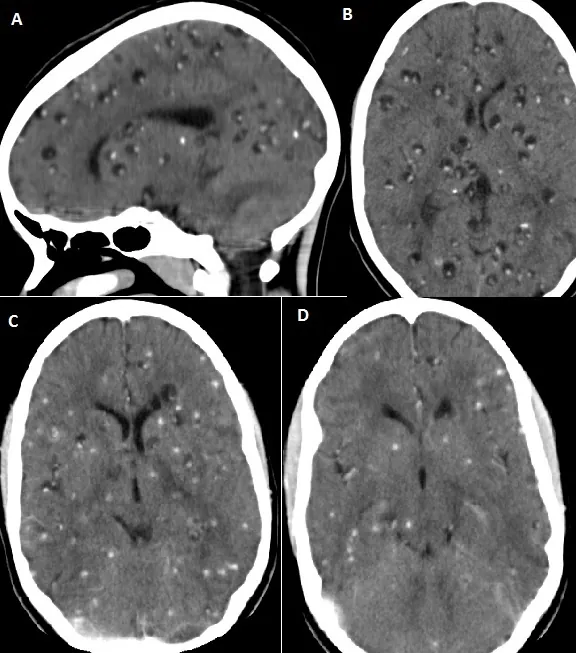
Focal epilepsy is epilepsy in which seizures arise from networks limited to one hemisphere. It is the commonest epilepsy type in adults and is usually structural: hippocampal sclerosis, tumours, stroke, trauma, cortical dysplasia, cavernomas, infection (including neurocysticercosis) and autoimmune encephalitis. Seizure semiology localises the onset zone: temporal lobe seizures cause epigastric rising, déjà vu, fear, staring with oral and manual automatisms and postictal dysphasia if dominant; frontal seizures are brief, often nocturnal, hypermotor or tonic; parietal seizures cause sensory disturbance; occipital seizures cause elementary visual phenomena. Seizures are classified by whether consciousness is preserved or impaired and may evolve to bilateral tonic–clonic seizures. Diagnosis combines history, EEG and MRI with an epilepsy protocol. Lamotrigine (or levetiracetam) is first-line; carbamazepine is an alternative. One-third become drug resistant after two appropriate drugs and should be referred early for epilepsy surgery assessment, which can cure many temporal lobe cases.
Patient case, mechanism, investigations, management, flashcards and exam-style questions.Open the lesson →
Key facts
- Focal seizures start in one hemisphere; classify by consciousness (preserved or impaired) and by observed features; they may evolve to bilateral tonic–clonic seizures
- Temporal lobe epilepsy is the commonest focal epilepsy in adults; mesial temporal sclerosis is its commonest cause
- Aura = a focal seizure with preserved consciousness; its content localises the onset zone
- Postictal dysphasia lateralises to the dominant (usually left) hemisphere; Todd paresis to the contralateral hemisphere
- MRI with an epilepsy protocol is required in focal epilepsy; CT misses hippocampal sclerosis and dysplasia
- First-line drugs: lamotrigine (SANAD II) or levetiracetam; carbamazepine and oxcarbazepine are alternatives
- Drug-resistant epilepsy = failure of two appropriate, tolerated drugs; refer for surgical evaluation without delay
- Anterior temporal lobectomy makes about 60–70% of selected patients seizure-free versus under 10% with continued medication
Differential diagnosis
| Condition | Clues | Key test |
|---|---|---|
| Transient ischaemic attack | Negative symptoms (weakness, numbness), no march, older age | MRI DWI, vascular imaging |
| Migraine aura | Visual or sensory symptoms spread over 5–20 minutes, then headache | Clinical; normal EEG |
| Panic attack | Fear, palpitations, hyperventilation, retained awareness, longer duration | Clinical; video-EEG if doubt |
| Transient global amnesia | Repetitive questioning for hours, no automatisms, retained identity | Clinical; DWI hippocampal dots |
| Functional seizures | Long, fluctuating, eyes closed, emotional triggers | Video-EEG |
| Parasomnia (sleepwalking, REM sleep behaviour disorder) | Non-stereotyped, longer, from deep or REM sleep | Video-polysomnography |
| Hypoglycaemia | Confusion, automatisms in a person on insulin | Capillary glucose |
Exam pearls
Guideline
NICE NG217 Epilepsies (2022); ILAE seizure classification 2017 and 2025 update; ILAE drug-resistance definition (2010)
References
- National Institute for Health and Care Excellence. Epilepsies in children, young people and adults (NG217). NICE 2022.
- Fisher RS, Cross JH, French JA, et al.. Operational classification of seizure types by the International League Against Epilepsy: position paper of the ILAE Commission for Classification and Terminology. Epilepsia 2017.
- Beniczky S, Trinka E, Wirrell E, et al.. Updated classification of epileptic seizures: position paper of the International League Against Epilepsy. Epilepsia 2025.
- Fisher RS, Acevedo C, Arzimanoglou A, et al.. ILAE official report: a practical clinical definition of epilepsy. Epilepsia 2014.
- Marson A, Burnside G, Appleton R, et al.. The SANAD II study of the effectiveness and cost-effectiveness of levetiracetam, zonisamide, or lamotrigine for newly diagnosed focal epilepsy: an open-label, non-inferiority, multicentre, phase 4, randomised controlled trial. Lancet 2021.
- Kwan P, Arzimanoglou A, Berg AT, et al.. Definition of drug resistant epilepsy: consensus proposal by the ad hoc Task Force of the ILAE Commission on Therapeutic Strategies. Epilepsia 2010.
Related topics
By Dr Khalid Seidi (B.Sc., M.D.) · MedEd World Clinical Knowledge library. Original teaching content checked against current guidelines (November 2026); confirm the latest local guidance before clinical use. Not a substitute for clinical judgement.