Clinical Knowledge › Internal medicine › Haematology and oncology › Haemolytic anaemias
G6PD deficiency
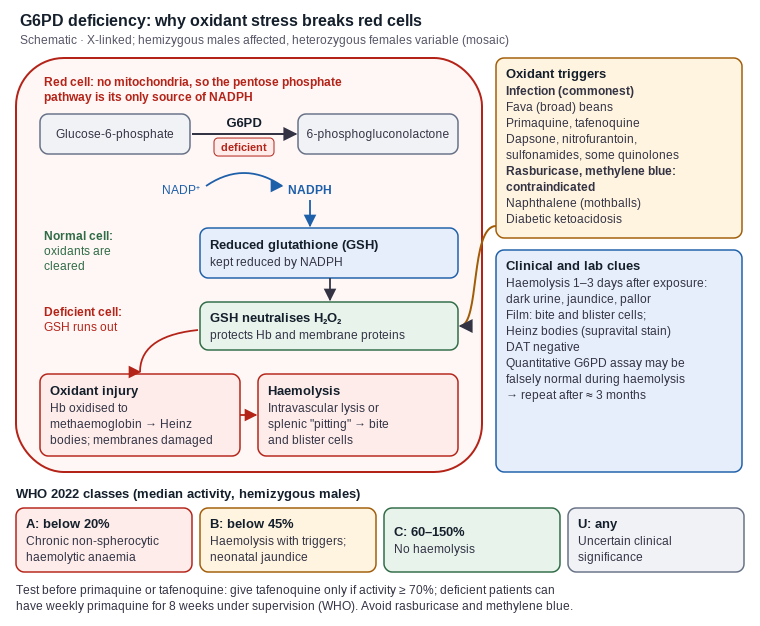
Glucose-6-phosphate dehydrogenase (G6PD) deficiency is the commonest human enzyme defect, affecting an estimated 400–500 million people, mainly in Africa, the Mediterranean, the Middle East and Asia, where it protects against severe malaria. The gene is X-linked, so hemizygous males are affected and heterozygous females have variable, mosaic enzyme activity. G6PD is the only source of NADPH in red cells, which keeps glutathione reduced and protects haemoglobin from oxidant damage. Most deficient people are well until an oxidant stress (infection, fava beans or drugs such as primaquine, tafenoquine, dapsone, rasburicase, methylene blue or nitrofurantoin) causes acute intravascular haemolysis with dark urine, jaundice and pallor 1–3 days later. Neonatal jaundice can cause kernicterus. The film shows bite and blister cells, and Heinz bodies on supravital staining; the DAT is negative. A quantitative enzyme assay confirms the diagnosis but may be falsely normal during haemolysis. Management is avoiding triggers, treating infection, supportive care and transfusion when needed, and testing before prescribing high-risk drugs.
Patient case, mechanism, investigations, management, flashcards and exam-style questions.Open the lesson →
Key facts
- X-linked recessive: hemizygous males are affected; heterozygous females range from normal to deficient because of X-inactivation
- G6PD generates NADPH in the pentose phosphate pathway, which maintains reduced glutathione against oxidant stress
- Infection is the commonest trigger; others are fava beans (favism) and oxidant drugs including primaquine, tafenoquine, dapsone, rasburicase, methylene blue and nitrofurantoin
- Acute haemolysis is largely intravascular: dark urine (haemoglobinuria), back pain, jaundice, falling Hb 1–3 days after exposure
- Film: bite cells (degmacytes), blister cells and Heinz bodies on supravital stain; DAT negative
- Enzyme activity may be falsely normal during or just after haemolysis because young reticulocytes have more G6PD; retest after about 3 months
- WHO 2022 classification groups variants by activity and phenotype: A (chronic haemolysis), B (triggered haemolysis), C (no haemolysis), U (uncertain)
- Tafenoquine requires quantitative G6PD activity of at least 70%; rasburicase is contraindicated in deficiency
Differential diagnosis
| Condition | Clues | Key test |
|---|---|---|
| Autoimmune haemolytic anaemia | Spherocytes, no clear oxidant trigger | DAT positive |
| Hereditary spherocytosis | Chronic haemolysis, splenomegaly, family history | Spherocytes, raised MCHC, reduced EMA binding |
| Malaria | Fever after travel, haemolysis | Thick and thin films or rapid antigen test |
| Haemolytic uraemic syndrome | Bloody diarrhoea, AKI, thrombocytopenia | Schistocytes, low platelets |
| Paroxysmal nocturnal haemoglobinuria | Haemoglobinuria, thrombosis, cytopenias | Flow cytometry for CD55/CD59 |
| Methaemoglobinaemia | Cyanosis with normal PaO₂ after oxidant drugs | Co-oximetry methaemoglobin level |
| Rhabdomyolysis | Dark urine after exertion or crush injury | Very high CK, urine dipstick blood without red cells, normal haptoglobin |
Exam pearls
Guideline
WHO classification of G6PD variants (Technical Advisory Group 2022, published 2024), WHO Guidelines for malaria (2025 update) on primaquine and tafenoquine with G6PD testing, and AAP 2022 neonatal hyperbilirubinaemia guideline
References
- Luzzatto L, et al.. New WHO classification of genetic variants causing G6PD deficiency. Bull World Health Organ 2024.
- Luzzatto L, Ally M, Notaro R. Glucose-6-phosphate dehydrogenase deficiency. Blood 2020.
- Cappellini MD, Fiorelli G. Glucose-6-phosphate dehydrogenase deficiency. Lancet 2008.
- World Health Organization. WHO guidelines for malaria. World Health Organization, Geneva 2025.
- Kemper AR, Newman TB, Slaughter JL, et al.. Clinical practice guideline revision: management of hyperbilirubinemia in the newborn infant 35 or more weeks of gestation. Pediatrics 2022.
- National Institute for Health and Care Excellence. Jaundice in newborn babies under 28 days (CG98). NICE 2023.
Related topics
By Dr Khalid Seidi (B.Sc., M.D.) · MedEd World Clinical Knowledge library. Original teaching content checked against current guidelines (November 2026); confirm the latest local guidance before clinical use. Not a substitute for clinical judgement.