Clinical Knowledge › Internal medicine › Haematology and oncology › Haemolytic anaemias
Paroxysmal nocturnal haemoglobinuria (PNH)
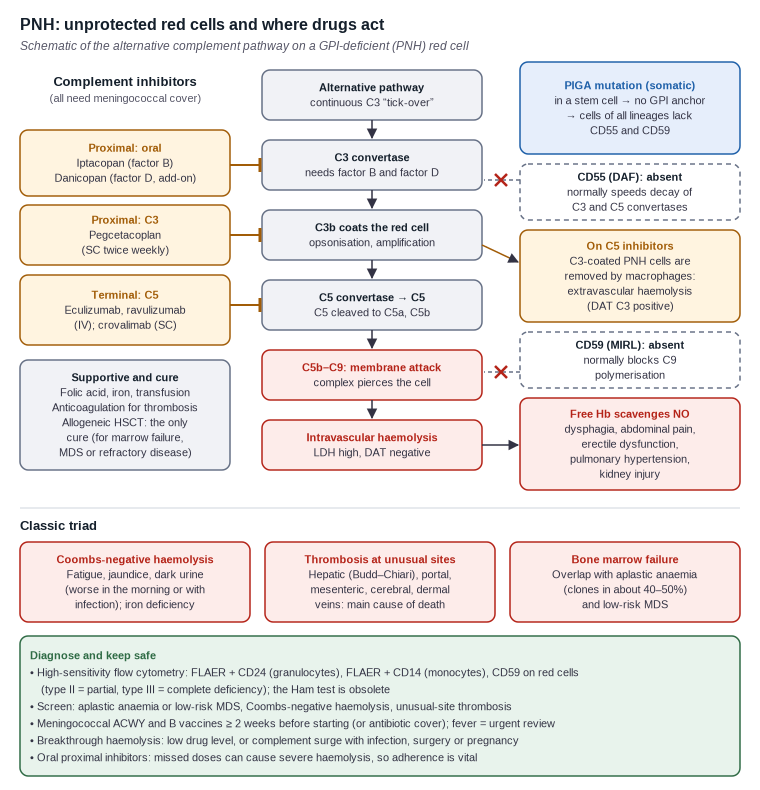
Paroxysmal nocturnal haemoglobinuria (PNH) is a rare acquired clonal disorder of haematopoietic stem cells. A somatic PIGA mutation prevents synthesis of the glycosylphosphatidylinositol (GPI) anchor, so blood cells lack the complement regulators CD55 and CD59. Unregulated alternative-pathway complement forms membrane attack complexes on red cells, causing intravascular haemolysis with dark morning urine, fatigue, dysphagia, abdominal pain and erectile dysfunction (nitric oxide depletion). The other two features of the classic triad are thrombosis at unusual sites (hepatic, mesenteric and cerebral veins), the leading cause of death, and bone marrow failure, as PNH clones often coexist with aplastic anaemia or MDS. Diagnosis is by high-sensitivity flow cytometry of red cells and granulocytes; LDH is markedly raised and the DAT is negative. Treatment is complement inhibition: C5 inhibitors (eculizumab, ravulizumab, crovalimab) or proximal inhibitors (pegcetacoplan, iptacopan, danicopan), all needing meningococcal vaccination. Allogeneic stem cell transplantation is the only cure.
Patient case, mechanism, investigations, management, flashcards and exam-style questions.Open the lesson →
Key facts
- Acquired somatic PIGA mutation (X-linked gene) in a stem cell: loss of GPI-anchored proteins
- Loss of CD59 (membrane inhibitor of reactive lysis) and CD55 (decay-accelerating factor) leads to complement-mediated intravascular haemolysis
- Classic triad: Coombs-negative intravascular haemolysis, thrombosis at unusual sites, bone marrow failure
- Thrombosis (Budd–Chiari, mesenteric, cerebral venous sinus, dermal veins) is the main cause of death in untreated PNH
- Diagnosis: high-sensitivity flow cytometry – CD59 on red cells and FLAER with CD24/CD14 on granulocytes and monocytes; the Ham test is obsolete
- Screen for PNH clones in aplastic anaemia, unexplained Coombs-negative haemolysis and unusual-site thrombosis
- Complement inhibitors transform survival; all require meningococcal vaccination (ACWY and B) and urgent assessment of fever
- On C5 inhibitors, extravascular haemolysis (C3-coated cells, DAT positive for C3) can persist; proximal (C3, factor B, factor D) inhibitors address it
Differential diagnosis
| Condition | Clues | Key test |
|---|---|---|
| Warm autoimmune haemolytic anaemia | Spherocytes, extravascular haemolysis | DAT positive (IgG ± C3) |
| Thrombotic microangiopathy (TTP, HUS) | Schistocytes, thrombocytopenia, renal or neurological injury | Film, ADAMTS13, complement studies |
| G6PD deficiency | Episodic intravascular haemolysis after oxidant trigger, bite cells | G6PD assay |
| Aplastic anaemia without PNH clone | Pancytopenia, hypocellular marrow, no haemolysis | Flow cytometry for GPI-deficient cells |
| Myeloproliferative neoplasm with splanchnic thrombosis | Budd–Chiari with raised counts | JAK2 V617F, CALR testing |
| Antiphospholipid syndrome | Venous and arterial thrombosis, pregnancy loss | Lupus anticoagulant, anticardiolipin, anti-β2GPI |
| Myoglobinuria (rhabdomyolysis) | Dark urine, dipstick positive for blood, no red cells | Creatine kinase; plasma is clear (not pink) |
Exam pearls
Guideline
International PNH Interest Group consensus (2005) and ICCS flow cytometry guidelines (2010, updated 2018), with 2023–2025 expert guidance on proximal complement inhibitors
References
- Hill A, DeZern AE, Kinoshita T, Brodsky RA.. Paroxysmal nocturnal haemoglobinuria. Nat Rev Dis Primers 2017.
- Hillmen P, Szer J, Weitz I, et al.. Pegcetacoplan versus eculizumab in paroxysmal nocturnal hemoglobinuria. N Engl J Med 2021.
- Peffault de Latour R, Röth A, Kulasekararaj AG, et al.. Oral iptacopan monotherapy in paroxysmal nocturnal hemoglobinuria. N Engl J Med 2024.
- Kulasekararaj AG, Lazana I.. Paroxysmal nocturnal hemoglobinuria: where are we going. Am J Hematol 2023.
- Fattizzo B, Versino F, Barcellini W, et al.. Breakthrough hemolysis in paroxysmal nocturnal hemoglobinuria throughout clinical trials: from definition to clinical practice. Blood 2025.
- Panse J.. Paroxysmal nocturnal hemoglobinuria: where we stand. Am J Hematol 2023.
Related topics
By Dr Khalid Seidi (B.Sc., M.D.) · MedEd World Clinical Knowledge library. Original teaching content checked against current guidelines (November 2026); confirm the latest local guidance before clinical use. Not a substitute for clinical judgement.