Clinical Knowledge › Internal medicine › Haematology and oncology › Haemolytic anaemias
Hereditary elliptocytosis
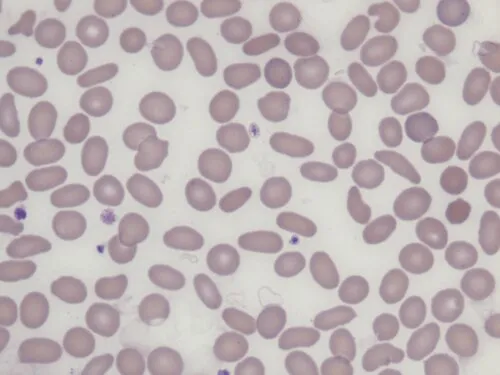
Hereditary elliptocytosis (HE) is a group of inherited red cell membrane disorders in which many circulating red cells are oval or elongated. Most cases are autosomal dominant variants of alpha-spectrin (SPTA1), beta-spectrin (SPTB) or protein 4.1R (EPB41) that weaken horizontal links in the membrane skeleton, so cells deformed in the microcirculation do not recover their biconcave shape and may fragment. HE is common in malaria-endemic West Africa. Most carriers are asymptomatic, with a normal haemoglobin and a striking blood film found by chance; about 10% have chronic haemolysis with anaemia, jaundice, splenomegaly and gallstones. Severe forms include hereditary pyropoikilocytosis (very low MCV, fragments and microspherocytes, thermal instability) and transient neonatal poikilocytosis. Southeast Asian ovalocytosis, a band 3 deletion, causes rigid stomatocytic ovalocytes with little haemolysis. Diagnosis rests on the film, family studies and ektacytometry or gene testing. Asymptomatic HE needs no treatment; haemolytic forms need folic acid and, if severe, splenectomy.
Patient case, mechanism, investigations, management, flashcards and exam-style questions.Open the lesson →
Key facts
- Elliptocytes are normal in small numbers; HE is suspected when they exceed about 25% and are familial
- Usually autosomal dominant; SPTA1 (about 65%), SPTB (about 30%) and EPB41 variants
- Defect is in horizontal (spectrin dimer–dimer, spectrin–actin–4.1R) interactions, unlike vertical defects in hereditary spherocytosis
- Most patients have no anaemia; about 10% have compensated or overt haemolysis
- Hereditary pyropoikilocytosis: severe recessive form with MCV 50–70 fL, fragments, microspherocytes and red cells that fragment at about 45–46°C
- Southeast Asian ovalocytosis: 27-bp deletion in band 3 (SLC4A1), rigid stomatocytic ovalocytes, malaria protection, homozygosity lethal in utero
- Osmotic fragility is usually normal in common HE but increased in pyropoikilocytosis; EMA binding is reduced in HPP and SAO
- Splenectomy benefits severe HE and HPP but is not needed in mild HE or SAO
Differential diagnosis
| Condition | Clues | Key test |
|---|---|---|
| Iron deficiency anaemia | Pencil cells, microcytosis, low ferritin | Ferritin and iron studies |
| Thalassaemia trait | Microcytosis with target cells, normal ferritin | HbA2 (beta) or DNA testing (alpha) |
| Megaloblastic anaemia | Macro-ovalocytes and hypersegmented neutrophils | B12 and folate |
| Primary myelofibrosis or MDS | Teardrop cells, leucoerythroblastic film, older adult | Marrow trephine, JAK2/CALR/MPL |
| Hereditary spherocytosis | Spherocytes, increased osmotic fragility, splenomegaly | EMA binding reduced; family film |
| Microangiopathic haemolysis | Schistocytes, thrombocytopenia, acute illness | Platelets, LDH, ADAMTS13, renal function |
| Pyruvate kinase deficiency | Non-spherocytic haemolysis with prickle cells after splenectomy | PK enzyme assay, PKLR testing |
Exam pearls
Guideline
ICSH guidelines for the laboratory diagnosis of nonimmune hereditary red cell membrane disorders (2015) and EHA-supported recommendations regarding splenectomy in hereditary haemolytic anaemias (2017)
References
- King MJ, Garçon L, Hoyer JD, et al.. ICSH guidelines for the laboratory diagnosis of nonimmune hereditary red cell membrane disorders. Int J Lab Hematol 2015.
- Iolascon A, Andolfo I, Barcellini W, et al.. Recommendations regarding splenectomy in hereditary hemolytic anemias. Haematologica 2017.
- Gallagher PG.. Hereditary elliptocytosis: spectrin and protein 4.1R. Semin Hematol 2004.
- Da Costa L, Galimand J, Fenneteau O, Mohandas N.. Hereditary spherocytosis, elliptocytosis, and other red cell membrane disorders. Blood Rev 2013.
- King MJ, Zanella A.. Hereditary red cell membrane disorders and laboratory diagnostic testing. Int J Lab Hematol 2013.
- Hoffbrand AV, Higgs DR, Keeling DM, Mehta AB, eds.. Postgraduate Haematology. 2016.
Related topics
By Dr Khalid Seidi (B.Sc., M.D.) · MedEd World Clinical Knowledge library. Original teaching content checked against current guidelines (November 2026); confirm the latest local guidance before clinical use. Not a substitute for clinical judgement.