Clinical Knowledge › Internal medicine › Haematology and oncology › Haemolytic anaemias
Hereditary spherocytosis
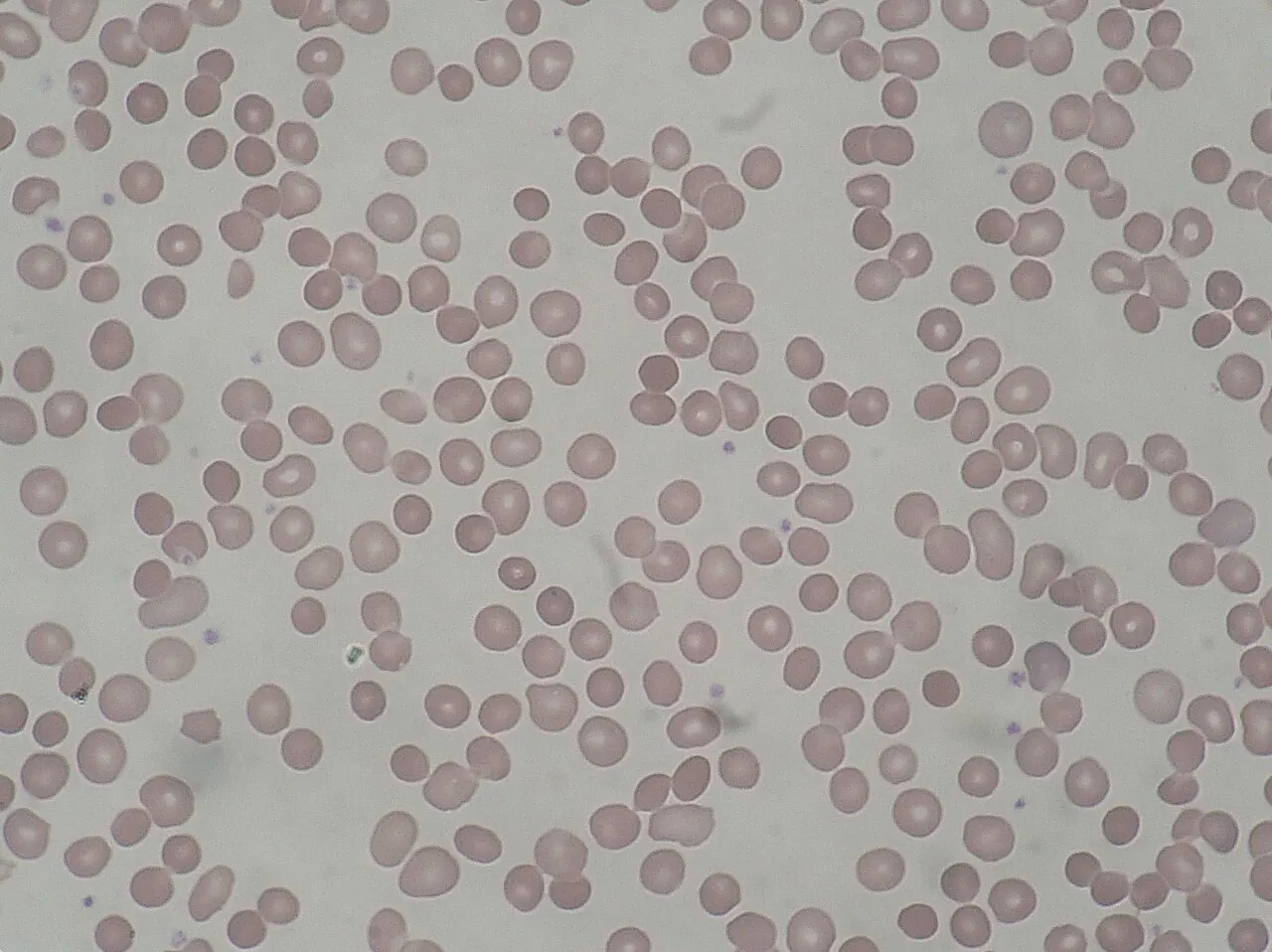
Hereditary spherocytosis (HS) is the commonest inherited haemolytic anaemia in people of northern European descent, affecting roughly 1 in 2000. Mutations in genes for red cell membrane proteins that link the lipid bilayer to the cytoskeleton (ankyrin, band 3, beta- and alpha-spectrin, protein 4.2) cause loss of membrane surface, so cells become small, dense spheres that cannot deform and are trapped and destroyed in the spleen. About three-quarters of families show autosomal dominant inheritance; the rest are recessive or new mutations. Severity ranges from compensated haemolysis found by chance to transfusion-dependent anaemia. Typical features are anaemia, jaundice (often presenting as neonatal hyperbilirubinaemia), splenomegaly and pigment gallstones, with aplastic crises after parvovirus B19. The film shows spherocytes, the MCHC is raised, the DAT is negative and the eosin-5′-maleimide (EMA) binding test is reduced. Management includes folic acid, transfusion when needed and, in moderate to severe disease, total or partial splenectomy after early childhood with vaccination and antibiotic prophylaxis.
Patient case, mechanism, investigations, management, flashcards and exam-style questions.Open the lesson →
Key facts
- Commonest inherited haemolytic anaemia in northern Europeans (about 1 in 2000); about 75% autosomal dominant
- Defects in vertical membrane linkages (ankyrin most often, then band 3 and beta-spectrin; alpha-spectrin and protein 4.2 recessive) cause membrane loss
- Classic triad: anaemia, jaundice and splenomegaly; pigment gallstones are common even in mild disease
- Lab hallmark: spherocytes, reticulocytosis, raised MCHC (often above 360 g/L), negative DAT
- EMA binding by flow cytometry is the recommended screening test; osmotic fragility is less sensitive and no longer preferred
- Parvovirus B19 causes aplastic crises; folate deficiency causes megaloblastic crises
- Splenectomy corrects haemolysis in most patients but is reserved for moderate to severe disease, ideally after age 6 (avoid before 3)
- After splenectomy: pneumococcal, Hib, meningococcal ACWY and B and annual influenza vaccines, plus antibiotic prophylaxis and urgent care for fever
Differential diagnosis
| Condition | Clues | Key test |
|---|---|---|
| Warm autoimmune haemolytic anaemia | Acquired, no family history, often secondary | DAT positive |
| ABO haemolytic disease of the newborn | Group O mother, group A or B baby, jaundice day 1 | Positive DAT (often weak) in neonate |
| G6PD deficiency | Episodic haemolysis with drugs, infections, fava beans; males | Bite cells, Heinz bodies; G6PD assay |
| Hereditary elliptocytosis and pyropoikilocytosis | Elliptocytes or bizarre fragments on film | Film morphology; membrane gene panel |
| Pyruvate kinase deficiency | Lifelong haemolysis, no spherocytes, normal EMA | PK enzyme assay |
| Southeast Asian ovalocytosis | Stomatocytic ovalocytes, usually mild | Band 3 deletion testing |
| Gilbert syndrome | Mild unconjugated jaundice with fasting, no anaemia | Normal Hb, reticulocytes and LDH |
Exam pearls
Guideline
BSH Guidelines for the diagnosis and management of hereditary spherocytosis – 2011 update (published 2012), ICSH 2015 guidance on laboratory diagnosis of red cell membrane disorders and European recommendations on splenectomy in hereditary haemolytic anaemias (2017)
References
- Bolton-Maggs PHB, Langer JC, Iolascon A, Tittensor P, King MJ. Guidelines for the diagnosis and management of hereditary spherocytosis – 2011 update. Br J Haematol 2012.
- King MJ, Garçon L, Hoyer JD, et al.. ICSH guidelines for the laboratory diagnosis of nonimmune hereditary red cell membrane disorders. Int J Lab Hematol 2015.
- Iolascon A, Andolfo I, Barcellini W, et al.. Recommendations regarding splenectomy in hereditary hemolytic anemias. Haematologica 2017.
- Perrotta S, Gallagher PG, Mohandas N. Hereditary spherocytosis. Lancet 2008.
- Davies JM, Lewis MPN, Wimperis J, et al.. Review of guidelines for the prevention and treatment of infection in patients with an absent or dysfunctional spleen. Br J Haematol 2011.
- Hoffbrand AV, Steensma DP. Hoffbrand's Essential Haematology. 2019.
Related topics
By Dr Khalid Seidi (B.Sc., M.D.) · MedEd World Clinical Knowledge library. Original teaching content checked against current guidelines (November 2026); confirm the latest local guidance before clinical use. Not a substitute for clinical judgement.