Clinical Knowledge › Internal medicine › Basics of internal medicine › Clinical assessment
General physical examination
The general physical examination is the systematic, head-to-toe survey that every medical patient receives before (or alongside) system-specific examinations. It starts at the end of the bed: does the patient look well or unwell, breathless, in pain, pale, jaundiced, cyanosed, cachectic or confused? It then moves through vital signs, hands and nails, face, eyes and mouth, neck (jugular venous pressure, lymph nodes, thyroid), skin and legs, with a screening look at the chest, abdomen and nervous system. Many classic diagnoses are made here: clubbing, koilonychia, palmar erythema, splinter haemorrhages, asterixis, a raised JVP, Virchow's node, pitting oedema. The examination is also a safety ritual: hand hygiene, consent, dignity, a chaperone for intimate examination and clear documentation. Signs are most useful when sought to test hypotheses from the history, when their accuracy is known, and when they are adapted to skin tone, age and setting.
Patient case, mechanism, investigations, management, flashcards and exam-style questions.Open the lesson →
Key facts
- Prepare with WIPER: Wash hands, Introduce, Permission, Expose appropriately, Reposition (usually 45° for the JVP)
- End-of-bed inspection: well or unwell, breathing, colour, nutrition, distress, attached devices, medicines and charts
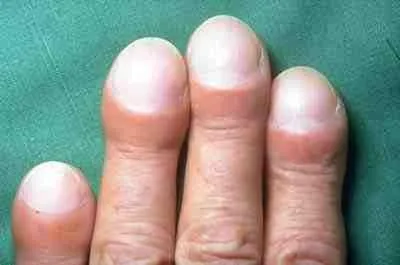
- Clubbing: loss of the nail-fold angle, increased nail-bed fluctuation; causes include lung cancer, bronchiectasis, lung fibrosis, cyanotic heart disease, endocarditis and IBD – not uncomplicated COPD
- JVP is raised if more than 3 cm vertically above the sternal angle with the patient at 45°
- Central cyanosis (tongue, lips) implies arterial desaturation; peripheral cyanosis alone reflects poor perfusion
- Jaundice is usually visible in the sclerae once bilirubin exceeds about 40–50 µmol/L (2.5–3 mg/dL)
- Virchow's node (left supraclavicular) suggests intra-abdominal malignancy, especially gastric cancer
- Offer a chaperone for intimate examinations and record the offer, the response and the chaperone's name
Differential diagnosis
| Condition | Clues | Key test |
|---|---|---|
| Pallor: iron-deficiency anaemia | Koilonychia, angular stomatitis, glossitis | FBC, ferritin; look for GI blood loss |
| Pallor: haemolysis | Pallor with mild jaundice and splenomegaly | Reticulocytes, bilirubin, LDH, haptoglobin, DAT |
| Jaundice: chronic liver disease | Spider naevi, palmar erythema, gynaecomastia, ascites | LFTs, INR, albumin, liver ultrasound |
| Clubbing: lung cancer | Smoker, weight loss, haemoptysis | Chest X-ray then CT chest |
| Raised JVP: right heart failure or fluid overload | Pitting oedema, hepatomegaly, positive abdominojugular test | Echocardiography, NT-proBNP |
| Lymphadenopathy: lymphoma or metastasis | Hard or rubbery, >2 cm, supraclavicular, persistent | Ultrasound and biopsy (excision or core) |
| Splinter haemorrhages: infective endocarditis | New murmur, fever, Janeway lesions, Osler nodes | Three sets of blood cultures and echocardiography |
Exam pearls
Guideline
WHO Guidelines on Hand Hygiene in Health Care (2009) with 'My 5 Moments'; GMC Intimate examinations and chaperones (2013, refreshed alongside Good Medical Practice 2024); RCP National Early Warning Score 2 (2017)
References
- McGee S.. Evidence-Based Physical Diagnosis. 5th ed. Elsevier 2022.
- Verghese A, Charlton B, Kassirer JP, Ramsey M, Ioannidis JPA.. Inadequacies of physical examination as a cause of medical errors and adverse events: a collection of vignettes. Am J Med 2015.
- World Health Organization (WHO). WHO guidelines on hand hygiene in health care: first global patient safety challenge – clean care is safer care. WHO, Geneva 2009.
- General Medical Council (GMC). Intimate examinations and chaperones. GMC, London 2024.
- Peterson MC, Holbrook JH, Von Hales D, Smith NL, Staker LV.. Contributions of the history, physical examination, and laboratory investigation in making medical diagnoses. West J Med 1992.
- Sjoding MW, Dickson RP, Iwashyna TJ, Gay SE, Valley TS.. Racial bias in pulse oximetry measurement. N Engl J Med 2020.
Related topics
By Dr Khalid Seidi (B.Sc., M.D.) · MedEd World Clinical Knowledge library. Original teaching content checked against current guidelines (November 2026); confirm the latest local guidance before clinical use. Not a substitute for clinical judgement.