Clinical Knowledge › Ear, nose and throat › Clinical problems
Hearing loss: approach to the patient
Hearing loss is the commonest sensory disability: the WHO estimates that more than 1.5 billion people have some hearing loss and about 430 million have disabling loss. The approach rests on three questions. Is the loss conductive (outer or middle ear: wax, otitis externa, effusion, perforation, cholesteatoma, otosclerosis) or sensorineural (cochlea or auditory nerve: presbycusis, noise, ototoxic drugs, Ménière disease, vestibular schwannoma, sudden idiopathic loss)? Is it sudden or gradual? Is it symmetrical or asymmetrical? Otoscopy and 512 Hz tuning fork tests (Rinne and Weber) give a bedside answer that pure tone audiometry and tympanometry confirm. Sudden sensorineural loss is an emergency: refer the same day and start oral corticosteroids within 2 weeks. Asymmetric sensorineural loss or unilateral tinnitus needs MRI of the internal auditory meatus. Most chronic loss is managed with hearing aids, communication strategies and, when aids no longer help, cochlear implants. Untreated loss is linked with isolation, depression, falls and dementia.
Patient case, mechanism, investigations, management, flashcards and exam-style questions.Open the lesson →
Key facts
- Conductive loss: Rinne negative (bone > air) in the affected ear and Weber lateralises TO that ear
- Sensorineural loss: Rinne positive in both ears and Weber lateralises AWAY from the affected ear
- Severe unilateral sensorineural loss can give a false-negative Rinne because bone-conducted sound is heard by the other cochlea
- Sudden sensorineural hearing loss (≥30 dB over 3 contiguous frequencies within 72 hours) needs same-day referral and steroids within 2 weeks
- Asymmetric sensorineural loss (NICE: ≥15 dB difference at 2 adjacent frequencies) or unilateral tinnitus → MRI internal auditory meatus to exclude vestibular schwannoma
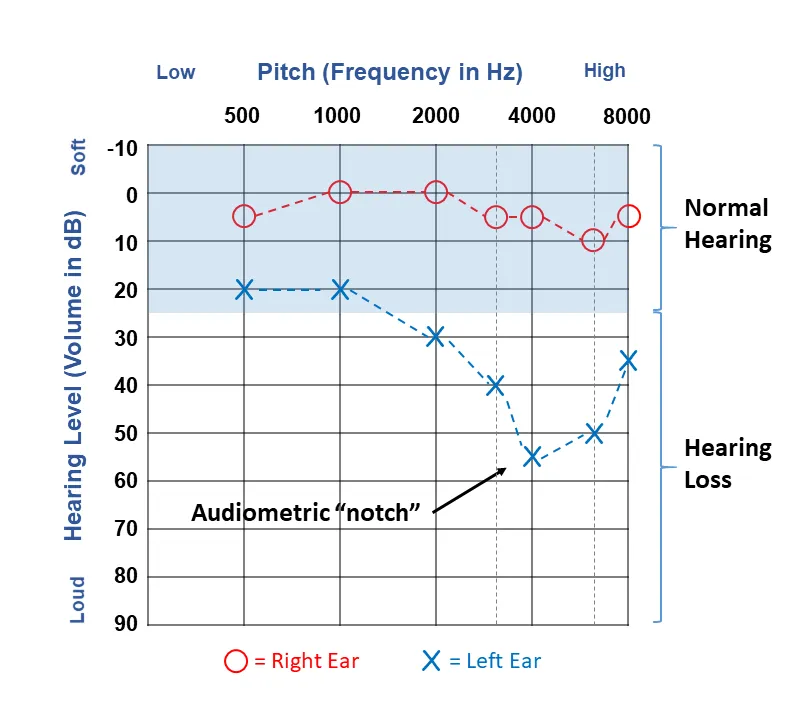
- Audiogram patterns: presbycusis sloping high-frequency; noise notch at 4 kHz; Ménière low-frequency fluctuating; otosclerosis Carhart notch at 2 kHz on bone conduction
- Tympanogram: A normal, B flat (effusion; large volume if perforated), C negative pressure, As stiff (otosclerosis), Ad floppy (ossicular discontinuity)
- Hearing loss is one of the two largest modifiable risk factors for dementia in the 2024 Lancet Commission (about 7% of cases, equal with high LDL cholesterol); offer amplification early
Differential diagnosis
| Condition | Clues | Key test |
|---|---|---|
| Earwax impaction | Gradual muffled hearing, often after cotton buds or hearing-aid use | Otoscopy; hearing improves after removal |
| Otitis media with effusion | Child with speech delay or adult after URTI; dull retracted drum | Type B tympanogram, normal canal volume |
| Otosclerosis | Young adult, family history, worse in pregnancy, normal drum | Conductive loss with Carhart notch; As tympanogram |
| Presbycusis | Older adult, bilateral, trouble in noise | Symmetrical sloping high-frequency SNHL |
| Noise-induced hearing loss | Occupational or recreational noise, tinnitus | Audiometric notch at 3–6 kHz, recovery at 8 kHz |
| Sudden sensorineural hearing loss | Unilateral loss over hours to 3 days, often on waking | PTA ≥30 dB over 3 frequencies; MRI IAM |
| Vestibular schwannoma | Asymmetric SNHL, unilateral tinnitus, poor speech discrimination | Gadolinium MRI of the internal auditory meatus |
| Cholesteatoma | Painless smelly discharge, attic retraction or crust | Otomicroscopy; high-resolution CT temporal bone |
Exam pearls
Guideline
NICE NG98 Hearing loss in adults (2018), AAO-HNSF Sudden Hearing Loss guideline (2019 update), AAO-HNSF Age-Related Hearing Loss guideline (2024) and WHO World report on hearing (2021)
References
- National Institute for Health and Care Excellence. Hearing loss in adults: assessment and management (NG98). NICE, London 2018.
- Chandrasekhar SS, Tsai Do BS, Schwartz SR, Bontempo LJ, et al.. Clinical Practice Guideline: Sudden Hearing Loss (Update). Otolaryngol Head Neck Surg 2019.
- Tsai Do BS, Bush ML, Weinreich HM, Schwartz SR, et al.. Clinical Practice Guideline: Age-Related Hearing Loss. Otolaryngol Head Neck Surg 2024.
- World Health Organization. World report on hearing. WHO, Geneva 2021.
- Lin FR, Pike JR, Albert MS, Arnold M, et al.. Hearing intervention versus health education control to reduce cognitive decline in older adults with hearing loss in the USA (ACHIEVE): a multicentre, randomised controlled trial. Lancet 2023.
- Livingston G, Huntley J, Liu KY, Costafreda SG, et al.. Dementia prevention, intervention, and care: 2024 report of the Lancet standing Commission. Lancet 2024.
Related topics
By Dr Khalid Seidi (B.Sc., M.D.) · MedEd World Clinical Knowledge library. Original teaching content checked against current guidelines (November 2026); confirm the latest local guidance before clinical use. Not a substitute for clinical judgement.