Clinical Knowledge › Ear, nose and throat › Clinical problems
Hoarseness: approach to the patient
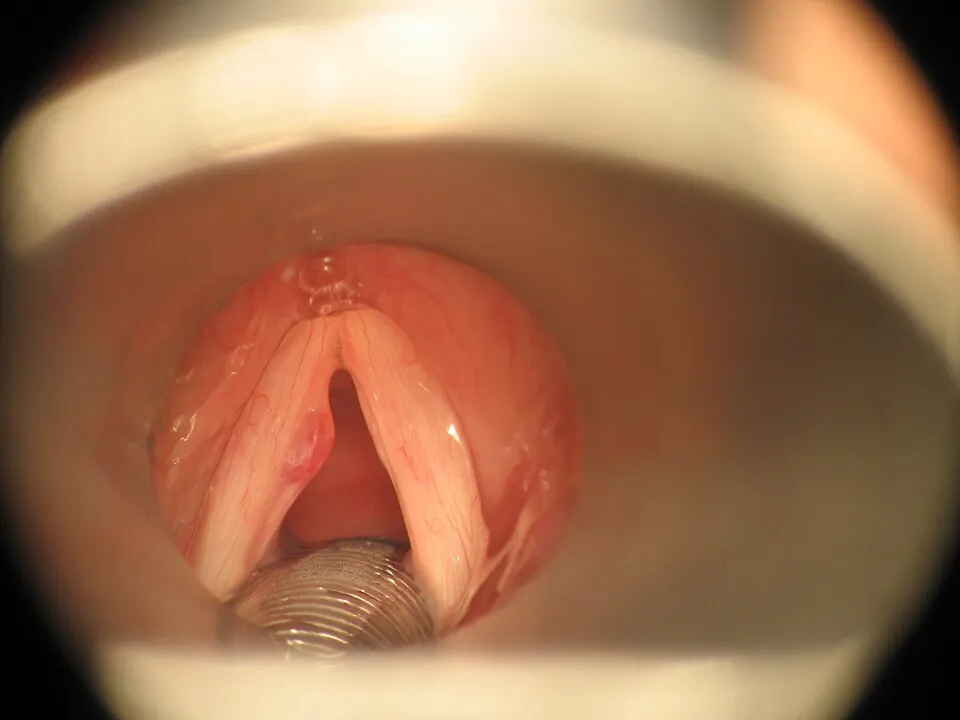
Hoarseness (dysphonia) is a change in voice quality, pitch, loudness or effort. Most acute hoarseness is viral laryngitis and settles within 2–3 weeks. Persistent hoarseness has a wide differential: benign vocal fold lesions, laryngopharyngeal reflux, recurrent respiratory papillomatosis, laryngeal cancer, vocal fold paralysis from damage to the recurrent laryngeal nerve, neurological disease and functional (muscle tension) dysphonia. The left recurrent laryngeal nerve loops under the aortic arch, so a left vocal fold palsy can be the first sign of lung cancer, mediastinal disease or an aortic aneurysm. The key investigation is flexible nasendoscopy. Laryngoscopy is needed if hoarseness lasts more than 4 weeks, or sooner with red flags such as smoking, neck lump, stridor, haemoptysis, dysphagia, recent neck surgery or intubation. In the UK, adults aged 45 or over with persistent unexplained hoarseness are referred on a suspected cancer pathway. Treatment targets the cause; voice therapy helps most benign and functional problems.
Patient case, mechanism, investigations, management, flashcards and exam-style questions.Open the lesson →
Key facts
- Laryngoscopy if hoarseness persists beyond 4 weeks, or at any time if a serious cause is suspected (AAO-HNSF 2018)
- NICE NG12: suspected cancer pathway referral for people aged 45 or over with persistent unexplained hoarseness; a chest X-ray is reasonable in smokers or when chest symptoms coexist (NG12 lung criteria for those aged 40 or over)
- Do not prescribe antireflux drugs, oral steroids or antibiotics for hoarseness before the larynx has been examined, unless there are clear indications
- Do not image the neck or chest before laryngoscopy; image after laryngoscopy shows a palsy or mass
- Unexplained vocal fold palsy needs CT from skull base to the aortic arch (left recurrent nerve course)
- Vocal fold nodules are bilateral, at the junction of the anterior and middle thirds, in heavy voice users; first-line treatment is voice therapy
- Glottic cancer presents early with hoarseness and has a good prognosis; supraglottic cancer presents late, often with nodes
- Breathy voice and weak 'bovine' cough suggest vocal fold palsy; stridor with a normal voice suggests bilateral palsy and an airway emergency
Differential diagnosis
| Condition | Clues | Key test |
|---|---|---|
| Acute viral laryngitis | URTI, hoarse less than 3 weeks, improving | Clinical; laryngoscopy if persistent |
| Vocal fold nodules | Teacher, singer or shouting child, bilateral | Laryngoscopy with stroboscopy |
| Reinke oedema | Heavy smoker, low-pitched gruff voice, often a woman | Laryngoscopy |
| Laryngeal squamous cell carcinoma | Smoker, persistent hoarseness, stridor, otalgia, neck node | Laryngoscopy, biopsy, CT/MRI |
| Vocal fold palsy | Breathy voice, weak cough, after thyroid or chest surgery or with lung cancer | Laryngoscopy then CT skull base to mediastinum |
| Laryngopharyngeal reflux | Throat clearing, globus, morning hoarseness | Laryngoscopy: posterior laryngeal oedema; trial of PPI if signs |
| Recurrent respiratory papillomatosis | Child or adult, progressive hoarseness, exophytic lesions | Laryngoscopy and biopsy; HPV 6/11 |
| Muscle tension dysphonia | Strained voice, normal folds, stress, voice misuse | Laryngoscopy shows supraglottic squeeze |
Exam pearls
Guideline
AAO-HNSF Clinical Practice Guideline: Hoarseness (Dysphonia) update (2018), NICE NG12 Suspected cancer: recognition and referral (2015, updated) and NICE NG36 Cancer of the upper aerodigestive tract (2016, updated 2018)
References
- Stachler RJ, Francis DO, Schwartz SR, Damask CC, et al.. Clinical Practice Guideline: Hoarseness (Dysphonia) (Update). Otolaryngol Head Neck Surg 2018.
- National Institute for Health and Care Excellence. Suspected cancer: recognition and referral (NG12). NICE, London 2015.
- National Institute for Health and Care Excellence. Cancer of the upper aerodigestive tract: assessment and management in people aged 16 and over (NG36). NICE, London 2016.
- Rosenthal LH, Benninger MS, Deeb RH. Vocal fold immobility: a longitudinal analysis of etiology over 20 years. Laryngoscope 2007.
- Expert Panel on Neurologic Imaging: Aulino JM, Kirsch CFE, Burns J, et al.. ACR Appropriateness Criteria Neck Mass-Adenopathy. J Am Coll Radiol 2019.
- Watkinson JC, Clarke RW, eds.. Scott-Brown's Otorhinolaryngology Head and Neck Surgery. CRC Press 2018.
Related topics
By Dr Khalid Seidi (B.Sc., M.D.) · MedEd World Clinical Knowledge library. Original teaching content checked against current guidelines (November 2026); confirm the latest local guidance before clinical use. Not a substitute for clinical judgement.