Clinical Knowledge › Ear, nose and throat › Clinical problems
Loss of smell: approach to the patient
Measurable olfactory dysfunction is common, affecting up to about one adult in five and rising steeply with age, yet it is often ignored. Patients usually complain of loss of taste because flavour depends on retronasal smell. Classify the loss as quantitative (anosmia, hyposmia) or qualitative (parosmia, phantosmia) and by mechanism: conductive (air cannot reach the olfactory cleft, as in chronic rhinosinusitis with nasal polyps), sensorineural (damage to the olfactory epithelium, as after viral infection including COVID-19), or central (head injury, neurodegeneration, tumours). The commonest causes are sinonasal disease, post-infectious loss, head trauma and ageing. Assessment includes a focused history, nasal endoscopy and a validated psychophysical smell test; MRI is reserved for unexplained loss, red flags or suspected central or congenital causes. Unilateral symptoms, bloody discharge or neurological signs suggest neoplasia. Treat the cause (for example intranasal and short oral steroids, surgery or biologics for polyps) and offer olfactory training for most patients.
Patient case, mechanism, investigations, management, flashcards and exam-style questions.Open the lesson →
Key facts
- Patients with smell loss usually report loss of 'taste' because flavour is mainly retronasal smell; basic tastes (sweet, salt, sour, bitter, umami) are preserved
- Mechanisms: conductive (polyps, rhinitis), sensorineural (post-viral, toxic), central (trauma, neurodegeneration, tumour)
- Commonest causes: chronic rhinosinusitis with nasal polyps, post-infectious (including COVID-19), head injury, age-related decline
- Head injury shears olfactory fila at the cribriform plate; occipital impacts (contre-coup) are classic
- Hyposmia can precede motor symptoms of Parkinson disease and cognitive decline in Alzheimer disease by years
- Congenital anosmia with hypogonadotrophic hypogonadism is Kallmann syndrome
- Olfactory training (four odours twice daily for at least 12 weeks) is the best-supported treatment for post-infectious loss
- Unilateral nasal symptoms, bloody discharge or neurological signs with smell loss need urgent ENT or neuroimaging
Differential diagnosis
| Condition | Clues | Key test |
|---|---|---|
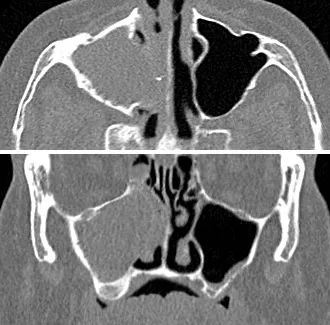
| Chronic rhinosinusitis with nasal polyps | Bilateral obstruction, discharge, fluctuating smell, asthma or aspirin sensitivity | Nasal endoscopy; CT sinuses |
| Post-infectious olfactory dysfunction | Sudden loss after URTI or COVID-19; parosmia during recovery | Psychophysical test; diagnosis of exclusion |
| Post-traumatic anosmia | Head injury, often occipital; may be immediate | MRI (frontal/olfactory bulb contusion) |
| Neurodegenerative disease | Gradual loss in older adult with tremor, rigidity or memory decline | Neurological examination; specialist assessment |
| Olfactory groove meningioma | Unilateral anosmia, personality change, visual loss (Foster Kennedy) | MRI brain with contrast |
| Sinonasal malignancy | Unilateral obstruction, blood-stained discharge, cheek swelling | Endoscopy and biopsy; CT and MRI |
| Kallmann syndrome | Lifelong anosmia, delayed puberty | LH/FSH, sex steroids; MRI olfactory bulbs |
| Age-related (presbyosmia) | Gradual bilateral decline in older adults | Psychophysical test with age norms |
Exam pearls
Guideline
European Rhinologic Society Position Paper on Olfactory Dysfunction (2023 update of the 2017 paper); EPOS 2020 for chronic rhinosinusitis
References
- Whitcroft KL, Altundag A, Balungwe P, et al.. Position paper on olfactory dysfunction: 2023. Rhinology 2023.
- Hummel T, Whitcroft KL, Andrews P, et al.. Position paper on olfactory dysfunction. Rhinol Suppl 2017.
- Hummel T, Rissom K, Reden J, et al.. Effects of olfactory training in patients with olfactory loss. Laryngoscope 2009.
- Fokkens WJ, Lund VJ, Hopkins C, et al.. European Position Paper on Rhinosinusitis and Nasal Polyps 2020 (EPOS2020). Rhinology 2020.
- Papadakis MA, Rabow MW, McQuaid KR, eds.. CURRENT Medical Diagnosis & Treatment 2026 (chapter 8: Ear, nose and throat disorders). McGraw Hill 2026.
- Pinto JM, Wroblewski KE, Kern DW, Schumm LP, McClintock MK.. Olfactory dysfunction predicts 5-year mortality in older adults. PLoS One 2014.
Related topics
By Dr Khalid Seidi (B.Sc., M.D.) · MedEd World Clinical Knowledge library. Original teaching content checked against current guidelines (November 2026); confirm the latest local guidance before clinical use. Not a substitute for clinical judgement.