Clinical Knowledge › Neurology › Infections of the nervous system
Herpes simplex encephalitis
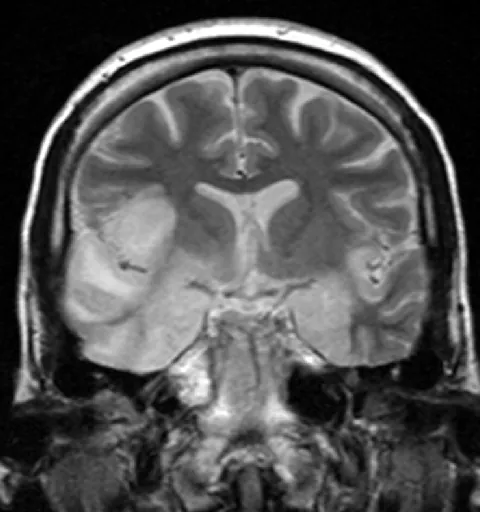
Herpes simplex encephalitis (HSE) is the commonest cause of sporadic fatal viral encephalitis worldwide. In adults and older children it is usually caused by HSV-1, spreading along trigeminal or olfactory pathways to the medial temporal and orbitofrontal lobes, where it causes asymmetric haemorrhagic necrotising inflammation. Neonatal disease is usually HSV-2 acquired at birth. Patients develop fever, headache, behavioural change, confusion, aphasia, olfactory or gustatory hallucinations and focal or generalised seizures over days. CSF typically shows a lymphocytic pleocytosis with raised protein and red cells; HSV PCR is the diagnostic test but can be negative in the first 72 hours. MRI shows temporal lobe and insular T2/FLAIR and diffusion abnormality. Untreated mortality is around 70%. IV aciclovir 10 mg/kg every 8 hours must start immediately on suspicion, without waiting for tests, and continue for 14–21 days. Survivors often have memory, behavioural and seizure sequelae, and about a quarter develop secondary anti-NMDA receptor encephalitis within weeks.
Patient case, mechanism, investigations, management, flashcards and exam-style questions.Open the lesson →
Key facts
- HSV-1 causes about 90% of adult HSE; HSV-2 causes most neonatal HSV encephalitis
- Predilection for medial temporal lobes, insula and orbitofrontal cortex, often asymmetric
- Start IV aciclovir 10 mg/kg every 8 hours as soon as encephalitis is suspected (teaching dose; check local protocol and renal function)
- CSF HSV PCR has about 96% sensitivity and 99% specificity, but may be falsely negative in the first 72 hours; repeat if suspicion remains
- CSF: lymphocytic pleocytosis, raised protein, normal or slightly low glucose, red cells or xanthochromia from haemorrhagic necrosis
- MRI is the most sensitive imaging; CT is normal early in about a third
- Untreated mortality is about 70%; with aciclovir it falls to around 10–20%, but most survivors have sequelae
- Post-HSV anti-NMDAR encephalitis occurs in about 25%, usually 2–6 weeks after HSE
Differential diagnosis
| Condition | Clues | Key test |
|---|---|---|
| Autoimmune encephalitis (anti-NMDAR, LGI1) | Subacute, psychiatric features, no fever, HSV PCR negative | CSF and serum neuronal antibodies |
| Bacterial meningitis | Neck stiffness, rash, neutrophilic CSF, low glucose | CSF Gram stain and culture |
| Brain abscess | Fever, focal signs, ring-enhancing lesion | Contrast MRI |
| VZV encephalitis or vasculopathy | Recent shingles, strokes, immunosuppression | CSF VZV PCR and antibody |
| Ischaemic stroke | Sudden onset, vascular territory, no fever | DWI MRI, vascular imaging |
| Non-convulsive status epilepticus | Fluctuating confusion, subtle twitching | EEG |
| Glioma | Subacute focal signs, mass effect | MRI with contrast and spectroscopy |
Exam pearls
Guideline
IDSA encephalitis guideline (2008) and Association of British Neurologists/British Infection Association national guideline for suspected viral encephalitis in adults (2012)
References
- Tunkel AR, Glaser CA, Bloch KC, et al.. The management of encephalitis: clinical practice guidelines by the Infectious Diseases Society of America. Clin Infect Dis 2008.
- Solomon T, Michael BD, Smith PE, et al.. Management of suspected viral encephalitis in adults--Association of British Neurologists and British Infection Association National Guidelines. J Infect 2012.
- Whitley RJ, Alford CA, Hirsch MS, et al.. Vidarabine versus acyclovir therapy in herpes simplex encephalitis. N Engl J Med 1986.
- Granerod J, Ambrose HE, Davies NW, et al.. Causes of encephalitis and differences in their clinical presentations in England: a multicentre, population-based prospective study. Lancet Infect Dis 2010.
- Armangue T, Spatola M, Vlagea A, et al.. Frequency, symptoms, risk factors, and outcomes of autoimmune encephalitis after herpes simplex encephalitis: a prospective observational study and retrospective analysis. Lancet Neurol 2018.
- Penman ID, Ralston SH, Strachan MWJ, Hobson RP, eds.. Davidson's Principles and Practice of Medicine. 2022.
Related topics
By Dr Khalid Seidi (B.Sc., M.D.) · MedEd World Clinical Knowledge library. Original teaching content checked against current guidelines (November 2026); confirm the latest local guidance before clinical use. Not a substitute for clinical judgement.