Clinical Knowledge › Neurology › Infections of the nervous system
Neurocysticercosis
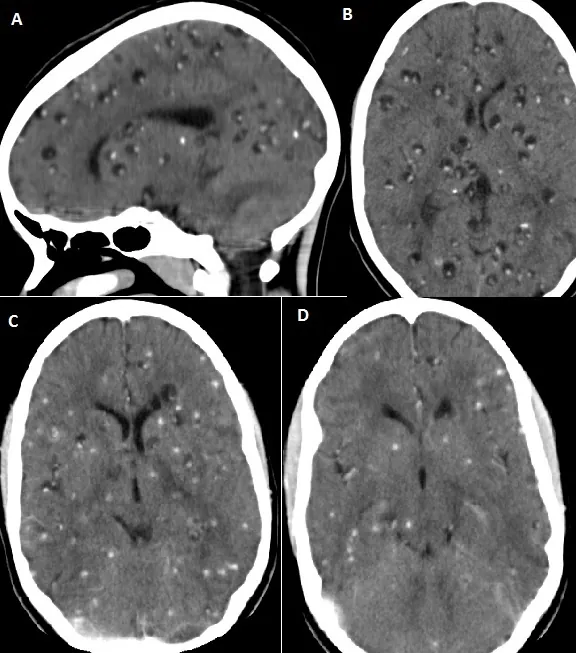
Neurocysticercosis (NCC) is infection of the nervous system by the larval stage (cysticercus) of the pork tapeworm Taenia solium and is a leading preventable cause of acquired epilepsy worldwide. Humans develop cysticercosis by ingesting T. solium eggs shed by a human tapeworm carrier (faecal–oral spread), not by eating undercooked pork, which causes intestinal taeniasis. Parenchymal cysts cause seizures, usually when the cyst degenerates and provokes inflammation; extraparenchymal disease causes hydrocephalus, raised intracranial pressure, arachnoiditis and stroke. CT and MRI show cysts at different stages, including the pathognomonic scolex. Diagnosis uses the revised Del Brutto criteria with neuroimaging, serology (EITB) and exposure. Management is individualised: antiseizure medicines, corticosteroids and antiparasitic therapy (albendazole, plus praziquantel for more than two cysts) for viable parenchymal cysts; endoscopic removal or shunting for ventricular disease and hydrocephalus; and no antiparasitic treatment for calcified lesions alone.
Patient case, mechanism, investigations, management, flashcards and exam-style questions.Open the lesson →
Key facts
- Humans get cysticercosis by ingesting T. solium eggs from a human carrier; eating undercooked pork causes intestinal taeniasis
- NCC is the commonest cause of acquired epilepsy in endemic areas (about 30% of epilepsy in Latin America, sub-Saharan Africa and South Asia)
- Imaging stages: vesicular (cyst with scolex), colloidal (ring enhancement and oedema), granular nodular, calcified
- 'Hole with a dot' (cyst with eccentric scolex) is pathognomonic on CT or MRI
- Albendazole 15 mg/kg/day for 10–14 days for 1–2 viable cysts; add praziquantel 50 mg/kg/day for more than 2 cysts (teaching doses; check local protocol)
- Give corticosteroids with antiparasitic therapy to reduce inflammatory reaction; screen for latent TB and Strongyloides
- Do not give antiparasitic drugs for calcified lesions only or for cysticercal encephalitis with diffuse oedema
- Fundoscopy before antiparasitic treatment to exclude raised intracranial pressure and ocular cysticercosis
Differential diagnosis
| Condition | Clues | Key test |
|---|---|---|
| Tuberculoma | Ring-enhancing lesion often over 2 cm, irregular, with TB elsewhere | Chest imaging, CSF, MR spectroscopy (lipid peak) |
| Cerebral toxoplasmosis | HIV with low CD4, multiple lesions in basal ganglia | Toxoplasma serology; HIV and CD4 |
| Brain abscess | Fever, rapidly enlarging ring lesion with restricted diffusion | DWI MRI; blood cultures |
| Metastases | Older patient, known cancer, multiple lesions at grey–white junction | CT chest/abdomen; biopsy |
| Hydatid cyst (echinococcosis) | Large unilocular cyst without scolex visible, no oedema | Echinococcus serology |
| Low-grade glioma | Progressive focal signs, non-resolving mass | MRI with spectroscopy, biopsy |
Exam pearls
Guideline
IDSA/ASTMH Clinical Practice Guidelines for diagnosis and treatment of neurocysticercosis (2017, published 2018) and revised diagnostic criteria (Del Brutto et al., 2017)
References
- White AC, Coyle CM, Rajshekhar V, et al.. Diagnosis and Treatment of Neurocysticercosis: 2017 Clinical Practice Guidelines by the Infectious Diseases Society of America (IDSA) and the American Society of Tropical Medicine and Hygiene (ASTMH). Clin Infect Dis 2018.
- Del Brutto OH, Nash TE, White AC, et al.. Revised diagnostic criteria for neurocysticercosis. J Neurol Sci 2017.
- Garcia HH, Nash TE, Del Brutto OH. Clinical symptoms, diagnosis, and treatment of neurocysticercosis. Lancet Neurol 2014.
- Garcia HH, Gonzales I, Lescano AG, et al.. Efficacy of combined antiparasitic therapy with praziquantel and albendazole for neurocysticercosis: a double-blind, randomised controlled trial. Lancet Infect Dis 2014.
- Penman ID, Ralston SH, Strachan MWJ, Hobson RP, eds.. Davidson's Principles and Practice of Medicine. 2022.
- Loscalzo J, Fauci AS, Kasper DL, et al., eds.. Harrison's Principles of Internal Medicine. 2022.
Related topics
By Dr Khalid Seidi (B.Sc., M.D.) · MedEd World Clinical Knowledge library. Original teaching content checked against current guidelines (November 2026); confirm the latest local guidance before clinical use. Not a substitute for clinical judgement.