Clinical Knowledge › Neurology › Infections of the nervous system
Neurosyphilis
Neurosyphilis is infection of the nervous system by Treponema pallidum. It can occur at any stage of syphilis. Early forms (weeks to a few years) include asymptomatic CSF abnormalities, syphilitic meningitis with cranial neuropathies, meningovascular syphilis causing strokes in young adults, and ocular and otic syphilis (uveitis, optic neuritis, hearing loss, tinnitus). Late parenchymal forms, now uncommon, appear 10–30 years after infection: general paresis (progressive dementia, personality change, grandiosity, tremor and dysarthria) and tabes dorsalis (lightning pains, sensory ataxia, areflexia, Charcot joints and Argyll Robertson pupils). HIV co-infection increases risk and alters presentation. Diagnosis combines reactive serum treponemal and non-treponemal tests with CSF abnormalities: CSF VDRL is highly specific but insensitive, whereas CSF treponemal antibodies are sensitive. Treatment is IV benzylpenicillin 18–24 million units daily for 10–14 days, with ceftriaxone or procaine penicillin plus probenecid as alternatives, and serological and clinical follow-up.
Patient case, mechanism, investigations, management, flashcards and exam-style questions.Open the lesson →
Key facts
- Neurosyphilis can occur at any stage of syphilis; early forms are now commoner than late parenchymal forms
- Ocular and otic syphilis are treated as neurosyphilis, even with normal CSF
- Meningovascular syphilis causes ischaemic stroke in young adults from endarteritis of medium and small arteries
- General paresis: progressive dementia with personality change, delusions, dysarthria and tremor
- Tabes dorsalis: lightning pains, sensory ataxia, positive Romberg, areflexia, Charcot joints, Argyll Robertson pupils
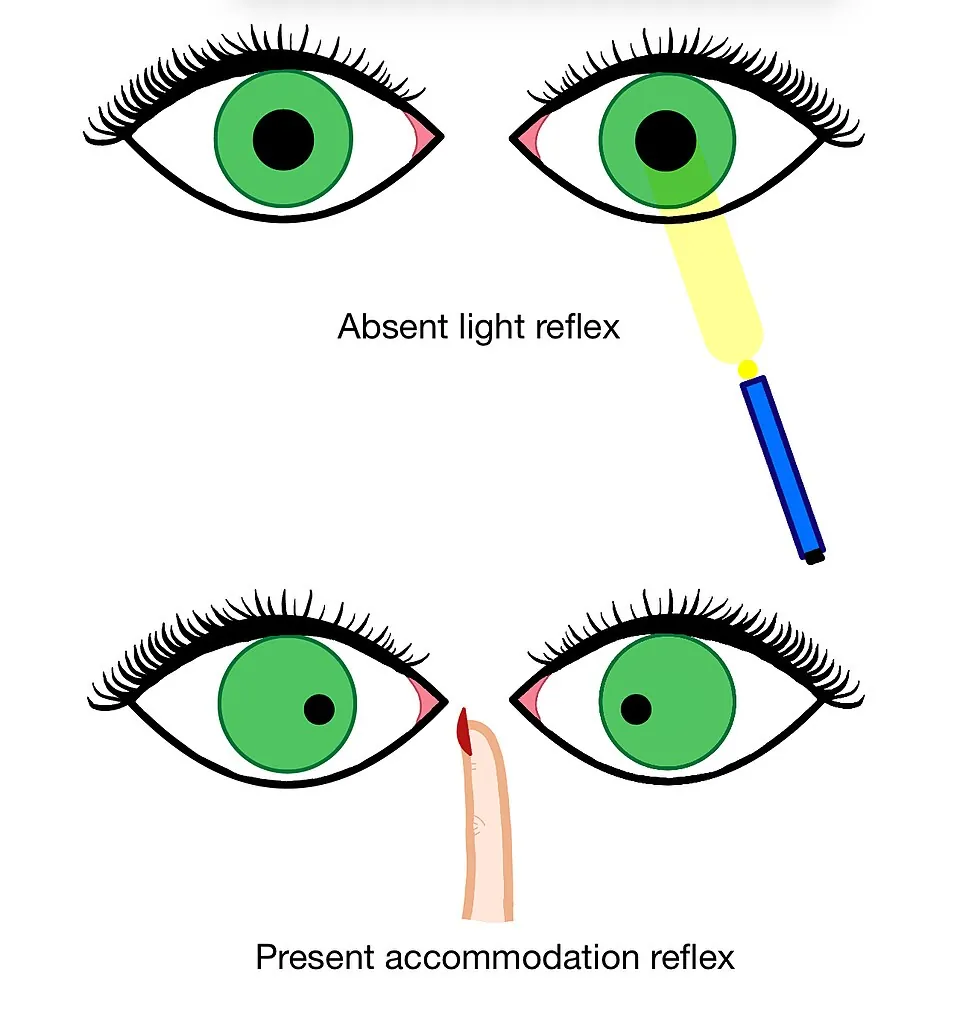
- Argyll Robertson pupils: small irregular pupils that accommodate but do not react to light
- CSF VDRL is specific but only about 50–70% sensitive; a negative CSF FTA-ABS makes neurosyphilis unlikely
- Treatment: aqueous benzylpenicillin 18–24 million units/day IV (3–4 MU every 4 hours) for 10–14 days (teaching dose; check local protocol)
Differential diagnosis
| Condition | Clues | Key test |
|---|---|---|
| Alzheimer disease or frontotemporal dementia | No serological evidence of syphilis, gradual decline | Treponemal serology; CSF |
| Vitamin B12 deficiency (SACD) | Dorsal column loss with macrocytosis, UMN signs | Serum B12, MMA |
| Diabetic autonomic and sensory neuropathy | Diabetes, Charcot joints, abnormal pupils | HbA1c; normal syphilis serology |
| Multiple sclerosis | Optic neuritis, myelitis in young adults | MRI, OCBs, negative syphilis serology |
| Tuberculous meningitis | Subacute basal meningitis with cranial nerve palsies | CSF Xpert Ultra, culture |
| HIV-associated neurocognitive disorder | Subcortical cognitive impairment in HIV | CD4, viral load, CSF VDRL negative |
| Bipolar disorder or psychosis | Grandiosity without neurological signs | Syphilis serology negative |
Exam pearls
Guideline
CDC Sexually Transmitted Infections Treatment Guidelines (2021) and IUSTI 2020 European guideline on the management of syphilis
References
- Workowski KA, Bachmann LH, Chan PA, et al.. Sexually Transmitted Infections Treatment Guidelines, 2021. MMWR Recomm Rep 2021.
- Janier M, Unemo M, Dupin N, et al.. 2020 European guideline on the management of syphilis. J Eur Acad Dermatol Venereol 2021.
- Ropper AH. Neurosyphilis. N Engl J Med 2019.
- Penman ID, Ralston SH, Strachan MWJ, Hobson RP, eds.. Davidson's Principles and Practice of Medicine. 2022.
- Loscalzo J, Fauci AS, Kasper DL, et al., eds.. Harrison's Principles of Internal Medicine. 2022.
- Papadakis MA, McPhee SJ, Rabow MW, et al., eds.. Current Medical Diagnosis and Treatment 2026. 2026.
Related topics
By Dr Khalid Seidi (B.Sc., M.D.) · MedEd World Clinical Knowledge library. Original teaching content checked against current guidelines (November 2026); confirm the latest local guidance before clinical use. Not a substitute for clinical judgement.