Clinical Knowledge › Internal medicine › Rheumatology and immunology › Connective tissue diseases
IgG4-related disease
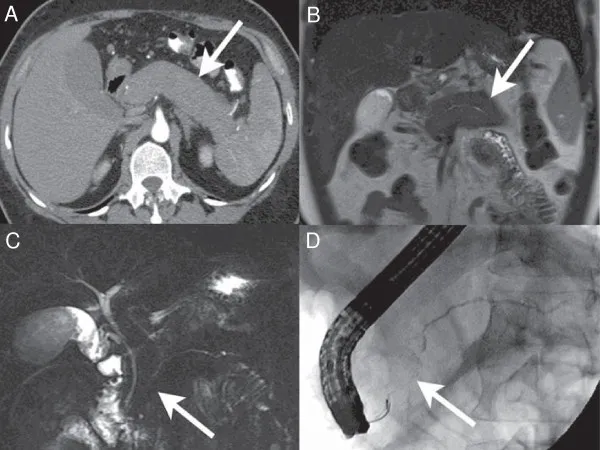
IgG4-related disease (IgG4-RD) is a chronic immune-mediated fibroinflammatory condition that forms tumour-like swellings in one or many organs. It mainly affects men aged 50–70. Typical sites are the pancreas (type 1 autoimmune pancreatitis), bile ducts, salivary and lacrimal glands (Mikulicz disease), orbits, retroperitoneum and aorta, kidneys, lungs, thyroid and meninges. Patients often present with painless obstructive jaundice, symmetrical gland swelling, a pancreatic or renal 'mass' or hydronephrosis from retroperitoneal fibrosis, so cancer and lymphoma must always be excluded. Serum IgG4 is raised in most patients but is neither sensitive nor specific. The diagnosis rests on typical imaging and histology: a dense lymphoplasmacytic infiltrate rich in IgG4-positive plasma cells, storiform fibrosis and obliterative phlebitis. The 2019 ACR/EULAR criteria guide classification. Glucocorticoids induce remission quickly, and a poor response should prompt a search for another diagnosis. Relapses are treated with rituximab; inebilizumab became the first approved drug in 2025.
Patient case, mechanism, investigations, management, flashcards and exam-style questions.Open the lesson →
Key facts
- Fibroinflammatory multiorgan disease of middle-aged and older men forming tumour-like lesions
- Classic sites: pancreas (type 1 AIP), bile ducts, salivary and lacrimal glands, orbit, retroperitoneum and aorta, kidney
- Histology: lymphoplasmacytic infiltrate with abundant IgG4+ plasma cells, storiform fibrosis, obliterative phlebitis
- Serum IgG4 is raised in about 60–70%; levels over twice the upper limit are more specific but not diagnostic
- Always exclude pancreatic cancer, cholangiocarcinoma and lymphoma before treating
- 2019 ACR/EULAR classification: entry criterion, exclusion criteria, then weighted inclusion items scoring 20 or more points
- Glucocorticoids work within weeks (prednisolone about 0.6 mg/kg/day); no response suggests another diagnosis
- Relapses are common; rituximab is used for relapse and inebilizumab (anti-CD19) reduced flares in the MITIGATE trial
Differential diagnosis
| Condition | Clues | Key test |
|---|---|---|
| Pancreatic adenocarcinoma | Focal mass, weight loss, raised CA 19-9, upstream duct dilatation | Pancreatic-protocol CT, EUS-guided biopsy |
| Cholangiocarcinoma or primary sclerosing cholangitis | Biliary strictures; PSC in younger patients with IBD | MRCP pattern, brush cytology, IgG4 and biopsy |
| Lymphoma | Lymphadenopathy, B symptoms, mass lesions | Biopsy with flow cytometry; PET-CT |
| Sjögren syndrome | Gland swelling with prominent dry eyes and mouth, women | Anti-Ro/La; lip biopsy |
| Granulomatosis with polyangiitis | Orbital mass, sinus disease, nephritis | PR3-ANCA; granulomatous vasculitis |
| Sarcoidosis | Lacrimal and parotid swelling, hilar nodes | Non-caseating granulomas; serum ACE, calcium |
| Multicentric Castleman disease | Lymphadenopathy, high IgG4 possible, fever, very high CRP and IL-6 | Lymph node biopsy; HHV-8 |
| Erdheim–Chester disease | Retroperitoneal 'hairy kidney', bone sclerosis | BRAF V600E; histiocytes on biopsy |
Exam pearls
Guideline
2019 ACR/EULAR classification criteria for IgG4-RD, 2015 International consensus guidance on management of IgG4-RD and 2020 revised comprehensive diagnostic criteria (Japan)
References
- Wallace ZS, Naden RP, Chari S, et al.. The 2019 American College of Rheumatology/European League Against Rheumatism classification criteria for IgG4-related disease. Ann Rheum Dis 2020.
- Khosroshahi A, Wallace ZS, Crowe JL, et al.. International consensus guidance statement on the management and treatment of IgG4-related disease. Arthritis Rheumatol 2015.
- Stone JH, Khosroshahi A, Zhang W, et al.. Inebilizumab for treatment of IgG4-related disease. N Engl J Med 2025.
- Umehara H, Okazaki K, Kawa S, et al.. The 2020 revised comprehensive diagnostic (RCD) criteria for IgG4-RD. Mod Rheumatol 2021.
- Wallace ZS, Zhang Y, Perugino CA, et al.. Clinical phenotypes of IgG4-related disease: an analysis of two international cross-sectional cohorts. Ann Rheum Dis 2019.
- Lanzillotta M, Mancuso G, Della-Torre E. Advances in the diagnosis and management of IgG4 related disease. BMJ 2020.
Related topics
By Dr Khalid Seidi (B.Sc., M.D.) · MedEd World Clinical Knowledge library. Original teaching content checked against current guidelines (November 2026); confirm the latest local guidance before clinical use. Not a substitute for clinical judgement.