Clinical Knowledge › Internal medicine › Rheumatology and immunology › Connective tissue diseases
Inclusion body myositis
Inclusion body myositis (IBM) is the commonest acquired muscle disease in people over 50. It combines autoimmune inflammation, in which clonal cytotoxic CD8 T cells invade muscle fibres, with degenerative changes such as rimmed vacuoles and aggregates of misfolded proteins. Men are affected about twice as often as women and onset is usually after 45. Weakness creeps on over years and has a typical pattern: wasting of the quadriceps causes falls and knee buckling, weakness of the deep finger flexors impairs grip, and dysphagia affects up to half of patients. Weakness is often asymmetric. Creatine kinase is normal or only mildly raised, and anti-cytosolic 5'-nucleotidase 1A (anti-cN1A) antibodies support the diagnosis. Muscle MRI and biopsy confirm it. Unlike dermatomyositis and polymyositis, IBM does not respond to glucocorticoids or other immunosuppressants. Care relies on exercise, falls prevention, orthoses and management of dysphagia. Most patients eventually need a walking aid, and aspiration pneumonia is a major cause of death.
Patient case, mechanism, investigations, management, flashcards and exam-style questions.Open the lesson →
Key facts
- Commonest acquired myopathy after age 50; men affected about twice as often as women; onset usually after 45
- Typical pattern: quadriceps (knee extensor) and deep finger flexor weakness, often asymmetric, with forearm and thigh wasting
- Falls from knee buckling and a weak grip are common first complaints; diagnosis is often delayed by about 5 years
- Dysphagia affects 40–60%, mainly from cricopharyngeal dysfunction, and raises aspiration risk
- CK is normal or mildly raised (no more than 15 times the upper limit in a typical presentation); anti-cN1A antibodies are found in about a third to a half
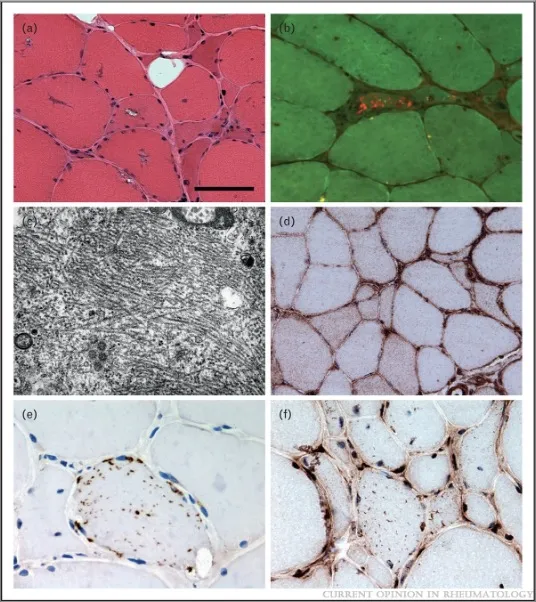
- Biopsy: endomysial CD8 T cells invading non-necrotic fibres, MHC class I upregulation, rimmed vacuoles, p62/TDP-43 aggregates, COX-negative fibres
- No drug has proven benefit in randomised trials; glucocorticoids, IVIG and methotrexate do not halt progression
- Associations: T-cell large granular lymphocytic leukaemia, HCV, HIV and Sjögren syndrome
Differential diagnosis
| Condition | Clues | Key test |
|---|---|---|
| Polymyositis or immune-mediated necrotising myopathy | Symmetric proximal weakness over weeks to months; CK often very high | CK, anti-SRP/anti-HMGCR, biopsy (necrosis without rimmed vacuoles) |
| Dermatomyositis | Heliotrope rash, Gottron papules, proximal weakness | Myositis-specific antibodies; biopsy perifascicular atrophy |
| Motor neurone disease | Asymmetric weakness with fasciculations, upper motor neurone signs, bulbar palsy | EMG with widespread denervation; no rimmed-vacuole myopathy |
| Myotonic dystrophy type 1 | Distal and facial weakness, ptosis, grip myotonia, cataracts, family history | Genetic test for CTG repeat expansion |
| Oculopharyngeal muscular dystrophy | Ptosis and dysphagia in later life, family history | PABPN1 genetic test |
| Statin myopathy | Symmetric proximal aches after starting a statin | CK; improvement after stopping; anti-HMGCR if persistent |
| Cervical or lumbar radiculopathy | Dermatomal pain and sensory loss with weakness | MRI spine; nerve conduction studies |
Exam pearls
Guideline
ENMC 2024 revised diagnostic criteria for inclusion body myositis (272nd workshop) and 2017 EULAR/ACR classification criteria for idiopathic inflammatory myopathies
References
- Lilleker JB, Naddaf E, Saris CGJ, Schmidt J, de Visser M, Weihl CC, et al.. 272nd ENMC international workshop: 10 years of progress - revision of the ENMC 2013 diagnostic criteria for inclusion body myositis and clinical trial readiness. Neuromuscul Disord 2024.
- Rose MR; ENMC IBM Working Group. 188th ENMC International Workshop: Inclusion Body Myositis, 2-4 December 2011, Naarden, The Netherlands. Neuromuscul Disord 2013.
- Lundberg IE, Tjärnlund A, Bottai M, et al.. 2017 European League Against Rheumatism/American College of Rheumatology classification criteria for adult and juvenile idiopathic inflammatory myopathies and their major subgroups. Ann Rheum Dis 2017.
- Greenberg SA. Inclusion body myositis: clinical features and pathogenesis. Nat Rev Rheumatol 2019.
- Santos EJF, Farisogullari B, Yapp N, Townsley H, Sousa P, Machado PM. Efficacy and safety of pharmacological treatments in inclusion body myositis: a systematic review. RMD Open 2025.
- Badrising UA, Henderson R, Reddel S, et al.. Optimism in inclusion body myositis: a double-blind randomised controlled phase III trial investigating the effect of sirolimus on disease progression in patients with IBM as measured by the IBM Functional Rating Scale. Clin Exp Rheumatol 2025.
Related topics
By Dr Khalid Seidi (B.Sc., M.D.) · MedEd World Clinical Knowledge library. Original teaching content checked against current guidelines (November 2026); confirm the latest local guidance before clinical use. Not a substitute for clinical judgement.