Clinical Knowledge › Internal medicine › Infectious diseases › Tuberculosis and mycobacterial infections
Leprosy (Hansen disease)
Leprosy (Hansen disease) is a chronic granulomatous infection caused by Mycobacterium leprae (and rarely M. lepromatosis), an acid-fast bacillus that cannot be cultured in vitro, divides every 12–14 days and prefers the cooler skin, peripheral nerves, nasal mucosa and anterior eye. It spreads mainly by respiratory droplets from untreated multibacillary patients after prolonged close contact; most exposed people are naturally resistant. About 175 000–185 000 new cases are reported each year, mostly in India, Brazil and Indonesia. The host's cell-mediated immunity determines a spectrum from tuberculoid disease, with few hypopigmented anaesthetic patches and few bacilli, to lepromatous disease, with diffuse infiltration, nodules, madarosis and many bacilli. Diagnosis is clinical, based on WHO cardinal signs: a hypopigmented or reddish patch with definite sensory loss, a thickened peripheral nerve with sensory or motor loss, or acid-fast bacilli on a slit-skin smear. WHO recommends rifampicin, dapsone and clofazimine for all patients: 6 months for paucibacillary and 12 months for multibacillary disease. Immune reactions (type 1 reversal and type 2 erythema nodosum leprosum) cause most nerve damage and need prompt corticosteroids. Single-dose rifampicin protects contacts.
Patient case, mechanism, investigations, management, flashcards and exam-style questions.Open the lesson →
Key facts
- M. leprae is acid-fast, obligately intracellular, unculturable in vitro and favours temperatures around 30–33 °C (skin, nerves, nose, testes)
- Transmission is mainly by droplets from untreated multibacillary patients after prolonged close contact; armadillos are a reservoir in the Americas
- WHO cardinal signs: anaesthetic hypopigmented or reddish patch; thickened nerve with sensory or motor loss; AFB on slit-skin smear
- Paucibacillary (PB): 1–5 lesions, no nerve involvement, no bacilli; multibacillary (MB): more than 5 lesions, nerve involvement or positive smear
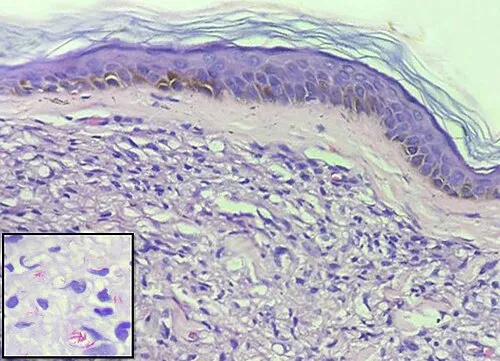
- Tuberculoid = strong Th1 immunity, few bacilli; lepromatous = weak Th1/strong Th2 response, many bacilli (globi, foamy macrophages)
- WHO MDT for all: rifampicin, dapsone and clofazimine; 6 months PB, 12 months MB
- Type 1 reaction (reversal) = delayed hypersensitivity with neuritis; type 2 (ENL) = immune complex disease with tender nodules, fever, iritis, orchitis
- Single-dose rifampicin post-exposure prophylaxis reduces leprosy in contacts by about 50–60%
Differential diagnosis
| Condition | Clues | Key test |
|---|---|---|
| Pityriasis versicolor | Scaly hypopigmented macules, normal sensation | KOH microscopy: spaghetti-and-meatballs |
| Vitiligo | Depigmented (milk-white), not hypopigmented, normal sensation | Wood lamp; clinical |
| Post-inflammatory hypopigmentation | History of prior rash; normal sensation | Clinical |
| Cutaneous sarcoidosis | Plaques and nodules, lung or eye involvement | Biopsy: non-caseating granulomas, no AFB |
| Cutaneous leishmaniasis (diffuse or post-kala-azar) | Nodules in endemic area, normal sensation | Slit-skin smear for amastigotes; PCR |
| Diabetic or other peripheral neuropathy | Symmetrical sensory loss without thickened nerves or skin lesions | Glucose, HbA1c, nerve conduction |
| Cutaneous tuberculosis or NTM infection | Ulcers or plaques, sensation preserved | Biopsy with culture |
Exam pearls
Guideline
WHO Guidelines for the diagnosis, treatment and prevention of leprosy (2018) and WHO Global Leprosy Strategy 2021–2030 'Towards zero leprosy'
References
- World Health Organization. Guidelines for the diagnosis, treatment and prevention of leprosy. WHO Regional Office for South-East Asia, New Delhi 2018.
- World Health Organization. Towards zero leprosy. Global leprosy (Hansen's disease) strategy 2021–2030. WHO Regional Office for South-East Asia, New Delhi 2021.
- Britton WJ, Lockwood DNJ. Leprosy. Lancet 2004.
- Ridley DS, Jopling WH. Classification of leprosy according to immunity. A five-group system. Int J Lepr Other Mycobact Dis 1966.
- Moet FJ, Pahan D, Oskam L, Richardus JH. Effectiveness of single dose rifampicin in preventing leprosy in close contacts of patients with newly diagnosed leprosy: cluster randomised controlled trial. BMJ 2008.
- Richardus JH, Tiwari A, Barth-Jaeggi T, et al.. Leprosy post-exposure prophylaxis with single-dose rifampicin (LPEP): an international feasibility programme. Lancet Glob Health 2021.
Related topics
By Dr Khalid Seidi (B.Sc., M.D.) · MedEd World Clinical Knowledge library. Original teaching content checked against current guidelines (November 2026); confirm the latest local guidance before clinical use. Not a substitute for clinical judgement.