Clinical Knowledge › Internal medicine › Gastroenterology and hepatology › Diseases of the liver
Liver abscess
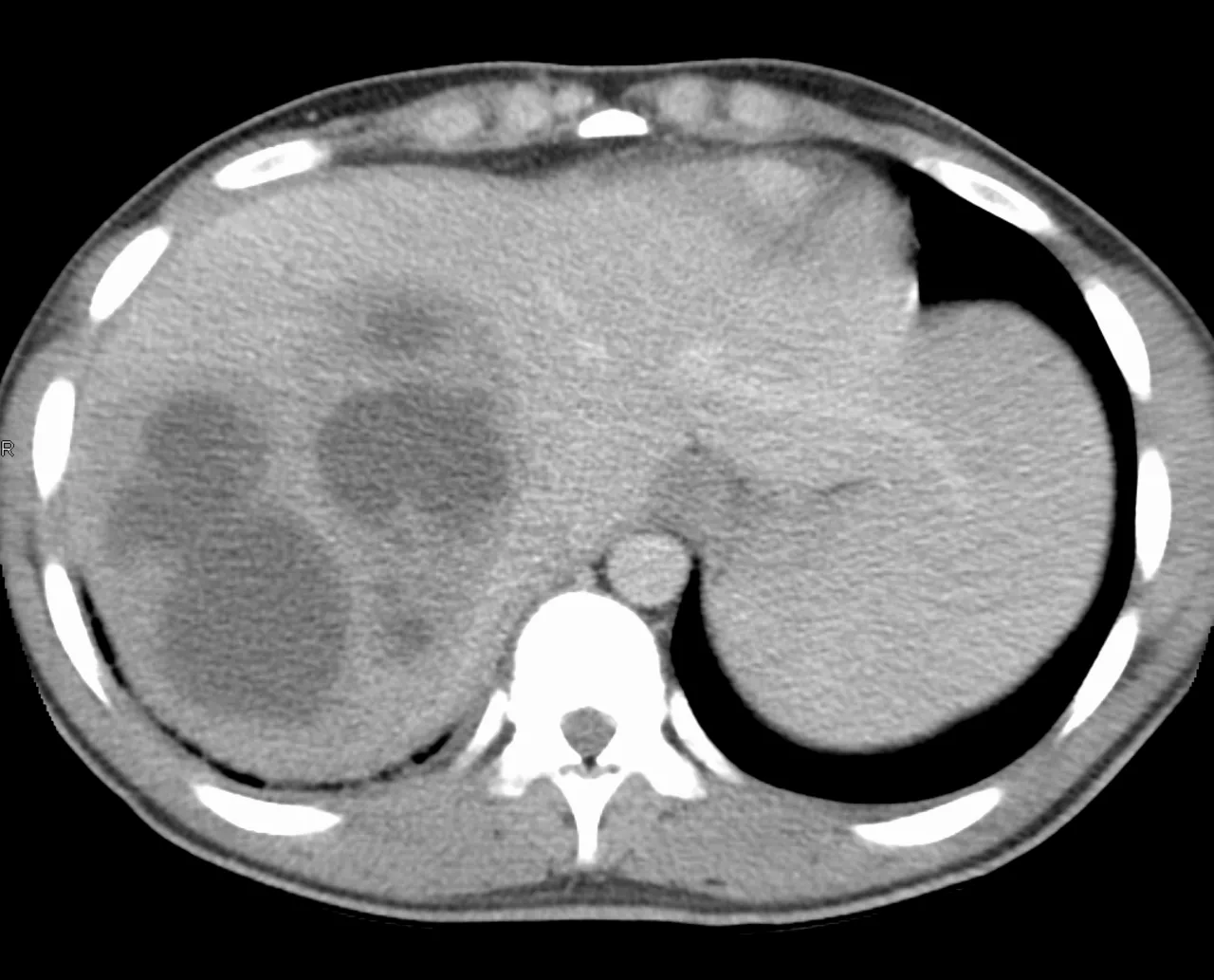
A liver abscess is a localised collection of pus within the liver parenchyma. Pyogenic abscesses are the commonest type in high-income countries and arise from biliary infection, portal spread from the bowel (diverticulitis, appendicitis), haematogenous seeding or are cryptogenic; in East and South-East Asia hypervirulent Klebsiella pneumoniae now dominates, especially in people with diabetes, and can spread to the eye, brain and lungs. Amoebic abscess, caused by Entamoeba histolytica, affects mainly young men in or from endemic areas and is usually a single right-lobe lesion. Patients present with fever, right upper quadrant pain and tender hepatomegaly; jaundice is uncommon unless the biliary tree is involved. Ultrasound or contrast CT confirms the lesion, and blood cultures, aspirate culture and amoebic serology identify the cause. Pyogenic abscesses need antibiotics for about 4–6 weeks plus percutaneous aspiration or catheter drainage when larger than 3–5 cm; amoebic abscesses respond to metronidazole followed by a luminal agent. Always look for and treat the source.
Patient case, mechanism, investigations, management, flashcards and exam-style questions.Open the lesson →
Key facts
- Pyogenic liver abscess is the commonest type in high-income countries; biliary disease is the most frequent identifiable source
- Hypervirulent (K1/K2 capsular type) Klebsiella pneumoniae is the leading cause in Asia, typically in diabetes, and may cause endophthalmitis or meningitis
- Amoebic liver abscess: young man, travel to or residence in an endemic area, single right-lobe abscess, often no diarrhoea at presentation
- Classic presentation: fever, right upper quadrant pain and tender hepatomegaly; ALP and CRP are raised and a right pleural effusion is common
- Ultrasound is the first-line test; contrast CT shows a rim-enhancing hypodense lesion and helps find the source
- Pyogenic abscess: blood cultures, then empirical cover for Gram-negatives and anaerobes (for example ceftriaxone plus metronidazole) for about 4–6 weeks
- Drain pyogenic abscesses larger than about 3–5 cm percutaneously; surgery is reserved for rupture, failure of drainage or a surgical source
- Amoebic abscess: metronidazole 750 mg three times daily for 7–10 days, then a luminal agent (paromomycin) to clear gut cysts
Differential diagnosis
| Condition | Clues | Key test |
|---|---|---|
| Hydatid (echinococcal) cyst | Sheep or dog contact, often few symptoms; daughter cysts and calcified wall | Echinococcus serology; ultrasound WHO cyst classification; avoid blind aspiration |
| Necrotic or cystic liver metastasis | Weight loss, known primary, multiple lesions, less fever | Contrast CT or MRI pattern; tumour markers; biopsy |
| Hepatocellular carcinoma with necrosis | Background cirrhosis or hepatitis B; arterial enhancement with washout | Multiphase CT or MRI; AFP |
| Acute cholecystitis or cholangitis | Murphy sign, gallstones, jaundice; no intrahepatic collection | Ultrasound of gallbladder and ducts; MRCP |
| Infected simple cyst or biliary cystadenoma | Known cyst that becomes painful with fever | Imaging history; cyst fluid analysis |
| Right lower lobe pneumonia or subphrenic abscess | Cough, crackles, effusion; collection below the diaphragm rather than in the liver | Chest X-ray and CT of chest and abdomen |
Exam pearls
Guideline
IDSA complicated intra-abdominal infection guideline (2010) with the IDSA 2024 update on risk assessment, imaging and microbiological evaluation; Surgical Infection Society revised guideline (2017); and the Singapore oral-versus-intravenous Klebsiella liver abscess trial (2020)
References
- Solomkin JS, Mazuski JE, Bradley JS, et al.. Diagnosis and management of complicated intra-abdominal infection in adults and children: guidelines by the Surgical Infection Society and the Infectious Diseases Society of America. Clin Infect Dis 2010.
- Bonomo RA, Tamma PD, Abrahamian FM, et al.. 2024 Clinical Practice Guideline Update by the Infectious Diseases Society of America on Complicated Intra-abdominal Infections. Clin Infect Dis 2024.
- Mazuski JE, Tessier JM, May AK, et al.. The Surgical Infection Society revised guidelines on the management of intra-abdominal infection. Surg Infect (Larchmt) 2017.
- Molton JS, Chan M, Kalimuddin S, et al.. Oral vs intravenous antibiotics for patients with Klebsiella pneumoniae liver abscess: a randomized, controlled noninferiority study. Clin Infect Dis 2020.
- Siu LK, Yeh KM, Lin JC, Fung CP, Chang FY.. Klebsiella pneumoniae liver abscess: a new invasive syndrome. Lancet Infect Dis 2012.
- Lardière-Deguelte S, Ragot E, Amroun K, et al.. Hepatic abscess: diagnosis and management. J Visc Surg 2015.
Related topics
By Dr Khalid Seidi (B.Sc., M.D.) · MedEd World Clinical Knowledge library. Original teaching content checked against current guidelines (November 2026); confirm the latest local guidance before clinical use. Not a substitute for clinical judgement.