Clinical Knowledge › Internal medicine › Basics of internal medicine › Perioperative medicine
Perioperative cardiovascular risk assessment
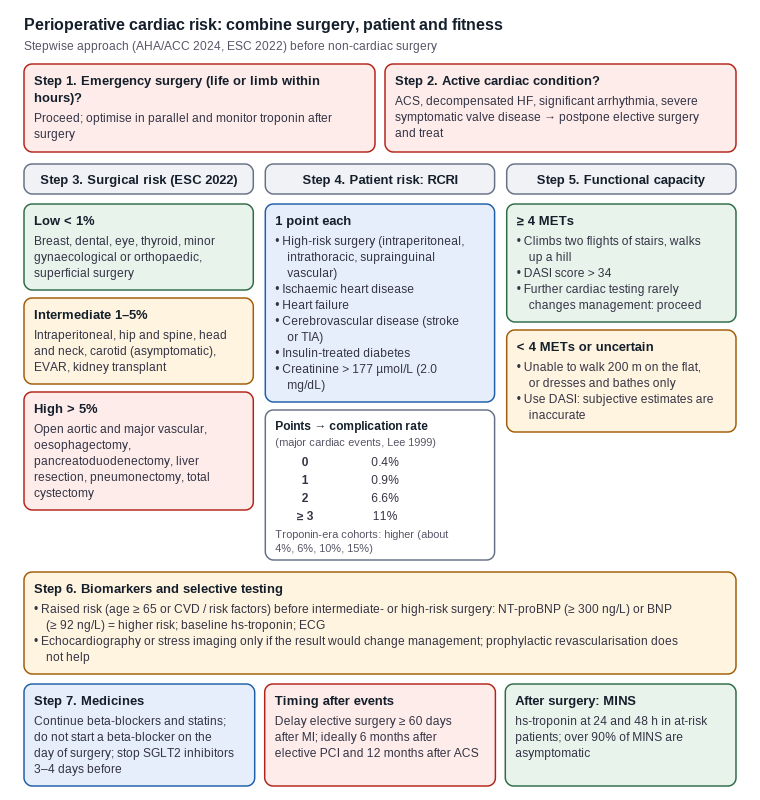
Major adverse cardiovascular events (MACE) – myocardial infarction or injury, heart failure, arrhythmia, stroke and cardiac death – are the leading medical causes of death after non-cardiac surgery. Preoperative assessment aims to estimate this risk, identify conditions that must be treated before elective surgery, and plan monitoring, not to 'clear' a patient. The approach is stepwise: urgency of surgery; active cardiac conditions (acute coronary syndrome, decompensated heart failure, unstable arrhythmia, severe symptomatic valve disease); intrinsic surgical risk (low <1%, intermediate 1–5%, high >5%); patient risk with a validated tool such as the Revised Cardiac Risk Index (RCRI) or the NSQIP calculator; and functional capacity (able to climb two flights of stairs, about 4 METs, or a DASI score above 34). Natriuretic peptides and baseline high-sensitivity troponin refine risk in older or higher-risk patients, while stress testing is reserved for results that would change management irrespective of surgery. Prophylactic revascularisation does not help, and starting high-dose beta-blockers on the day of surgery is harmful. Postoperative troponin surveillance detects myocardial injury after non-cardiac surgery (MINS), which is usually silent but predicts 30-day mortality.
Patient case, mechanism, investigations, management, flashcards and exam-style questions.Open the lesson →
Key facts
- Perioperative MACE affects roughly 1 in 30 adults having inpatient non-cardiac surgery and is the main medical cause of postoperative death
- Active cardiac conditions that postpone elective surgery: ACS, decompensated heart failure, significant arrhythmia, severe symptomatic aortic stenosis
- Surgical risk (ESC 2022): low <1% (breast, eye, dental, thyroid), intermediate 1–5% (intraperitoneal, hip, carotid, EVAR), high >5% (open aortic, oesophagectomy, pancreatoduodenectomy, pneumonectomy)
- RCRI has 6 items: high-risk surgery, ischaemic heart disease, heart failure, cerebrovascular disease, insulin-treated diabetes, creatinine >177 µmol/L (2 mg/dL)
- Good functional capacity (≥4 METs, two flights of stairs, DASI >34) means further cardiac testing rarely changes management
- NT-proBNP ≥300 ng/L or BNP ≥92 ng/L before surgery identifies higher risk (CCS 2017)
- MINS = postoperative troponin rise of ischaemic origin within 30 days; over 90% are asymptomatic but 30-day mortality rises with peak troponin
- Delay elective surgery at least 60 days after MI, ideally 6 months after elective PCI and 12 months after ACS
Differential diagnosis
| Condition | Clues | Key test |
|---|---|---|
| Acute coronary syndrome presenting preoperatively | Rest or crescendo chest pain, dynamic ECG changes | Serial hs-troponin and ECG; postpone elective surgery |
| Decompensated heart failure | Orthopnoea, raised JVP, crackles, oedema | NT-proBNP, chest X-ray, echocardiography |
| Severe aortic stenosis | Ejection systolic murmur radiating to carotids, slow-rising pulse, syncope | Transthoracic echocardiography (Vmax ≥4 m/s, mean gradient ≥40 mmHg) |
| Uncontrolled atrial fibrillation | Irregularly irregular pulse, rate >110/min | ECG, thyroid function, echocardiography |
| Pulmonary hypertension | Loud P2, right heart strain, exertional breathlessness | Echocardiography; right heart catheterisation if needed |
| Non-cardiac dyspnoea (COPD, anaemia, deconditioning) | Breathlessness without cardiac signs | Spirometry, FBC, natriuretic peptide to exclude HF |
| Hypertrophic obstructive cardiomyopathy | Murmur louder on Valsalva, young patient, syncope | Echocardiography |
Exam pearls
Guideline
2024 AHA/ACC multisociety guideline for perioperative cardiovascular management for non-cardiac surgery; 2022 ESC guidelines on cardiovascular assessment and management of patients undergoing non-cardiac surgery; Canadian Cardiovascular Society perioperative guideline (2017)
References
- Thompson A, Fleischmann KE, Smilowitz NR, et al.. 2024 AHA/ACC/ACS/ASNC/HRS/SCA/SCCT/SCMR/SVM Guideline for Perioperative Cardiovascular Management for Noncardiac Surgery: A Report of the American College of Cardiology/American Heart Association Joint Committee on Clinical Practice Guidelines. Circulation 2024.
- Halvorsen S, Mehilli J, Cassese S, et al.. 2022 ESC Guidelines on cardiovascular assessment and management of patients undergoing non-cardiac surgery. Eur Heart J 2022.
- Duceppe E, Parlow J, MacDonald P, et al.. Canadian Cardiovascular Society Guidelines on Perioperative Cardiac Risk Assessment and Management for Patients Who Undergo Noncardiac Surgery. Can J Cardiol 2017.
- Lee TH, Marcantonio ER, Mangione CM, et al.. Derivation and prospective validation of a simple index for prediction of cardiac risk of major noncardiac surgery. Circulation 1999.
- Gupta PK, Gupta H, Sundaram A, et al.. Development and validation of a risk calculator for prediction of cardiac risk after surgery. Circulation 2011.
- Devereaux PJ, Yang H, Yusuf S, et al.. Effects of extended-release metoprolol succinate in patients undergoing non-cardiac surgery (POISE trial): a randomised controlled trial. Lancet 2008.
Related topics
By Dr Khalid Seidi (B.Sc., M.D.) · MedEd World Clinical Knowledge library. Original teaching content checked against current guidelines (November 2026); confirm the latest local guidance before clinical use. Not a substitute for clinical judgement.