Clinical Knowledge › Internal medicine › Basics of internal medicine › Perioperative medicine
Perioperative management of diabetes
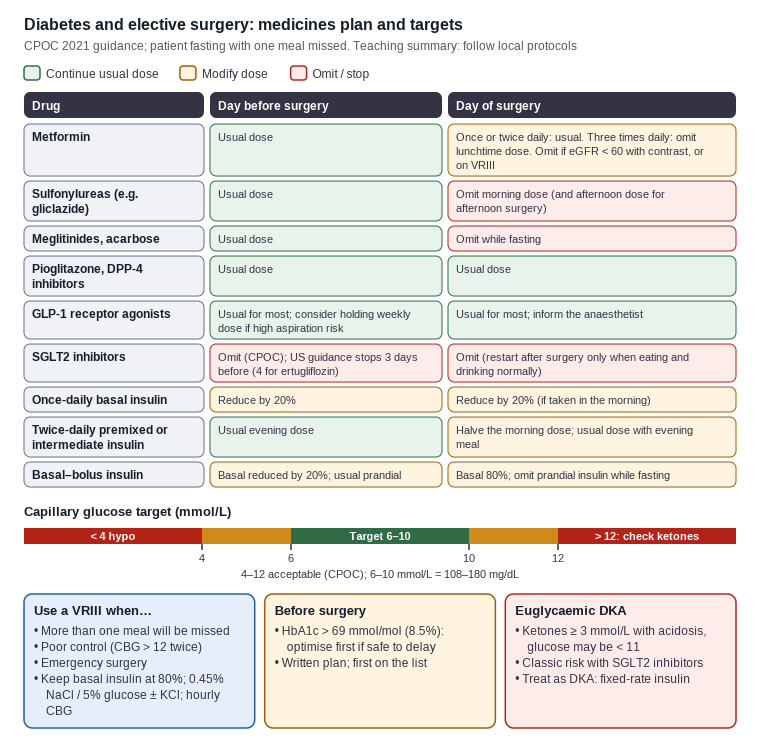
About 1 in 6 surgical inpatients has diabetes, and they have more infections, myocardial events, acute kidney injury, longer stays and higher mortality than people without it. Surgical stress raises cortisol, catecholamines and glucagon, causing insulin resistance and hyperglycaemia, while fasting and missed doses risk hypoglycaemia and, in insulin-deficient patients or those taking SGLT2 inhibitors, ketoacidosis. Good care starts in primary care and preoperative clinic: check HbA1c (UK guidance refers for optimisation above 69 mmol/mol, 8.5%), screen for complications, and give a written medicines plan. Patients go first on the list. Most oral agents are continued or omitted only on the day of surgery; sulfonylureas are omitted while fasting, SGLT2 inhibitors are stopped in advance, and basal insulin is continued at about 80% of the usual dose. Patients expected to miss more than one meal, those with poor control and most emergency cases need a variable-rate intravenous insulin infusion with glucose-containing fluid while basal insulin continues. The perioperative glucose target is 6–10 mmol/L (4–12 acceptable). After surgery, usual treatment restarts with eating, and ketones are checked in anyone unwell on an SGLT2 inhibitor.
Patient case, mechanism, investigations, management, flashcards and exam-style questions.Open the lesson →
Key facts
- Perioperative capillary glucose target 6–10 mmol/L (108–180 mg/dL); 4–12 mmol/L acceptable (CPOC)
- Refer for optimisation before elective surgery if HbA1c >69 mmol/mol (8.5%) when safe to delay (UK); ADA suggests below 64 mmol/mol (8%) where feasible
- Put people with diabetes first on the operating list to shorten fasting
- Continue basal (long-acting) insulin at about 80% of the usual dose; never stop basal insulin in type 1 diabetes
- Omit sulfonylureas and meglitinides while fasting; metformin is usually continued unless more than one meal is missed or contrast with eGFR <60
- SGLT2 inhibitors: omit the day before and day of surgery (CPOC); FDA/ADA advise stopping 3 days before (4 for ertugliflozin)
- Use a VRIII when more than one meal will be missed, glucose is poorly controlled, or surgery is emergency; keep basal insulin running
- Euglycaemic DKA: ketones ≥3 mmol/L and acidosis with glucose that may be below 11 mmol/L – classic risk with SGLT2 inhibitors
Differential diagnosis
| Condition | Clues | Key test |
|---|---|---|
| Stress hyperglycaemia without known diabetes | High glucose, HbA1c <48 mmol/mol | HbA1c; treat glucose >10 mmol/L |
| Undiagnosed diabetes | HbA1c ≥48 mmol/mol on admission | HbA1c; plan follow-up |
| Diabetic ketoacidosis | Glucose >11 mmol/L, ketones ≥3 mmol/L, pH <7.3 | Blood ketones, venous gas |
| Euglycaemic DKA (SGLT2 inhibitor) | Nausea, abdominal pain, normal-ish glucose | Blood ketones and venous pH |
| Hyperosmolar hyperglycaemic state | Glucose >30 mmol/L, osmolality >320, no significant ketosis | Serum osmolality, ketones |
| Steroid-induced hyperglycaemia | Afternoon/evening rise after dexamethasone or prednisolone | CBG profile; morning NPH/isophane insulin |
| Hypoglycaemia from residual sulfonylurea | Confusion or delayed waking while fasting | CBG; IV glucose |
Exam pearls
Guideline
Centre for Perioperative Care (CPOC) guideline for perioperative care of people with diabetes undergoing elective and emergency surgery (2021, with later amendments); ADA Standards of Care in Diabetes 2026, section 16; multisociety GLP-1 receptor agonist perioperative guidance (2024)
References
- Centre for Perioperative Care (CPOC) and Diabetes UK. Guideline for perioperative care for people with diabetes mellitus undergoing elective and emergency surgery. CPOC, London 2021.
- American Diabetes Association Professional Practice Committee. 16. Diabetes care in the hospital: Standards of Care in Diabetes—2026. Diabetes Care 2026.
- Kindel TL, Wang AY, Wadhwa A, et al.. Multisociety clinical practice guidance for the safe use of glucagon-like peptide-1 receptor agonists in the perioperative period. Surg Obes Relat Dis 2024.
- Dhatariya K, Levy N, Russon K, et al.. Perioperative use of glucagon-like peptide-1 receptor agonists and sodium-glucose cotransporter 2 inhibitors for diabetes mellitus. Br J Anaesth 2024.
- Frisch A, Chandra P, Smiley D, et al.. Prevalence and clinical outcome of hyperglycemia in the perioperative period in noncardiac surgery. Diabetes Care 2010.
- Korytkowski MT, Muniyappa R, Antinori-Lent K, et al.. Management of hyperglycemia in hospitalized adult patients in non-critical care settings: an Endocrine Society clinical practice guideline. J Clin Endocrinol Metab 2022.
Related topics
By Dr Khalid Seidi (B.Sc., M.D.) · MedEd World Clinical Knowledge library. Original teaching content checked against current guidelines (November 2026); confirm the latest local guidance before clinical use. Not a substitute for clinical judgement.