Clinical Knowledge › Internal medicine › Basics of internal medicine › Perioperative medicine
Perioperative corticosteroid cover
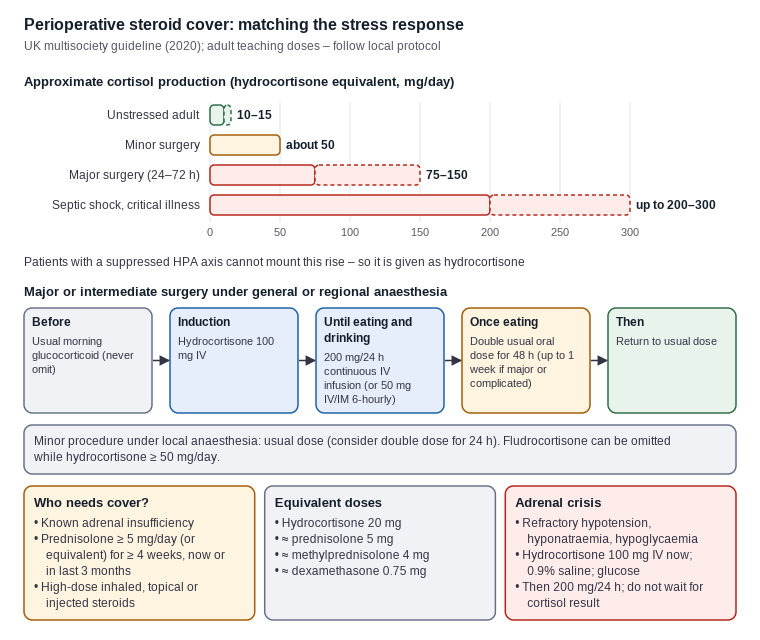
Surgery is a major physiological stress that normally increases cortisol secretion several-fold for 24–72 hours. Patients with adrenal insufficiency – primary (Addison disease, congenital adrenal hyperplasia, adrenalectomy), secondary (pituitary disease) or, most commonly, tertiary from long-term glucocorticoid therapy – cannot mount this response and may develop perioperative adrenal crisis with refractory hypotension, hypoglycaemia, hyponatraemia and death. Anyone who has taken the equivalent of prednisolone 5 mg or more daily for 4 weeks or longer, or high-dose inhaled, topical or injected steroids, should be assumed to have a suppressed hypothalamic–pituitary–adrenal axis. Their usual glucocorticoid must never be omitted, and extra 'stress' cover is given in proportion to the operation: for major surgery under general or regional anaesthesia, hydrocortisone 100 mg IV at induction followed by 200 mg every 24 hours by continuous infusion (or 50 mg every 6 hours) until eating, then double the usual oral dose for 48 hours or longer after complicated surgery. Minor procedures need less. Unexplained intraoperative hypotension in an at-risk patient should be treated with hydrocortisone. Steroid emergency cards, sick-day rules and clear documentation prevent avoidable crises.
Patient case, mechanism, investigations, management, flashcards and exam-style questions.Open the lesson →
Key facts
- Normal adult cortisol production is only about 10–15 mg/day of hydrocortisone equivalent (5–10 mg/m²; oral replacement doses are 15–25 mg/day because of incomplete bioavailability); major surgery raises it to roughly 75–150 mg/day for 24–72 h
- Assume HPA suppression with prednisolone ≥5 mg/day (or equivalent) for ≥4 weeks, or high-dose inhaled, topical or intra-articular steroids
- Equivalent doses: hydrocortisone 20 mg ≈ prednisolone 5 mg ≈ methylprednisolone 4 mg ≈ dexamethasone 0.75 mg
- Major surgery: hydrocortisone 100 mg IV at induction, then 200 mg/24 h infusion (or 50 mg IV/IM 6-hourly) until eating and drinking
- After recovery: double the usual oral dose for 48 h (up to a week after major or complicated surgery), then usual dose
- Hydrocortisone ≥50 mg/day has enough mineralocorticoid activity; fludrocortisone can be omitted while on high doses
- Etomidate inhibits 11β-hydroxylase and can precipitate adrenal crisis
- Unexplained, fluid- and vasopressor-resistant hypotension in an at-risk patient: give hydrocortisone 100 mg IV immediately
Differential diagnosis
| Condition | Clues | Key test |
|---|---|---|
| Perioperative adrenal crisis | Hypotension unresponsive to fluids and vasopressors, hyponatraemia, hypoglycaemia | Treat empirically; random cortisol before hydrocortisone if no delay |
| Septic shock | Fever, source of infection, raised lactate | Cultures, lactate, imaging |
| Hypovolaemia / haemorrhage | Falling Hb, drain output, tachycardia | FBC, examine wounds, respond to fluids |
| Anaphylaxis | Rash, bronchospasm, after drug or latex | Mast cell tryptase |
| Anaesthetic drug effect (neuraxial block, vasodilators) | Timing with drug, responds to vasopressor | Clinical |
| Cardiogenic shock / perioperative MI | Chest pain, ECG change, troponin rise | ECG, troponin, echocardiography |
| Hypothyroidism / myxoedema coma | Hypothermia, bradycardia | TSH, free T4 (give steroids before thyroxine) |
Exam pearls
Guideline
Association of Anaesthetists/RCP/Society for Endocrinology guideline on glucocorticoids in the perioperative period (2020); ESE/Endocrine Society joint guideline on glucocorticoid-induced adrenal insufficiency (2024); NICE NG243 Adrenal insufficiency (2024); Society for Endocrinology adrenal crisis emergency guidance (2016)
References
- Woodcock T, Barker P, Daniel S, et al.. Guidelines for the management of glucocorticoids during the peri-operative period for patients with adrenal insufficiency: Guidelines from the Association of Anaesthetists, the Royal College of Physicians and the Society for Endocrinology UK. Anaesthesia 2020.
- Beuschlein F, Else T, Bancos I, et al.. European Society of Endocrinology and Endocrine Society Joint Clinical Guideline: Diagnosis and Therapy of Glucocorticoid-induced Adrenal Insufficiency. J Clin Endocrinol Metab 2024.
- Bornstein SR, Allolio B, Arlt W, et al.. Diagnosis and Treatment of Primary Adrenal Insufficiency: An Endocrine Society Clinical Practice Guideline. J Clin Endocrinol Metab 2016.
- Arlt W; Society for Endocrinology Clinical Committee.. Society for Endocrinology Endocrine Emergency Guidance: Emergency management of acute adrenal insufficiency (adrenal crisis) in adult patients. Endocr Connect 2016.
- Rushworth RL, Torpy DJ, Falhammar H.. Adrenal Crisis. N Engl J Med 2019.
- National Institute for Health and Care Excellence (NICE). Adrenal insufficiency: identification and management (NG243). NICE guideline 2024.
Related topics
By Dr Khalid Seidi (B.Sc., M.D.) · MedEd World Clinical Knowledge library. Original teaching content checked against current guidelines (November 2026); confirm the latest local guidance before clinical use. Not a substitute for clinical judgement.