Clinical Knowledge › Urology › Scrotal and penile conditions
Peyronie disease
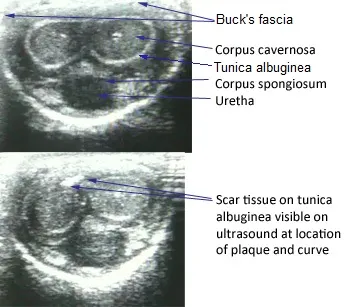
Peyronie disease is an acquired, localised fibrotic disorder of the tunica albuginea of the penis. A fibrous, sometimes calcified, plaque forms, usually dorsally, after repeated microtrauma in genetically predisposed men, and leads to penile curvature, indentation or hourglass deformity, shortening, painful erections and erectile dysfunction. It affects about 3–9% of men, mostly in their 50s, and is linked with Dupuytren contracture, plantar fibromatosis, diabetes and erectile dysfunction. The disease has an active (inflammatory) phase of 6–18 months with pain and changing deformity, followed by a stable phase. Diagnosis is clinical, supported by an objective assessment of the erect penis, ideally after an in-office intracavernosal injection. Treatment depends on phase: analgesia and counselling in the active phase (oral supplements are largely ineffective), penile traction or intralesional collagenase or verapamil for selected stable deformities, and surgery (plication, plaque incision with grafting, or penile prosthesis) once the disease has been stable for at least 3–6 months.
Patient case, mechanism, investigations, management, flashcards and exam-style questions.Open the lesson →
Key facts
- Peyronie disease = acquired fibrosis of the tunica albuginea causing curvature, indentation, shortening, pain and erectile dysfunction
- Prevalence about 3–9% of adult men; peak in the sixth decade; often under-reported because of embarrassment
- Dorsal curvature is commonest because most plaques form on the dorsal tunica; a palpable plaque is found in most men
- Associated with Dupuytren contracture, plantar fibromatosis (Ledderhose), diabetes, erectile dysfunction and radical prostatectomy
- Active phase (6–18 months): painful erections and changing deformity; stable phase: no pain and no change in deformity for at least 3 months
- Psychological distress and depression are common: assess bother, relationship and erectile function
- Oral agents (vitamin E, tamoxifen, potassium aminobenzoate, carnitine) have little or no proven benefit for curvature
- Surgery only in stable disease: plication for simpler curvature with good erections, grafting for severe or complex deformity, prosthesis if erectile dysfunction is refractory
Differential diagnosis
| Condition | Clues | Key test |
|---|---|---|
| Congenital penile curvature | Young man, curvature since puberty, usually ventral or lateral, no plaque, no pain | Examination; history since adolescence |
| Penile fracture | Acute snap during intercourse, rapid detumescence and haematoma | Clinical; ultrasound or MRI |
| Post-priapism corporal fibrosis | Previous prolonged priapism, diffuse firmness and shortening | History; MRI shows diffuse fibrosis |
| Penile cancer or metastasis to the corpora | Hard irregular mass, systemic features, known pelvic cancer | MRI and biopsy |
| Mondor disease of the penis | Cord-like thrombosed superficial dorsal vein, no curvature | Doppler ultrasound |
| Erectile dysfunction without deformity | Poor rigidity, no plaque or curvature | IIEF score; examination |
Exam pearls
Guideline
EAU Sexual and Reproductive Health guidelines 2025 update (penile curvature) and 2026 edition, AUA Peyronie's disease guideline 2015 (amended), and ICSM 2024 recommendations (published 2026)
References
- Salonia A, Capogrosso P, Boeri L, et al.. European Association of Urology Guidelines on Male Sexual and Reproductive Health: 2025 Update on Male Hypogonadism, Erectile Dysfunction, Premature Ejaculation, and Peyronie's Disease. Eur Urol 2025.
- European Association of Urology. EAU Guidelines on Sexual and Reproductive Health (2026 edition). EAU Guidelines Office, Arnhem 2026.
- Nehra A, Alterowitz R, Culkin DJ, et al.. Peyronie's Disease: AUA Guideline. J Urol 2015.
- Chung E, Ziegelmann M, Lin HC, et al.. Management of Peyronie's disease: recommendations from the Fifth International Consultation on Sexual Medicine (ICSM 2024). Sex Med Rev 2026.
- Gelbard M, Goldstein I, Hellstrom WJ, et al.. Clinical efficacy, safety and tolerability of collagenase clostridium histolyticum for the treatment of peyronie disease in 2 large double-blind, randomized, placebo controlled phase 3 studies. J Urol 2013.
- Tienforti D, Hoxha M, Di Pasquale AB, Rizza V, Barbonetti A. Analysis of evidence on nutraceutical interventions for Peyronie's disease: a guideline-based critical review. Sex Med Rev 2024.
Related topics
By Dr Khalid Seidi (B.Sc., M.D.) · MedEd World Clinical Knowledge library. Original teaching content checked against current guidelines (November 2026); confirm the latest local guidance before clinical use. Not a substitute for clinical judgement.