Clinical Knowledge › Urology › Scrotal and penile conditions
Phimosis and paraphimosis
Phimosis is inability to retract the foreskin (prepuce) over the glans. In young boys a non-retractile foreskin is physiological and needs no treatment. Pathological phimosis is a scarred, non-elastic preputial ring, most often from lichen sclerosus (balanitis xerotica obliterans) or recurrent balanoposthitis; in adults, new phimosis should prompt testing for diabetes and careful examination for penile cancer, for which phimosis is a risk factor. Mild cases respond to a potent topical steroid for 4–8 weeks; scarred or refractory phimosis needs circumcision, with histology in adults. Paraphimosis is a urological emergency: a retracted foreskin trapped behind the coronal sulcus forms a constricting band, causing venous and lymphatic congestion, painful oedema and, if untreated, ischaemia. It is often iatrogenic, after catheterisation or cleaning when the foreskin is not returned. Treatment is prompt analgesia (penile block or topical anaesthetic), reduction of oedema by compression, and manual reduction; failure requires a dorsal slit, with later elective circumcision.
Patient case, mechanism, investigations, management, flashcards and exam-style questions.Open the lesson →
Key facts
- Physiological phimosis is normal in young boys (preputial adhesions); fewer than 1–2% still have a non-retractile foreskin in late adolescence
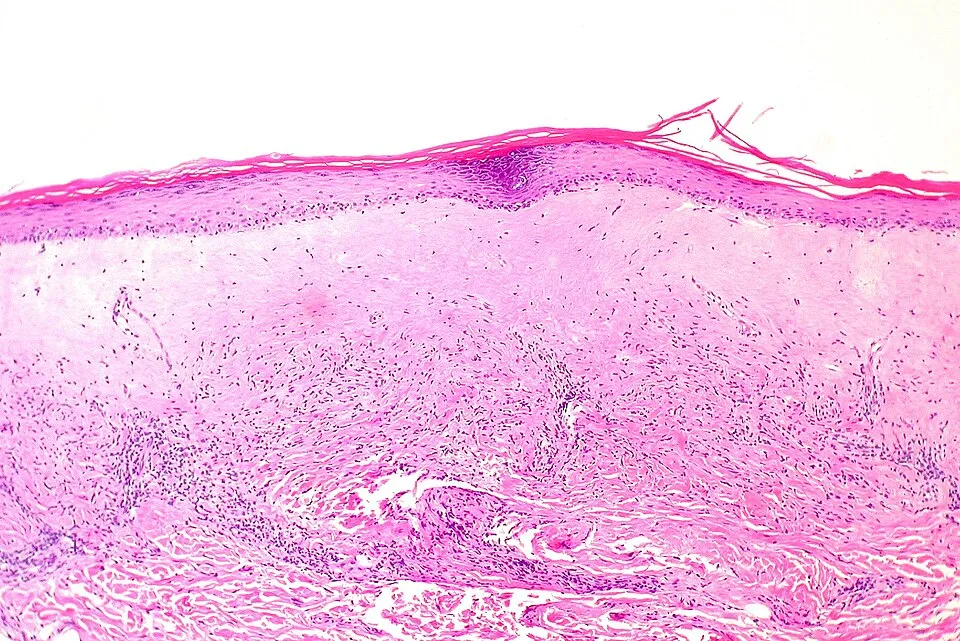
- Pathological phimosis: scarred white non-elastic ring; commonest cause lichen sclerosus (balanitis xerotica obliterans)
- New phimosis in an adult: check HbA1c or glucose (candidal balanoposthitis) and examine for penile cancer; SGLT2 inhibitors increase genital candidiasis
- First-line for phimosis: potent topical corticosteroid (for example betamethasone 0.1% or clobetasol propionate 0.05%) for 4–8 weeks with gentle stretching
- Circumcision indications: pathological phimosis or lichen sclerosus not responding to steroids, recurrent balanoposthitis, recurrent paraphimosis, selected recurrent UTI in boys with urinary tract anomalies
- Paraphimosis = retracted foreskin trapped behind the corona; urological emergency because of risk of glans ischaemia
- Commonest cause of paraphimosis in adults: failure to replace the foreskin after catheterisation, cystoscopy or washing
- Paraphimosis treatment: analgesia (penile block with plain local anaesthetic), compress oedema, manual reduction; dorsal slit if reduction fails
Differential diagnosis
| Condition | Clues | Key test |
|---|---|---|
| Physiological phimosis | Young boy, healthy foreskin, ballooning on voiding, no scarring | Clinical; no treatment |
| Lichen sclerosus (BXO) | White sclerotic ring, meatal involvement, itch, bleeding | Clinical; biopsy or histology of foreskin |
| Candidal balanoposthitis with diabetes | Itchy red glans and prepuce, fissures, recurrent | Swab, HbA1c or glucose |
| Penile cancer hidden by phimosis | Older man, discharge, bleeding, palpable mass under foreskin | Examination under anaesthesia; biopsy; dorsal slit if needed |
| Penile oedema without paraphimosis (angioedema, insect bite, cellulitis) | Foreskin can still be brought forward; no constricting band | Clinical; allergy history |
| Penile tourniquet (hair, band, ring) | Constricting object, often in toddlers or after sexual activity | Careful inspection; removal |
| Balanitis without phimosis | Inflamed glans, foreskin retractile | Swab for Candida, bacteria; STI testing |
Exam pearls
Guideline
EAU/ESPU Guidelines on Paediatric Urology (2025 edition, phimosis and paraphimosis); British Association of Dermatologists guidelines for lichen sclerosus (2018); EAU-ASCO Penile Cancer guideline (2023)
References
- European Association of Urology / European Society for Paediatric Urology. EAU/ESPU Guidelines on Paediatric Urology (section on phimosis and paraphimosis). EAU Guidelines Office, Arnhem 2025.
- Lewis FM, Tatnall FM, Velangi SS, et al.. British Association of Dermatologists guidelines for the management of lichen sclerosus, 2018. Br J Dermatol 2018.
- European Association of Urology / American Society of Clinical Oncology. EAU-ASCO Collaborative Guidelines on Penile Cancer. EAU Guidelines Office, Arnhem 2023.
- Pohlman GD, Phillips JM, Wilcox DT. Simple method of paraphimosis reduction revisited: point of technique and review of the literature. J Pediatr Urol 2013.
- Choe JM. Paraphimosis: current treatment options. Am Fam Physician 2000.
- Partin AW, Dmochowski RR, Kavoussi LR, Peters CA, eds.. Campbell-Walsh-Wein Urology. 2020.
Related topics
By Dr Khalid Seidi (B.Sc., M.D.) · MedEd World Clinical Knowledge library. Original teaching content checked against current guidelines (November 2026); confirm the latest local guidance before clinical use. Not a substitute for clinical judgement.