Clinical Knowledge › Ear, nose and throat › Neck and salivary glands
Pleomorphic adenoma
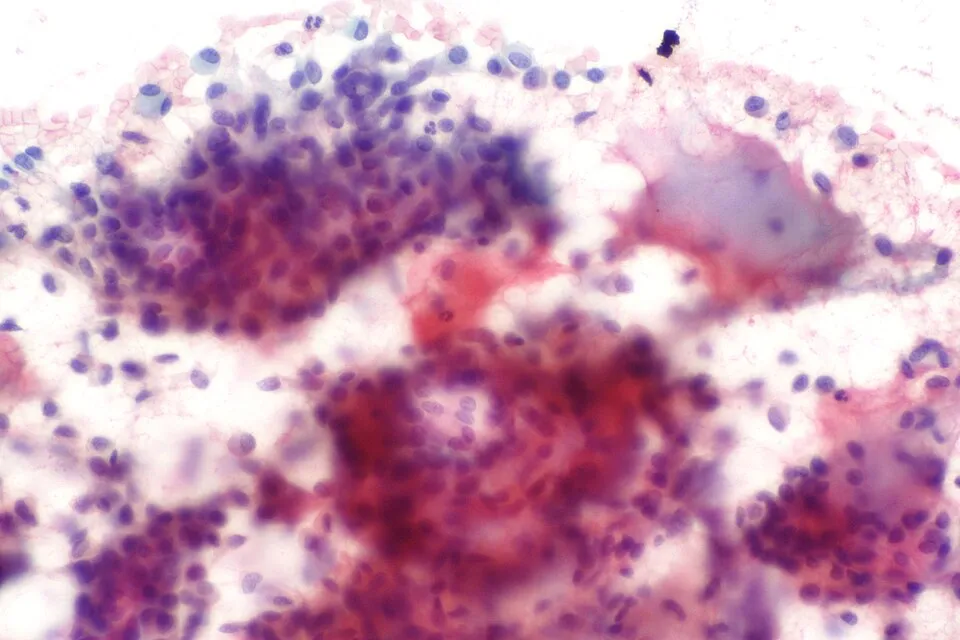
Pleomorphic adenoma is the commonest salivary gland tumour, making up most benign parotid tumours. It is a benign mixed tumour of epithelial and myoepithelial cells within a chondromyxoid stroma, usually driven by PLAG1 or HMGA2 gene rearrangements. It typically presents in adults aged 30–60, more often women, as a slow-growing, painless, firm, mobile lump in the tail of the parotid with normal facial nerve function. Ultrasound with ultrasound-guided fine-needle aspiration, reported with the Milan system, is the standard work-up; MRI shows a lobulated, very bright T2 lesion and maps deep or parapharyngeal extension. The tumour has an incomplete capsule with finger-like extensions, so simple enucleation leads to recurrence. Treatment is complete excision with a cuff of normal tissue, usually partial or superficial parotidectomy with facial nerve identification, or extracapsular dissection for small mobile superficial tumours. Untreated tumours can undergo malignant change (carcinoma ex pleomorphic adenoma), and recurrences are often multinodular.
Patient case, mechanism, investigations, management, flashcards and exam-style questions.Open the lesson →
Key facts
- Commonest salivary neoplasm; about 80% arise in the parotid, mostly the superficial lobe (often the tail); palate is the commonest minor-gland site
- Painless, slow-growing, firm, mobile, lobulated mass with a normal facial nerve
- Histology: epithelial and myoepithelial cells in chondromyxoid stroma (biphasic); PLAG1 or HMGA2 rearrangements
- Incomplete capsule with pseudopodia and satellite nodules: enucleation causes recurrence
- Ultrasound plus US-guided FNA (Milan category IVa 'Neoplasm: benign'); MRI is bright on T2 and maps deep-lobe extension
- Treatment: complete excision with margin, partial/superficial parotidectomy or extracapsular dissection, preserving the facial nerve
- Malignant transformation (carcinoma ex pleomorphic adenoma) risk rises with duration; warning signs are rapid growth, pain and facial palsy
- Parotidectomy complications: facial nerve weakness, Frey syndrome, greater auricular nerve numbness, sialocele, first-bite syndrome
Differential diagnosis
| Condition | Clues | Key test |
|---|---|---|
| Warthin tumour | Older male smoker, soft or cystic, parotid tail, may be bilateral or multifocal | Ultrasound/FNA: oncocytic cells and lymphoid stroma; uptake on technetium scan |
| Mucoepidermoid carcinoma | Rapid growth, pain, facial weakness, fixation, nodes | FNA/core biopsy; MRI |
| Adenoid cystic carcinoma | Pain, numbness, perineural spread, facial palsy | Biopsy; MRI with nerve imaging |
| Intraparotid lymph node / lymphoma | Associated scalp skin cancer or B symptoms | Ultrasound with FNA or core biopsy |
| Branchial cleft (first arch) cyst | Cystic, recurrent infection, near ear canal | Ultrasound/MRI |
| Sialadenitis or stone | Painful, meal-related, inflammatory | Ultrasound |
| Lipoma or neurofibroma | Soft, superficial or fusiform along a nerve | Ultrasound/MRI |
Exam pearls
Guideline
Management of Salivary Gland Tumours: UK National Multidisciplinary Guidelines (2016), with the WHO 5th edition head and neck tumour classification (2022), Milan System for Reporting Salivary Gland Cytopathology 2nd edition (2023/2024) and European Salivary Gland Society parotidectomy classification (2017)
References
- Sood S, McGurk M, Vaz F. Management of Salivary Gland Tumours: United Kingdom National Multidisciplinary Guidelines. J Laryngol Otol 2016.
- Skálová A, Hyrcza MD, Leivo I. Update from the 5th Edition of the World Health Organization Classification of Head and Neck Tumors: Salivary Glands. Head Neck Pathol 2022.
- Rossi ED, Baloch Z, Barkan G, et al.. Second edition of the Milan System for Reporting Salivary Gland Cytopathology: Refining the role of salivary gland FNA. J Am Soc Cytopathol 2024.
- Quer M, Vander Poorten V, Takes RP, et al.. Surgical options in benign parotid tumors: a proposal for classification. Eur Arch Otorhinolaryngol 2017.
- Albergotti WG, Nguyen SA, Zenk J, Gillespie MB. Extracapsular dissection for benign parotid tumors: a meta-analysis. Laryngoscope 2012.
- Witt RL, Eisele DW, Morton RP, et al.. Etiology and management of recurrent parotid pleomorphic adenoma. Laryngoscope 2015.
Related topics
By Dr Khalid Seidi (B.Sc., M.D.) · MedEd World Clinical Knowledge library. Original teaching content checked against current guidelines (November 2026); confirm the latest local guidance before clinical use. Not a substitute for clinical judgement.