Clinical Knowledge › Ear, nose and throat › Neck and salivary glands
Thyroglossal duct cyst
A thyroglossal duct cyst is the commonest congenital midline neck mass. It forms from a persistent remnant of the thyroglossal duct, the tract along which the thyroid descends from the foramen caecum of the tongue to the lower neck in early fetal life. The cyst usually lies in the midline at or just below the hyoid bone. Because the tract is tied to the hyoid and tongue base, the lump rises on swallowing and on protruding the tongue. Most present in children under 10, but about a third present in adults. The classic picture is a painless, smooth, fluctuant midline lump that may swell or become infected after an upper respiratory infection. Ultrasound confirms a cyst and, crucially, shows a normal thyroid gland in its usual place, so the patient's only thyroid tissue is not removed. Infection is treated with antibiotics first, avoiding incision. Definitive treatment is the Sistrunk operation, which removes the cyst, the tract, the central hyoid and a cuff of tongue-base tissue; recurrence is about 3–5%. About 1% contain carcinoma, almost always papillary thyroid cancer.
Patient case, mechanism, investigations, management, flashcards and exam-style questions.Open the lesson →
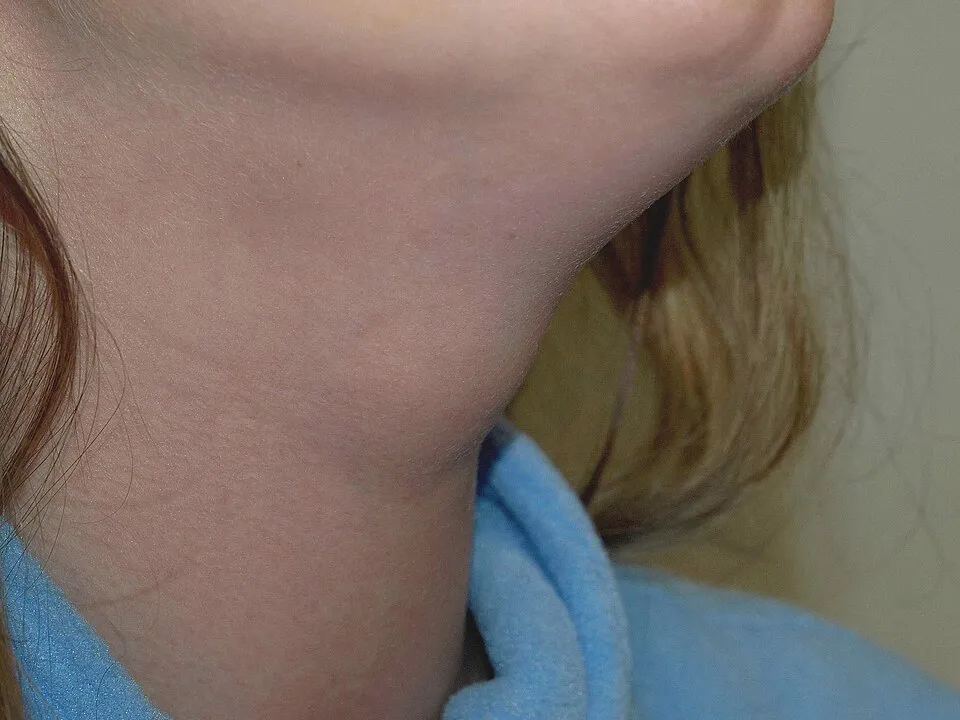
Key facts
- Commonest congenital neck mass; usually midline at or just below the hyoid (about two-thirds infrahyoid)
- Thyroid descends from the foramen caecum (junction of anterior two-thirds and posterior third of tongue), passing anterior to the hyoid; duct normally involutes by about week 10
- Moves up with swallowing and with tongue protrusion (thyroid nodules move with swallowing only)
- Most diagnosed under 10 years; often first noticed when infected after an upper respiratory infection
- Before surgery, ultrasound (with TFTs) must confirm normal thyroid tissue in the normal position: ectopic thyroid may be the only functioning thyroid
- Sistrunk operation: cyst, tract, central hyoid body and tongue-base core; recurrence about 3–5% versus up to 50% after simple excision
- Infected cyst: antibiotics and aspiration if needed; avoid incision and drainage, which causes a sinus and higher recurrence
- Carcinoma in about 1%, over 90% papillary; often found only on final histology
Differential diagnosis
| Condition | Clues | Key test |
|---|---|---|
| Dermoid cyst | Midline, often submental; moves with skin, not with tongue protrusion | Ultrasound (echogenic contents); histology |
| Ectopic thyroid | Solid midline lump; may be the only thyroid tissue; possible hypothyroidism | Ultrasound, TFTs, radionuclide scan |
| Thyroid nodule or goitre (pyramidal lobe) | Lower in neck; moves with swallowing but not tongue protrusion | Ultrasound, TFTs, FNA by U-score |
| Reactive or malignant lymph node (Delphian node) | Firm, may be multiple; infection or cancer history | Ultrasound, FNA |
| Lipoma or sebaceous cyst | Superficial; punctum in sebaceous cyst | Clinical; ultrasound |
| Plunging ranula | Submandibular extension, floor-of-mouth swelling | Ultrasound or MRI |
| Branchial cyst | Lateral, anterior to sternocleidomastoid | Ultrasound |
Exam pearls
Guideline
No dedicated guideline; standard of care is the Sistrunk procedure (1920) with modern systematic reviews (paediatric modified Sistrunk meta-analysis 2026; thyroglossal duct carcinoma reviews 2017 and 2025) and the AAO-HNS Evaluation of the Neck Mass in Adults guideline (2017)
References
- Sistrunk WE. The surgical treatment of cysts of the thyroglossal tract. Ann Surg 1920.
- Shaaban H, et al.. Outcomes of modified Sistrunk procedure for pediatric thyroglossal duct cyst removal: systematic review and meta-analysis. OTO Open 2026.
- Rayess HM, Monk I, Svider PF, et al.. Thyroglossal duct cyst carcinoma: a systematic review of clinical features and outcomes. Otolaryngol Head Neck Surg 2017.
- Thimsen V, et al.. Thyroglossal duct cyst carcinomas - a retrospective study and systematic review of the literature. Virchows Arch 2025.
- Ibrahim FF, Alnoury MK, Varma N, Daniel SJ. Surgical management outcomes of recurrent thyroglossal duct cyst in children - a systematic review. Int J Pediatr Otorhinolaryngol 2015.
- Pynnonen MA, Gillespie MB, Roman B, et al.. Clinical practice guideline: evaluation of the neck mass in adults. Otolaryngol Head Neck Surg 2017.
Related topics
By Dr Khalid Seidi (B.Sc., M.D.) · MedEd World Clinical Knowledge library. Original teaching content checked against current guidelines (November 2026); confirm the latest local guidance before clinical use. Not a substitute for clinical judgement.