Clinical Knowledge › Ear, nose and throat › Neck and salivary glands
Warthin tumour
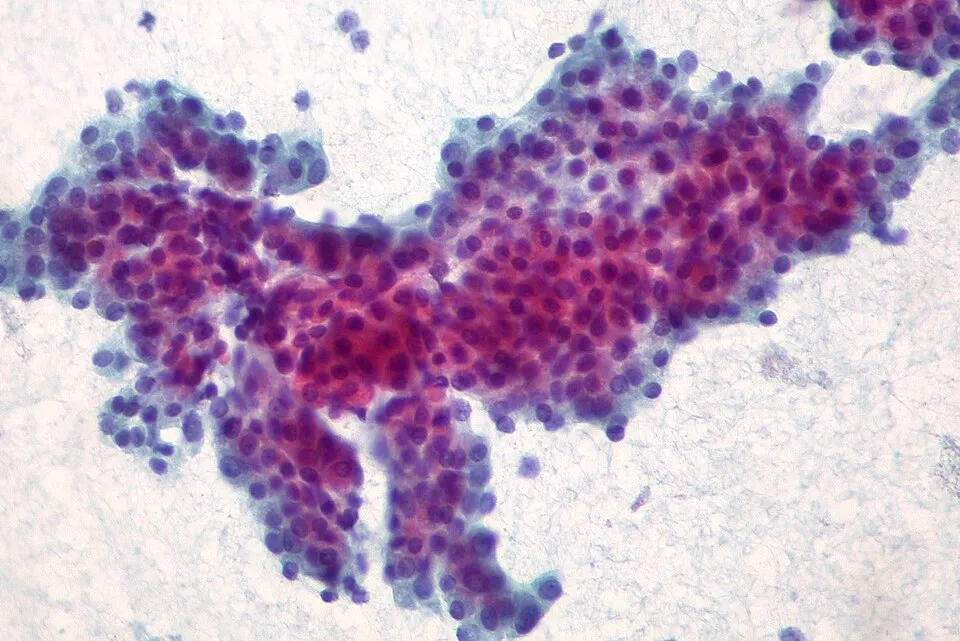
Warthin tumour (papillary cystadenoma lymphomatosum) is the second commonest benign salivary tumour and occurs almost only in the parotid, typically the tail. It affects people over 50, is strongly linked to cigarette smoking, and is the salivary tumour most likely to be bilateral or multifocal. Histologically it has cystic spaces lined by a double layer of mitochondria-rich oncocytic cells over a dense lymphoid stroma with germinal centres. Patients present with a slow-growing, painless, soft or fluctuant lump at the angle of the jaw with normal facial nerve function. Ultrasound shows a well-defined hypoechoic mass with cystic areas; ultrasound-guided FNA shows oncocytes with lymphocytes in a proteinaceous background. It is 'hot' on technetium-99m and FDG-PET scans. Malignant change is very rare. Once the diagnosis is secure, active surveillance is reasonable for older or frail patients; symptomatic, growing or uncertain lesions are removed by extracapsular dissection or partial superficial parotidectomy. Smoking cessation is advised.
Patient case, mechanism, investigations, management, flashcards and exam-style questions.Open the lesson →
Key facts
- Second commonest benign salivary tumour; almost exclusively parotid (lower pole/tail) and periparotid nodes
- Older adults (peak 60s); strong association with smoking; sex ratio has equalised as smoking patterns changed
- Most frequently bilateral or multifocal salivary tumour (synchronous or metachronous), especially in heavy smokers
- Histology: papillary cysts lined by a double layer of oncocytic epithelium over lymphoid stroma with germinal centres
- Oncocytes are packed with mitochondria: 'hot' on technetium-99m pertechnetate scintigraphy and FDG-avid on PET
- FNA: sheets of oncocytes, lymphocytes and proteinaceous debris (Milan IVa); squamous metaplasia can mimic carcinoma
- Malignant transformation is very rare; observation is acceptable when cytology and imaging are concordant
- Surgery when symptomatic, enlarging or diagnosis uncertain: extracapsular dissection or partial superficial parotidectomy
Differential diagnosis
| Condition | Clues | Key test |
|---|---|---|
| Pleomorphic adenoma | Younger, often female, firm, single, bright on T2 MRI | US-guided FNA: chondromyxoid matrix |
| Intraparotid lymph node metastasis | Skin cancer of scalp, ear or face; firm, growing | FNA; examine skin |
| Lymphoma | Rubbery, Sjögren history, B symptoms | Core biopsy |
| Benign lymphoepithelial cysts (HIV) | Bilateral cystic parotid swellings in HIV | HIV test; ultrasound |
| Branchial cleft cyst | Younger patient, unilocular cyst, may become infected | Ultrasound; FNA |
| Mucoepidermoid carcinoma (low grade) | Cystic parotid mass; may mimic Warthin on FNA | Core biopsy; MAML2 rearrangement |
| Oncocytoma | Solid oncocytic tumour without lymphoid stroma | FNA; histology |
Exam pearls
Guideline
UK National Multidisciplinary Guidelines for salivary gland tumours (2016) with Milan System 2nd edition (2023/2024), WHO 5th edition classification (2022) and international consensus review on Warthin tumour management (2021)
References
- Quer M, Hernandez-Prera JC, Silver CE, et al.. Current Trends and Controversies in the Management of Warthin Tumor of the Parotid Gland. Diagnostics (Basel) 2021.
- Nishimura H, Kawata R, Kinoshita I, et al.. Management for Warthin Tumor of the Parotid Gland: Surgery or Observation. A 21-Year Retrospective Study of 387 Cases. Ear Nose Throat J 2024.
- Peter Klussmann J, Wittekindt C, Florian Preuss S, et al.. High risk for bilateral Warthin tumor in heavy smokers--review of 185 cases. Acta Otolaryngol 2006.
- Aoki R, Tanaka T. Pathogenesis of Warthin's Tumor: Neoplastic or Non-Neoplastic?. Cancers (Basel) 2024.
- Rossi ED, Baloch Z, Barkan G, et al.. Second edition of the Milan System for Reporting Salivary Gland Cytopathology: Refining the role of salivary gland FNA. J Am Soc Cytopathol 2024.
- Sood S, McGurk M, Vaz F. Management of Salivary Gland Tumours: United Kingdom National Multidisciplinary Guidelines. J Laryngol Otol 2016.
Related topics
By Dr Khalid Seidi (B.Sc., M.D.) · MedEd World Clinical Knowledge library. Original teaching content checked against current guidelines (November 2026); confirm the latest local guidance before clinical use. Not a substitute for clinical judgement.