Clinical Knowledge › Ear, nose and throat › Neck and salivary glands
Salivary gland malignancy
Salivary gland cancers are rare, histologically varied tumours of the parotid, submandibular, sublingual and minor salivary glands. The smaller the gland, the higher the chance a tumour is malignant: about a fifth of parotid tumours, around half of submandibular tumours and most minor-gland tumours. Mucoepidermoid carcinoma is the commonest type (and the commonest in children); adenoid cystic carcinoma spreads along nerves; salivary duct carcinoma is aggressive and often HER2- or androgen-receptor-positive. Red flags are pain, rapid growth, facial nerve weakness, fixation, skin involvement, numbness and neck nodes. Work-up is ultrasound with guided FNA or core biopsy (Milan system), MRI for local and perineural extent, and CT or PET-CT for staging; open biopsy is avoided. Treatment is surgical excision with facial nerve preservation unless the nerve is invaded, neck dissection for nodal or high-risk disease, and postoperative radiotherapy for adverse features. Recurrent or metastatic disease is treated according to biomarkers such as HER2, androgen receptor and NTRK fusions.
Patient case, mechanism, investigations, management, flashcards and exam-style questions.Open the lesson →
Key facts
- Malignancy risk by site: parotid about 20–25%, submandibular about 40–50%, sublingual and minor glands the majority
- Mucoepidermoid carcinoma: commonest salivary cancer in adults and children; CRTC1–MAML2 fusion; graded low, intermediate or high
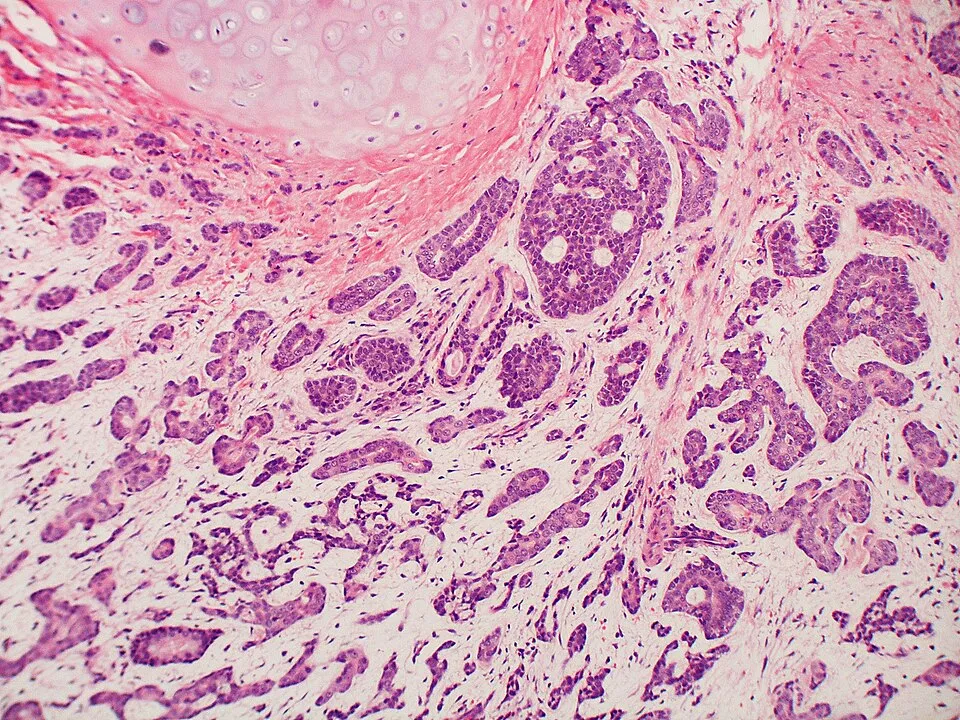
- Adenoid cystic carcinoma: cribriform pattern, MYB–NFIB fusion, perineural spread, late lung metastases, long natural history
- Salivary duct carcinoma: high grade, resembles breast ductal carcinoma; frequently androgen-receptor-positive and often HER2-positive
- Secretory carcinoma carries ETV6–NTRK3: responds to TRK inhibitors (larotrectinib, entrectinib)
- Facial nerve palsy with a parotid mass indicates malignancy until proved otherwise
- Staging: AJCC/UICC TNM (version 9 from 2026 unifies major and minor glands; N1 = 1–3 nodes without ENE, N2 = more than 3 nodes or any ENE; stage IV = M1 only)
- Postoperative radiotherapy for high grade, T3–T4, close or positive margins, perineural invasion or nodal disease (ASCO 2021)
Differential diagnosis
| Condition | Clues | Key test |
|---|---|---|
| Pleomorphic adenoma | Slow, painless, mobile, facial nerve normal | US-guided FNA (Milan IVa) |
| Warthin tumour | Older smoker, soft, parotid tail, bilateral | FNA: oncocytes and lymphocytes |
| Intraparotid metastasis (cutaneous SCC or melanoma) | History of scalp, ear or facial skin cancer; sun-exposed older patient | FNA; skin examination; PET-CT |
| Lymphoma (MALT) | Sjögren syndrome, bilateral or persistent parotid enlargement | Core biopsy with flow cytometry |
| Chronic sialadenitis / IgG4-related disease | Recurrent inflammatory swelling; firm submandibular glands | Ultrasound; IgG4; biopsy |
| Bell palsy with incidental parotid swelling | Sudden complete palsy, no mass | MRI if palsy does not recover or is progressive |
| First branchial cleft anomaly | Recurrent infection near ear and parotid | MRI/ultrasound |
Exam pearls
Guideline
ASCO Guideline: Management of Salivary Gland Malignancy (2021) and ESMO–EURACAN Clinical Practice Guideline (2022), with AJCC/UICC TNM version 9 for salivary gland carcinoma (2026) and Milan System 2nd edition (2023/2024)
References
- Geiger JL, Ismaila N, Beadle B, et al.. Management of Salivary Gland Malignancy: ASCO Guideline. J Clin Oncol 2021.
- van Herpen C, Vander Poorten V, Skalova A, et al.. Salivary gland cancer: ESMO-European Reference Network on Rare Adult Solid Cancers (EURACAN) Clinical Practice Guideline for diagnosis, treatment and follow-up. ESMO Open 2022.
- Skálová A, Hyrcza MD, Leivo I. Update from the 5th Edition of the World Health Organization Classification of Head and Neck Tumors: Salivary Glands. Head Neck Pathol 2022.
- Rossi ED, Baloch Z, Barkan G, et al.. Second edition of the Milan System for Reporting Salivary Gland Cytopathology: Refining the role of salivary gland FNA. J Am Soc Cytopathol 2024.
- Huang SH, Seethala RR, Patel SG, et al.. Key Updates on the Version 9 AJCC/UICC Staging System for Salivary Gland Carcinoma. Ann Surg Oncol 2026.
- Huang SH, Cotler J, Palis B, et al.. Proposed Version Nine of the AJCC and UICC TNM Classification for Salivary Gland Carcinoma. JAMA Otolaryngol Head Neck Surg 2026.
Related topics
By Dr Khalid Seidi (B.Sc., M.D.) · MedEd World Clinical Knowledge library. Original teaching content checked against current guidelines (November 2026); confirm the latest local guidance before clinical use. Not a substitute for clinical judgement.