Clinical Knowledge › Internal medicine › Haematology and oncology › Lymphoid neoplasms
Acute lymphoblastic leukaemia (ALL)
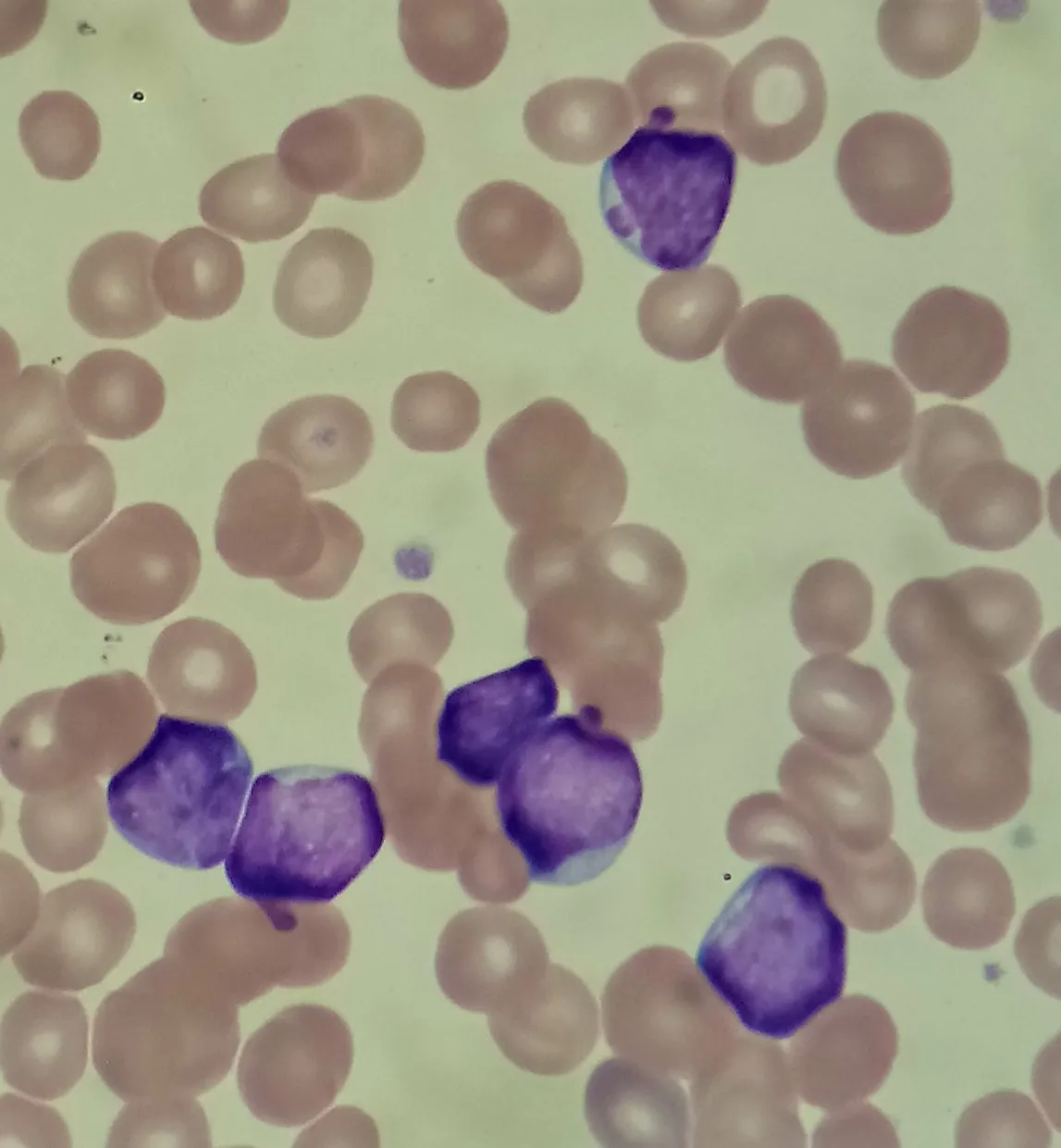
Acute lymphoblastic leukaemia (ALL) is a malignancy of B- or T-lymphoid precursors (lymphoblasts) that replace the marrow and may infiltrate lymph nodes, spleen, liver, the central nervous system, testes and, in T-ALL, the mediastinum. It is the commonest childhood cancer, peaking at 2–5 years, with a second rise in older adults. Children present with pallor, bruising, fever, bone pain or limp, lymphadenopathy and hepatosplenomegaly; adolescents with T-ALL may have a mediastinal mass. Diagnosis needs a blood film, bone marrow, flow cytometry (TdT, CD19/CD10 or cytoplasmic CD3), cytogenetics and molecular tests, and CSF examination. Treatment is risk-adapted multi-agent chemotherapy over about 2–3 years (induction, consolidation, CNS-directed therapy, intensification and maintenance), guided by measurable residual disease (MRD). Tyrosine kinase inhibitors treat Philadelphia-positive ALL, and blinatumomab, inotuzumab ozogamicin and CAR-T cells have transformed B-ALL care. Cure rates are about 90% in children and 40–60% in adults.
Patient case, mechanism, investigations, management, flashcards and exam-style questions.Open the lesson →
Key facts
- ALL is the commonest childhood malignancy (about 25% of childhood cancers), peak age 2–5 years; about 85% are B-ALL
- Lymphoblasts are TdT positive and myeloperoxidase negative; B-ALL expresses CD19, CD10, CD22, CD79a; T-ALL expresses cytoplasmic CD3 and CD7
- Favourable genetics in children: high hyperdiploidy and ETV6::RUNX1 t(12;21); adverse: KMT2A rearrangement (infants), hypodiploidy, Ph-like, BCR::ABL1 t(9;22)
- Philadelphia chromosome occurs in about 25% of adult ALL (rising with age) and is treated with a TKI
- Bone pain, limp or refusal to walk in a child with cytopenias is ALL until proven otherwise; T-ALL causes a mediastinal mass and SVC obstruction
- MRD after induction is the strongest prognostic factor and directs intensification, blinatumomab or transplant
- Maintenance uses daily oral mercaptopurine and weekly methotrexate; check TPMT/NUDT15 to avoid severe myelosuppression
- Vincristine must never be given intrathecally (fatal); asparaginase causes pancreatitis, thrombosis and hypersensitivity
Differential diagnosis
| Condition | Clues | Key test |
|---|---|---|
| Acute myeloid leukaemia | Older adults, gum hypertrophy, DIC, Auer rods | MPO positive, myeloid markers on flow cytometry |
| Aplastic anaemia | Pancytopenia without organomegaly or blasts | Hypocellular trephine |
| Immune thrombocytopenia | Isolated thrombocytopenia in a well child | Normal Hb and WBC, normal film |
| Infectious mononucleosis or other viral illness | Fever, lymphadenopathy, splenomegaly, atypical lymphocytes | EBV serology; no blasts; marrow normal |
| Juvenile idiopathic arthritis or osteomyelitis | Bone or joint pain and fever | Cytopenias and high LDH favour ALL; look at the film |
| Neuroblastoma or other small round blue cell tumour | Child with marrow infiltration and abdominal mass | Urinary catecholamines, imaging, marrow histology |
| Lymphoblastic lymphoma | Mediastinal or nodal mass with under 20–25% marrow blasts | Tissue biopsy; same disease spectrum as ALL |
Exam pearls
Guideline
NCCN Acute Lymphoblastic Leukemia guidelines (2025–2026 versions), ESMO ALL guideline 2016 and WHO 5th edition (2022) / ICC 2022 classifications
References
- Hoelzer D, Bassan R, Dombret H, et al.. Acute lymphoblastic leukaemia in adult patients: ESMO Clinical Practice Guidelines for diagnosis, treatment and follow-up. Ann Oncol 2016.
- Alaggio R, Amador C, Anagnostopoulos I, et al.. The 5th edition of the World Health Organization Classification of Haematolymphoid Tumours: lymphoid neoplasms. Leukemia 2022.
- Arber DA, Orazi A, Hasserjian RP, et al.. International Consensus Classification of myeloid neoplasms and acute leukemias: integrating morphologic, clinical, and genomic data. Blood 2022.
- Litzow MR, Sun Z, Mattison RJ, et al.. Blinatumomab for MRD-negative acute lymphoblastic leukemia in adults. N Engl J Med 2024.
- Foà R, Bassan R, Vitale A, et al.. Dasatinib–blinatumomab for Ph-positive acute lymphoblastic leukemia in adults. N Engl J Med 2020.
- Hunger SP, Mullighan CG. Acute lymphoblastic leukemia in children. N Engl J Med 2015.
Related topics
By Dr Khalid Seidi (B.Sc., M.D.) · MedEd World Clinical Knowledge library. Original teaching content checked against current guidelines (November 2026); confirm the latest local guidance before clinical use. Not a substitute for clinical judgement.