Clinical Knowledge › Internal medicine › Haematology and oncology › Lymphoid neoplasms
Hairy cell leukaemia
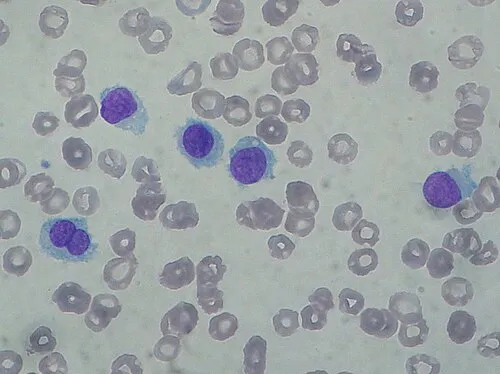
Hairy cell leukaemia (HCL) is a rare, chronic mature B-cell neoplasm in which small lymphoid cells with fine circumferential cytoplasmic projections infiltrate the bone marrow, splenic red pulp and liver. It mainly affects middle-aged men (median age about 55; male to female about 4:1). Almost all classic cases carry the BRAF V600E mutation, which constitutively activates MEK–ERK signalling. Patients present with fatigue, infections and left upper quadrant fullness; typical findings are pancytopenia with marked monocytopenia, splenomegaly without lymphadenopathy and a 'dry tap' marrow aspirate caused by reticulin fibrosis. Flow cytometry shows bright CD20 with CD11c, CD25, CD103 and CD123; annexin A1 immunostaining and BRAF V600E testing confirm the diagnosis. Treatment starts when cytopenias or symptoms develop: a single course of cladribine (or pentostatin), often with rituximab, gives complete remission in most patients and remissions lasting a decade or more. BRAF inhibitors with rituximab are used at relapse or when purine analogues are unsafe. Life expectancy is near normal.
Patient case, mechanism, investigations, management, flashcards and exam-style questions.Open the lesson →
Key facts
- Rare (about 2% of leukaemias); middle-aged men; median age about 55; male to female about 4:1
- BRAF V600E mutation in more than 95% of classic HCL; absent in HCL variant (splenic B-cell lymphoma/leukaemia with prominent nucleoli in WHO 2022)
- Pancytopenia with characteristic monocytopenia, splenomegaly (often massive) and usually no lymphadenopathy
- Hairy cells: oval nucleus, pale cytoplasm with circumferential projections; historically TRAP-positive
- Flow cytometry: CD19+, CD20 bright, CD11c+, CD25+, CD103+, CD123+, CD200 bright; CD5− and usually CD10−; annexin A1+ on immunohistochemistry
- Marrow aspirate is often a 'dry tap' from reticulin fibrosis; trephine shows a 'fried-egg' interstitial infiltrate
- Treat when Hb below 110 g/L, platelets below 100 × 10⁹/L, neutrophils below 1.0 × 10⁹/L, symptomatic splenomegaly or recurrent infection
- First line: cladribine (or pentostatin) ± rituximab; relapse: repeat purine analogue, vemurafenib or dabrafenib–trametinib with rituximab, or a BTK inhibitor
Differential diagnosis
| Condition | Clues | Key test |
|---|---|---|
| HCL variant / splenic B-cell lymphoma with prominent nucleoli | High white count with monocytes present | CD25− and annexin A1−, no BRAF V600E; responds poorly to cladribine alone |
| Splenic marginal zone lymphoma | Splenomegaly, villous lymphocytes | Polar villi, CD103− and CD25 usually −, annexin A1− |
| Splenic diffuse red pulp small B-cell lymphoma | Splenomegaly with mild lymphocytosis | CD103 variable, CD25−, annexin A1−, no BRAF V600E |
| Aplastic anaemia | Pancytopenia | No splenomegaly; hypocellular marrow without hairy cells |
| Primary myelofibrosis | Splenomegaly with dry tap | Teardrop cells, leucoerythroblastic film, JAK2/CALR/MPL mutation |
| Myelodysplastic syndrome | Pancytopenia in older adult | Dysplasia, no clonal B cells, spleen usually not enlarged |
| Chronic lymphocytic leukaemia | Lymphocytosis, splenomegaly | Lymphocytosis rather than pancytopenia; CD5+, CD23+, nodes |
Exam pearls
Guideline
Hairy Cell Leukemia Foundation updated international consensus guidelines for HCL and HCL variant (2026, replacing the 2017 guidelines), expert consensus on HCL in elderly patients (2025), NCCN Guidelines for hairy cell leukaemia (2026 version), WHO 5th edition and ICC (2022) classifications
References
- Zent CS, Tiacci E, Kreitman RJ, et al.. Updated consensus guidelines for the diagnosis and management of patients with HCL and HCL variant. Blood 2026.
- Grever MR, Abdel-Wahab O, Andritsos LA, et al.. Consensus guidelines for the diagnosis and management of patients with classic hairy cell leukemia. Blood 2017.
- Alaggio R, Amador C, Anagnostopoulos I, et al.. The 5th edition of the World Health Organization Classification of Haematolymphoid Tumours: Lymphoid Neoplasms. Leukemia 2022.
- Campo E, Jaffe ES, Cook JR, et al.. The International Consensus Classification of Mature Lymphoid Neoplasms: a report from the Clinical Advisory Committee. Blood 2022.
- Tiacci E, Trifonov V, Schiavoni G, et al.. BRAF mutations in hairy-cell leukemia. N Engl J Med 2011.
- Tiacci E, De Carolis L, Simonetti E, et al.. Vemurafenib plus rituximab in refractory or relapsed hairy-cell leukemia. N Engl J Med 2021.
Related topics
By Dr Khalid Seidi (B.Sc., M.D.) · MedEd World Clinical Knowledge library. Original teaching content checked against current guidelines (November 2026); confirm the latest local guidance before clinical use. Not a substitute for clinical judgement.