Clinical Knowledge › Internal medicine › Haematology and oncology › Lymphoid neoplasms
Diffuse large B-cell lymphoma (DLBCL)
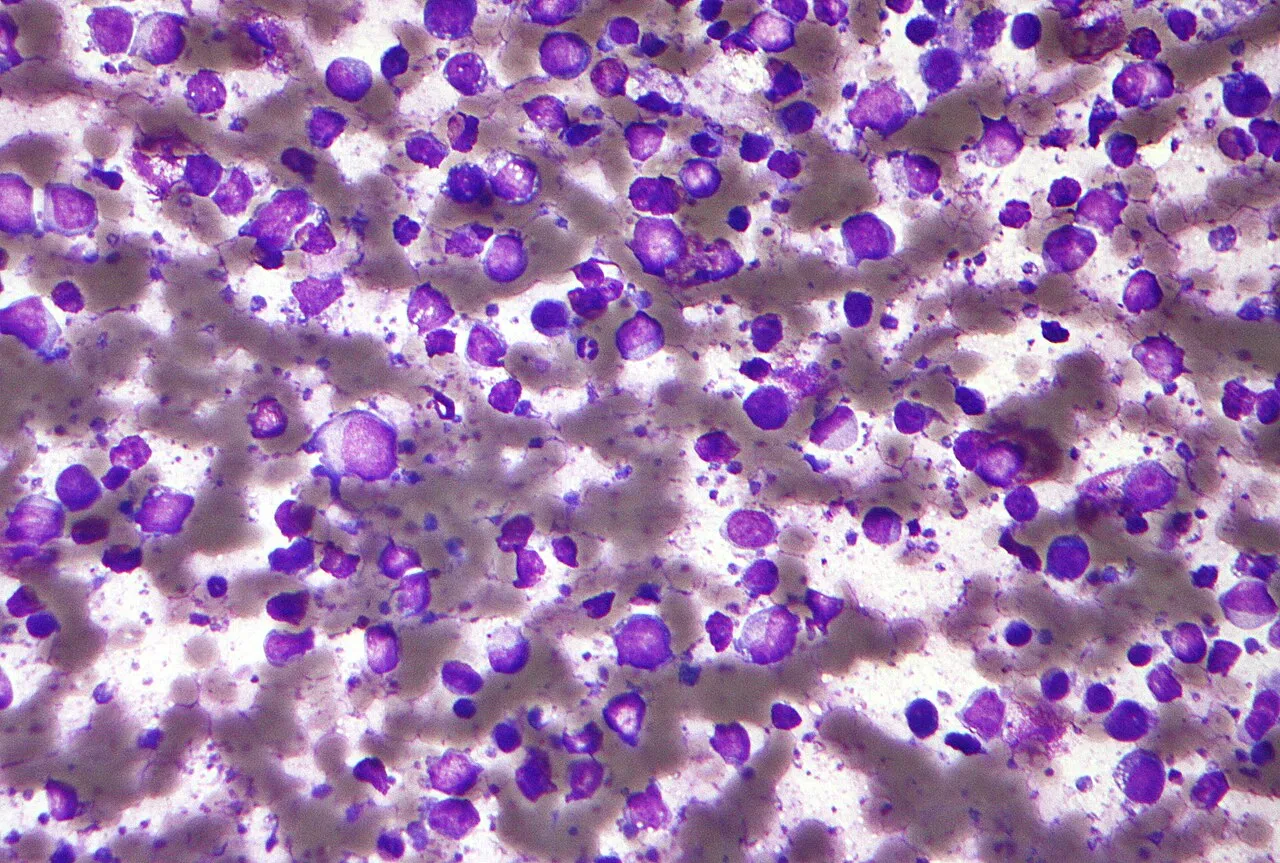
Diffuse large B-cell lymphoma is the commonest non-Hodgkin lymphoma and the prototype aggressive lymphoma. Sheets of large CD20+ B cells efface the lymph node; gene-expression subtypes (germinal centre B-cell-like and activated B-cell-like) and MYC, BCL2 and BCL6 rearrangements shape behaviour, and high-grade B-cell lymphoma with MYC and BCL2 rearrangements is now classified separately. It arises de novo or by transformation of follicular lymphoma or CLL (Richter transformation), with higher risk in HIV and transplant recipients. Typical patients are older adults with rapidly enlarging nodes or an extranodal mass (stomach, testis, bone, CNS), B symptoms and a raised LDH. Diagnosis requires excision or core biopsy; PET-CT stages disease (Lugano) and the International Prognostic Index guides risk. R-CHOP for six cycles cures about 60–70%; pola-R-CHP improves progression-free survival in intermediate-to-high-risk disease. Hepatitis B screening before rituximab, tumour lysis prophylaxis and CAR-T or bispecific antibodies for relapsed disease are key current points.
Patient case, mechanism, investigations, management, flashcards and exam-style questions.Open the lesson →
Key facts
- DLBCL accounts for about 30–40% of non-Hodgkin lymphomas; median age at diagnosis is about 65–70 years
- Histology: diffuse sheets of large B cells (CD19, CD20, CD79a, PAX5 positive) with high Ki-67; cell of origin by Hans algorithm (CD10, BCL6, MUM1)
- MYC plus BCL2 rearrangement ('double hit') defines high-grade B-cell lymphoma with MYC and BCL2 rearrangements (WHO 5th edition), with a worse outcome
- About 30–40% of cases are extranodal: GI tract (commonest), testis, bone, skin, CNS, Waldeyer ring
- International Prognostic Index: age above 60, raised LDH, ECOG performance status 2 or more, stage III–IV, more than one extranodal site
- First-line: R-CHOP every 21 days for 6 cycles (fewer for limited stage); pola-R-CHP is an option for IPI 2–5 (POLARIX)
- Screen for hepatitis B (HBsAg and anti-HBc) before rituximab: reactivation can cause fulminant hepatitis
- Relapse within 12 months or refractory disease: second-line CAR-T cell therapy (axi-cel, liso-cel); later lines include bispecific antibodies (glofitamab, epcoritamab)
Differential diagnosis
| Condition | Clues | Key test |
|---|---|---|
| Hodgkin lymphoma | Younger patients, contiguous nodal spread, itch, CD30+ CD15+ CD45− HRS cells | Excision biopsy with immunohistochemistry |
| Follicular lymphoma | Indolent, widespread small nodes for years, t(14;18) | Biopsy: follicular pattern, low proliferation |
| Burkitt lymphoma | Very rapid growth, abdominal mass, starry-sky pattern, Ki-67 near 100% | Biopsy with MYC FISH |
| Metastatic carcinoma or melanoma | Hard nodes, known primary, cytokeratin or S100 positive | Biopsy with immunohistochemistry |
| Tuberculosis | Fever, sweats, matted nodes, granulomas | Biopsy with culture and PCR |
| Reactive lymphadenopathy | Tender, small nodes with infection, resolve | Repeat examination; biopsy if persistent |
| Sarcoidosis | Bilateral hilar nodes, raised calcium, non-caseating granulomas | Biopsy, CT, ACE |
Exam pearls
Guideline
EHA Clinical Practice Guidelines for large B-cell lymphoma (2025), Lugano classification (2014) and WHO 5th edition/ICC (2022) classifications
References
- European Hematology Association (EHA). Large B-cell lymphoma (LBCL): EHA Clinical Practice Guidelines for diagnosis, treatment, and follow-up. HemaSphere 2025.
- Cheson BD, Fisher RI, Barrington SF, et al.. Recommendations for initial evaluation, staging, and response assessment of Hodgkin and non-Hodgkin lymphoma: the Lugano classification. J Clin Oncol 2014.
- Alaggio R, Amador C, Anagnostopoulos I, et al.. The 5th edition of the World Health Organization Classification of Haematolymphoid Tumours: Lymphoid Neoplasms. Leukemia 2022.
- Tilly H, Morschhauser F, Sehn LH, et al.. Polatuzumab vedotin in previously untreated diffuse large B-cell lymphoma. N Engl J Med 2022.
- Coiffier B, Lepage E, Briere J, et al.. CHOP chemotherapy plus rituximab compared with CHOP alone in elderly patients with diffuse large-B-cell lymphoma. N Engl J Med 2002.
- Locke FL, Miklos DB, Jacobson CA, et al.. Axicabtagene ciloleucel as second-line therapy for large B-cell lymphoma. N Engl J Med 2022.
Related topics
By Dr Khalid Seidi (B.Sc., M.D.) · MedEd World Clinical Knowledge library. Original teaching content checked against current guidelines (November 2026); confirm the latest local guidance before clinical use. Not a substitute for clinical judgement.