Clinical Knowledge › Internal medicine › Haematology and oncology › Lymphoid neoplasms
T-cell lymphomas (including mycosis fungoides)
Mature T-cell and NK-cell lymphomas are a varied group of neoplasms of post-thymic lymphocytes that make up about 10–15% of non-Hodgkin lymphomas in Europe and North America and more in East Asia. Nodal forms include peripheral T-cell lymphoma not otherwise specified, nodal T-follicular helper cell lymphoma (angioimmunoblastic type) and anaplastic large cell lymphoma (ALK-positive or ALK-negative). Extranodal forms include extranodal NK/T-cell lymphoma (EBV-driven, nasal), enteropathy-associated T-cell lymphoma (coeliac disease), hepatosplenic T-cell lymphoma and adult T-cell leukaemia/lymphoma (HTLV-1). Mycosis fungoides, the commonest primary cutaneous lymphoma, evolves slowly from patches to plaques and tumours; Sézary syndrome is its leukaemic, erythrodermic counterpart. Diagnosis needs biopsy with immunohistochemistry and T-cell clonality, then PET-CT or, for skin disease, TNMB staging. Early mycosis fungoides is treated with skin-directed therapy; nodal disease with CHOP-type chemotherapy, adding brentuximab vedotin for CD30-positive types, and transplant for selected patients.
Patient case, mechanism, investigations, management, flashcards and exam-style questions.Open the lesson →
Key facts
- Mature T/NK-cell lymphomas are about 10–15% of non-Hodgkin lymphomas in Western countries and up to a quarter in parts of East Asia
- Peripheral T-cell lymphoma, not otherwise specified (PTCL-NOS) is the commonest nodal subtype; most nodal types do worse than diffuse large B-cell lymphoma
- ALK-positive anaplastic large cell lymphoma affects children and young adults, is CD30-positive with t(2;5) NPM1::ALK and has the best prognosis
- Angioimmunoblastic (nodal TFH) lymphoma: older adult, generalised lymphadenopathy, rash, polyclonal hypergammaglobulinaemia and Coombs-positive haemolysis
- Extranodal NK/T-cell lymphoma is EBV-positive, destroys the nose and midline face, and needs asparaginase-based therapy plus radiotherapy
- Adult T-cell leukaemia/lymphoma follows HTLV-1 infection and causes hypercalcaemia, lytic lesions and 'flower cells' on the blood film
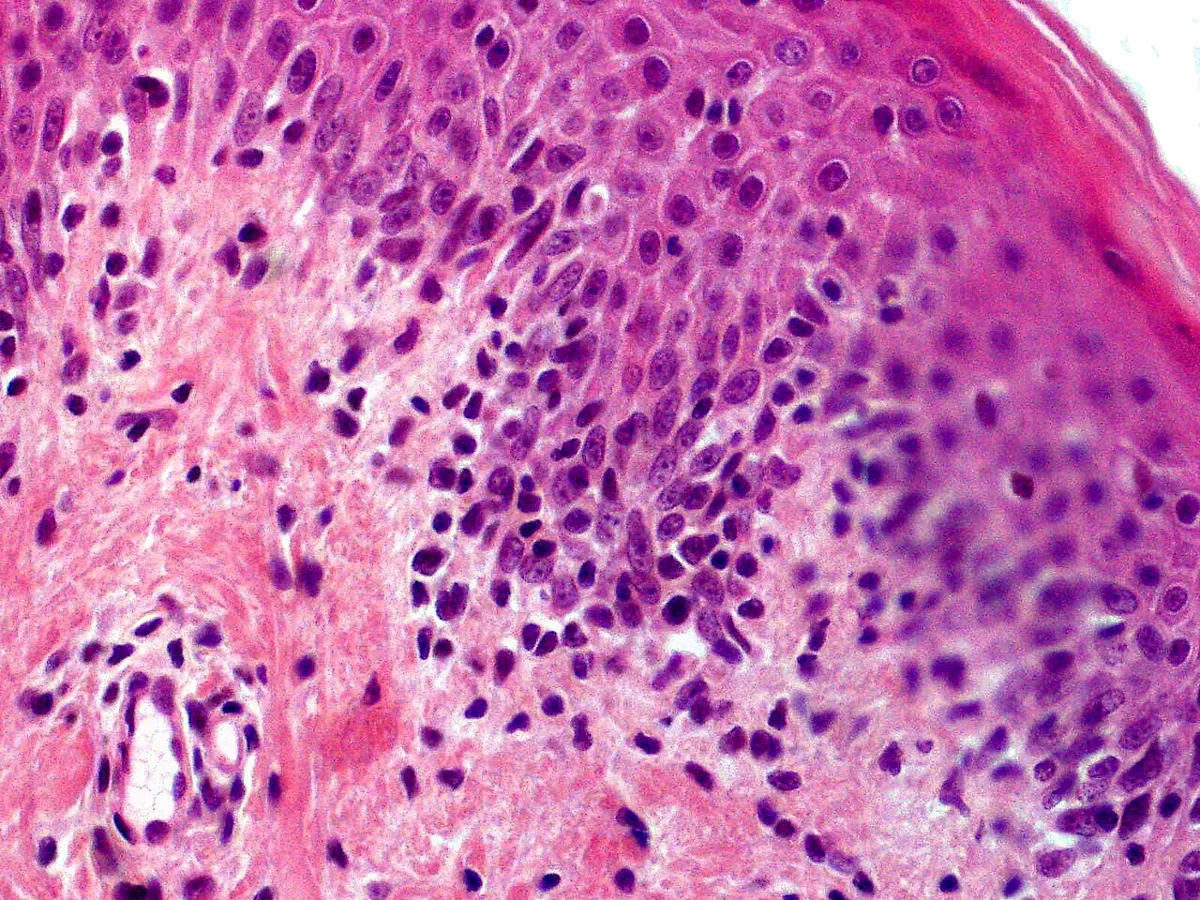
- Mycosis fungoides: patches and plaques in sun-protected skin, epidermotropic CD4+ cells with Pautrier microabscesses; early stage IA has near-normal life expectancy
- Sézary syndrome triad: erythroderma, generalised lymphadenopathy and clonal cerebriform T cells in blood (Sézary count ≥1000/µL or CD4:CD8 ratio ≥10)
Differential diagnosis
| Condition | Clues | Key test |
|---|---|---|
| Eczema or psoriasis (for early mycosis fungoides) | Itchy patches that respond fully to topical steroids; flexural or extensor rather than 'bathing trunk' distribution | Repeat skin biopsies off steroids with TCR clonality |
| Drug reaction or atopic erythroderma (for Sézary syndrome) | Recent drug exposure, eosinophilia, no clonal blood T cells | Blood flow cytometry (CD4:CD8, CD7/CD26 loss) and TCR clonality |
| Classical Hodgkin lymphoma | Young adult, mediastinal mass, CD30+ CD15+ Reed–Sternberg cells in a mixed background | Node excision with CD30, CD15, PAX5 and ALK immunostains |
| Diffuse large B-cell lymphoma | Rapidly enlarging nodes; CD20-positive large cells | Immunohistochemistry CD20/CD3 |
| Reactive or infectious lymphadenopathy (EBV, HIV, TB) | Tender nodes, short history, atypical lymphocytes | Serology, HIV test, node biopsy with culture |
| Granulomatosis with polyangiitis (for nasal NK/T-cell lymphoma) | Nasal destruction with renal and lung involvement, PR3-ANCA | Nasal biopsy with EBER in-situ hybridisation; ANCA |
| Coeliac crisis or refractory coeliac disease (for EATL) | Weight loss and diarrhoea despite gluten-free diet without perforation or mass | Endoscopic biopsy with aberrant T-cell immunophenotype; CT/PET |
Exam pearls
Guideline
ESMO–EHA Clinical Practice Guideline for peripheral T- and NK-cell lymphomas (2025), EORTC consensus recommendations for mycosis fungoides/Sézary syndrome – update 2023, ISCL/EORTC TNMB staging (2007) and WHO-HAEM5 / International Consensus Classification (2022)
References
- d'Amore F, Federico M, de Leval L, et al.. Peripheral T- and natural killer-cell lymphomas: ESMO–EHA Clinical Practice Guideline for diagnosis, treatment and follow-up. Ann Oncol 2025.
- Latzka J, Assaf C, Bagot M, et al.. EORTC consensus recommendations for the treatment of mycosis fungoides/Sézary syndrome – Update 2023. Eur J Cancer 2023.
- Olsen E, Vonderheid E, Pimpinelli N, et al.. Revisions to the staging and classification of mycosis fungoides and Sézary syndrome: a proposal of the ISCL and the cutaneous lymphoma task force of the EORTC. Blood 2007.
- Alaggio R, Amador C, Anagnostopoulos I, et al.. The 5th edition of the World Health Organization Classification of Haematolymphoid Tumours: Lymphoid Neoplasms. Leukemia 2022.
- Campo E, Jaffe ES, Cook JR, et al.. The International Consensus Classification of Mature Lymphoid Neoplasms: a report from the Clinical Advisory Committee. Blood 2022.
- Horwitz S, O'Connor OA, Pro B, et al.. Brentuximab vedotin with chemotherapy for CD30-positive peripheral T-cell lymphoma (ECHELON-2): a global, double-blind, randomised, phase 3 trial. Lancet 2019.
Related topics
By Dr Khalid Seidi (B.Sc., M.D.) · MedEd World Clinical Knowledge library. Original teaching content checked against current guidelines (November 2026); confirm the latest local guidance before clinical use. Not a substitute for clinical judgement.