Clinical Knowledge › Internal medicine › Gastroenterology and hepatology › Diseases of the pancreas
Acute pancreatitis
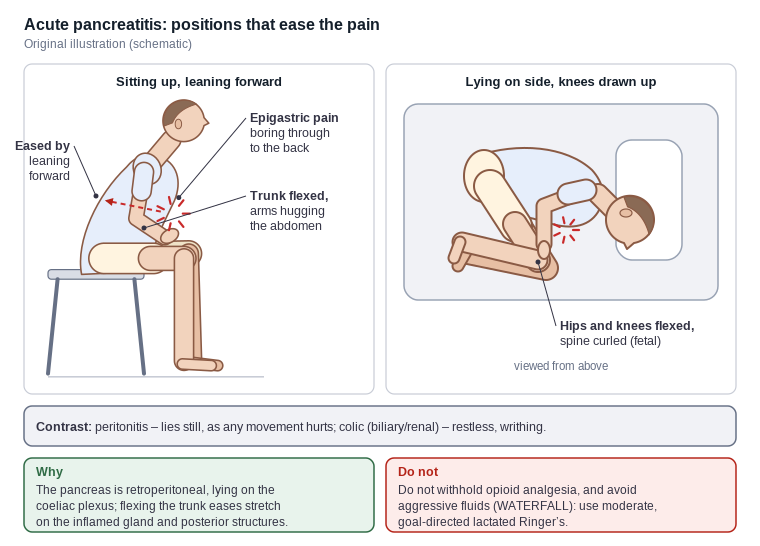
Acute pancreatitis is acute inflammation of the pancreas caused by premature activation of digestive enzymes within acinar cells. Gallstones and alcohol cause most cases; hypertriglyceridaemia, ERCP, drugs, hypercalcaemia and genetic factors account for many others. The diagnosis needs two of three features: typical epigastric pain radiating to the back, serum lipase or amylase at least three times the upper limit of normal, and characteristic imaging. The revised Atlanta classification grades severity by organ failure and local complications: most attacks are mild and settle within a week, but persistent organ failure beyond 48 hours defines severe disease with substantial mortality. Early care is supportive: goal-directed, moderate fluid resuscitation with lactated Ringer's solution (the WATERFALL trial showed harm from aggressive fluids), analgesia, early oral feeding, and no prophylactic antibiotics. Urgent ERCP is reserved for cholangitis, cholecystectomy should follow mild gallstone pancreatitis in the same admission, and infected necrosis is managed with a delayed step-up approach.
Patient case, mechanism, investigations, management, flashcards and exam-style questions.Open the lesson →
Key facts
- Diagnosis: two of three of typical pain, lipase or amylase at least 3 times the upper limit of normal, and characteristic imaging
- Gallstones and alcohol cause most cases; check triglycerides (above about 11.3 mmol/L or 1000 mg/dL) and calcium, and review drugs
- Revised Atlanta: mild (no organ failure or complications), moderately severe (transient organ failure under 48 hours or local complications), severe (persistent organ failure over 48 hours)
- Transabdominal ultrasound for gallstones in every patient; CT is not needed at presentation when the diagnosis is clear and is best after 72 hours if not improving
- Moderate, goal-directed lactated Ringer's resuscitation; aggressive fluids increased fluid overload without benefit (WATERFALL 2022)
- Early oral low-fat solid diet as tolerated within 24–48 hours; enteral rather than parenteral nutrition if feeding is not possible
- No prophylactic antibiotics; urgent ERCP only for cholangitis or persistent biliary obstruction
- Same-admission cholecystectomy for mild gallstone pancreatitis; infected necrosis: antibiotics and delayed step-up drainage once walled off
Differential diagnosis
| Condition | Clues | Key test |
|---|---|---|
| Perforated peptic ulcer | Sudden severe pain, peritonism, free gas | Erect chest X-ray or CT |
| Acute cholecystitis or cholangitis | Right upper quadrant pain, fever, Murphy sign, jaundice | Ultrasound, LFTs |
| Acute mesenteric ischaemia | Pain out of proportion, atrial fibrillation, raised lactate | CT angiography |
| Ruptured abdominal aortic aneurysm | Back pain, shock, pulsatile mass | Bedside ultrasound, CT angiography |
| Inferior myocardial infarction | Epigastric pain with ECG changes | ECG and troponin |
| Small bowel obstruction | Colicky pain, vomiting, distension | CT abdomen |
| Diabetic ketoacidosis | Abdominal pain, vomiting, raised amylase (lipase may be raised too) | Glucose, ketones, blood gas |
Exam pearls
Guideline
ACG guidelines on acute pancreatitis (2024), IAP revised guidelines on acute pancreatitis (2025) and the revised Atlanta classification (2012)
References
- Tenner S, Vege SS, Sheth SG, et al.. American College of Gastroenterology Guidelines: Management of Acute Pancreatitis. Am J Gastroenterol 2024.
- IAP/APA/EPC/IPC/JPS Working Group. International Association of Pancreatology Revised Guidelines on Acute Pancreatitis 2025. Pancreatology 2025.
- Banks PA, Bollen TL, Dervenis C, et al.; Acute Pancreatitis Classification Working Group.. Classification of acute pancreatitis—2012: revision of the Atlanta classification and definitions by international consensus. Gut 2013.
- de-Madaria E, Buxbaum JL, Maisonneuve P, et al.. Aggressive or Moderate Fluid Resuscitation in Acute Pancreatitis. N Engl J Med 2022.
- da Costa DW, Bouwense SA, Schepers NJ, et al.. Same-admission versus interval cholecystectomy for mild gallstone pancreatitis (PONCHO): a multicentre randomised controlled trial. Lancet 2015.
- van Santvoort HC, Besselink MG, Bakker OJ, et al.. A step-up approach or open necrosectomy for necrotizing pancreatitis. N Engl J Med 2010.
Related topics
By Dr Khalid Seidi (B.Sc., M.D.) · MedEd World Clinical Knowledge library. Original teaching content checked against current guidelines (November 2026); confirm the latest local guidance before clinical use. Not a substitute for clinical judgement.