Clinical Knowledge › Internal medicine › Gastroenterology and hepatology › Diseases of the pancreas
Pancreatic cystic neoplasms
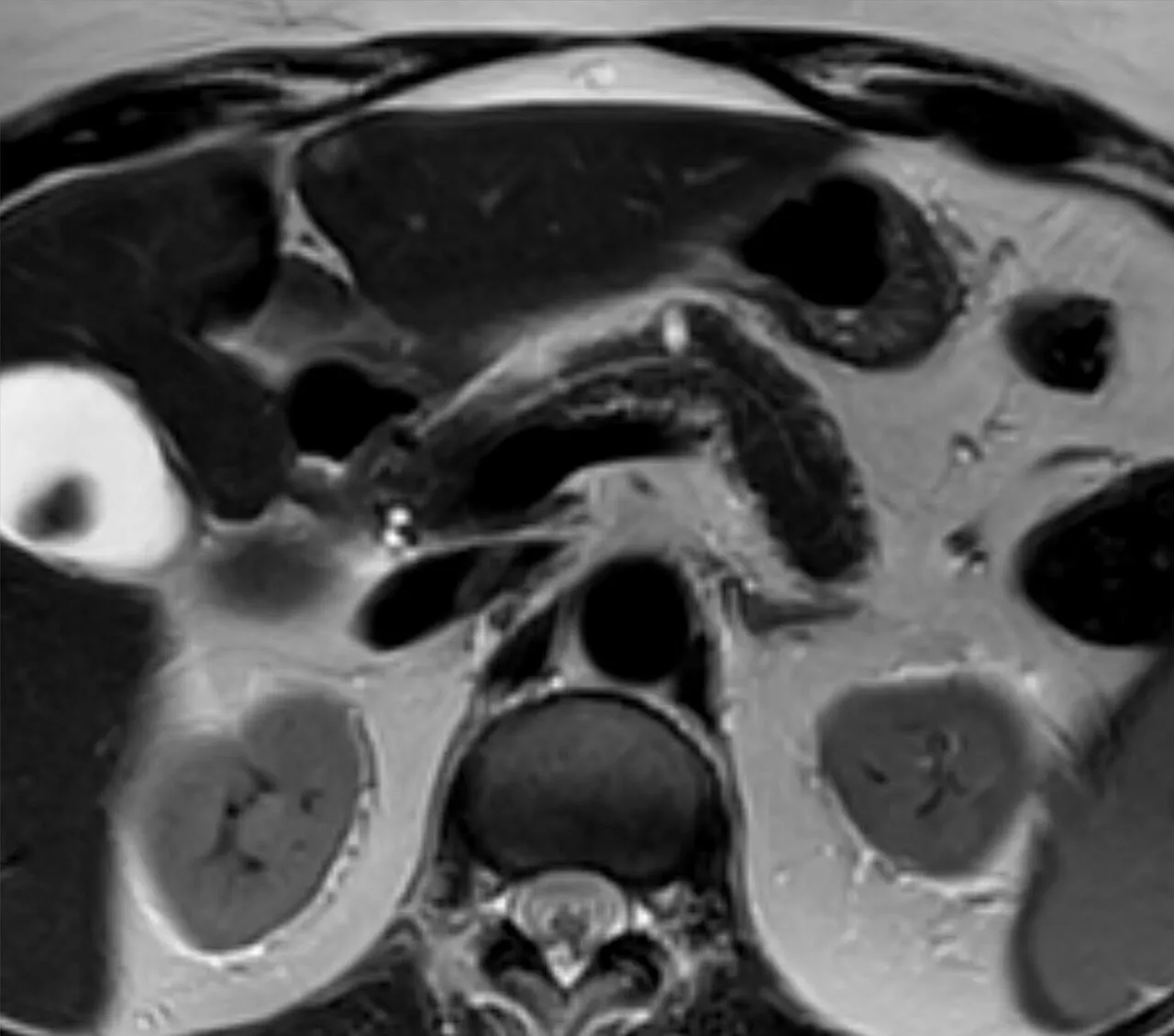
Pancreatic cysts are found incidentally on CT or MRI in a few per cent of adults and in more than one in ten people over 70. Most are small and harmless; some are neoplasms that can progress to pancreatic cancer. The key types are intraductal papillary mucinous neoplasm (IPMN), which arises in the duct system and is divided into main-duct, branch-duct and mixed types; mucinous cystic neoplasm (MCN), found almost only in middle-aged women in the body or tail; serous cystadenoma, a benign honeycomb lesion of older women; and the rare solid pseudopapillary neoplasm of young women. Pseudocysts after pancreatitis are the main non-neoplastic mimic. MRI with MRCP is the preferred test; endoscopic ultrasound with fine-needle aspiration is added when worrisome features are present. High-risk stigmata (jaundice, an enhancing solid component or mural nodule of 5 mm or more, a main duct of 10 mm or more, or positive cytology) call for surgery in fit patients, whereas small branch-duct IPMNs are followed by imaging and surveillance may stop after 5 stable years under the 2024 Kyoto guidelines.
Patient case, mechanism, investigations, management, flashcards and exam-style questions.Open the lesson →
Key facts
- Incidental pancreatic cysts are common and rise with age; most never become malignant
- Mucinous cysts (IPMN and MCN) are premalignant; serous cystadenomas are almost always benign
- Main-duct IPMN carries a high risk of high-grade dysplasia or cancer and is usually resected in fit patients
- Branch-duct IPMN without worrisome features is followed by MRI/MRCP or EUS at intervals set by size
- High-risk stigmata: obstructive jaundice, enhancing solid component or mural nodule ≥5 mm, main duct ≥10 mm, positive cytology
- MRI with MRCP is the best test to show duct communication, septa and nodules
- Cyst fluid CEA above about 192 ng/mL and low glucose suggest a mucinous cyst; KRAS and GNAS variants suggest IPMN
- Stop surveillance in patients who would not be fit for or would not accept pancreatic surgery
Differential diagnosis
| Condition | Clues | Key test |
|---|---|---|
| Pancreatic pseudocyst | History of acute or chronic pancreatitis; unilocular, no mural nodule | CT/MRI history-matched; fluid amylase very high, CEA low |
| Pancreatic ductal adenocarcinoma with cystic change | Solid hypo-enhancing mass with necrosis, duct cut-off, weight loss | Pancreatic-protocol CT and EUS-guided biopsy |
| Cystic pancreatic neuroendocrine tumour | Hypervascular rim on arterial phase imaging | EUS-FNA with chromogranin and synaptophysin staining; somatostatin receptor PET |
| Lymphoepithelial cyst | Middle-aged men, keratin-filled cyst | EUS-FNA showing squamous cells and keratin |
| Walled-off necrosis | After necrotising pancreatitis, contains solid debris | MRI or EUS shows non-liquid debris |
| Choledochal cyst or duodenal duplication | Cyst related to bile duct or duodenal wall | MRCP showing biliary origin; EUS layers |
Exam pearls
Guideline
International evidence-based Kyoto guidelines for IPMN (2024), European evidence-based guidelines on pancreatic cystic neoplasms (2018), ACG clinical guideline on pancreatic cysts (2018) and AGA guideline on asymptomatic neoplastic pancreatic cysts (2015)
References
- Ohtsuka T, Fernandez-Del Castillo C, Furukawa T, et al.. International evidence-based Kyoto guidelines for the management of intraductal papillary mucinous neoplasm of the pancreas. Pancreatology 2024.
- European Study Group on Cystic Tumours of the Pancreas. European evidence-based guidelines on pancreatic cystic neoplasms. Gut 2018.
- Elta GH, Enestvedt BK, Sauer BG, Lennon AM.. ACG clinical guideline: diagnosis and management of pancreatic cysts. Am J Gastroenterol 2018.
- Vege SS, Ziring B, Jain R, Moayyedi P.. American Gastroenterological Association Institute guideline on the diagnosis and management of asymptomatic neoplastic pancreatic cysts. Gastroenterology 2015.
- Tanaka M, Fernández-Del Castillo C, Kamisawa T, et al.. Revisions of international consensus Fukuoka guidelines for the management of IPMN of the pancreas. Pancreatology 2017.
- Goggins M, Overbeek KA, Brand R, et al.. Management of patients with increased risk for familial pancreatic cancer: updated recommendations from the International Cancer of the Pancreas Screening (CAPS) Consortium. Gut 2020.
Related topics
By Dr Khalid Seidi (B.Sc., M.D.) · MedEd World Clinical Knowledge library. Original teaching content checked against current guidelines (November 2026); confirm the latest local guidance before clinical use. Not a substitute for clinical judgement.