Clinical Knowledge › Internal medicine › Gastroenterology and hepatology › Diseases of the pancreas
Pancreatic cancer
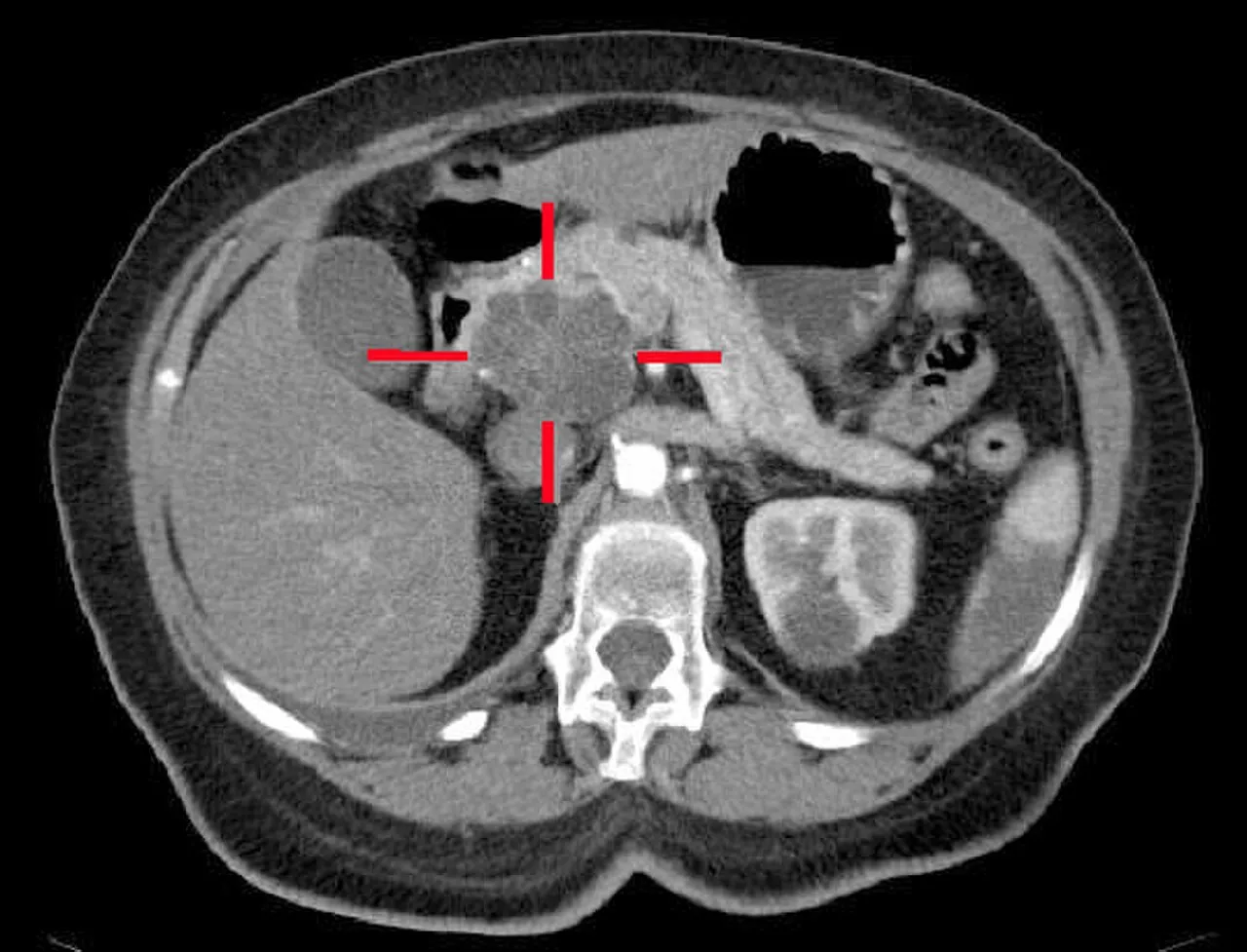
Pancreatic cancer usually means pancreatic ductal adenocarcinoma (PDAC), which makes up about 90% of pancreatic malignancies and is one of the leading causes of cancer death because most patients present late. Smoking, obesity, long-standing or new-onset diabetes, chronic pancreatitis and inherited variants such as BRCA2, PALB2, CDKN2A and Lynch syndrome raise the risk, and almost all tumours carry an activating KRAS mutation. Tumours of the head classically cause painless obstructive jaundice with a palpable gallbladder, while body and tail tumours present with back pain and weight loss. A pancreatic-protocol multiphasic CT is the key test for diagnosis and staging, endoscopic ultrasound gives tissue, and CA 19-9 supports monitoring but cannot make the diagnosis. Only about one in five patients is resectable: surgery followed by 6 months of modified FOLFIRINOX gives the best chance of cure. Advanced disease is treated with combination chemotherapy, and in 2026 the first RAS-targeted drug, daraxonrasib, was approved after it doubled survival in previously treated metastatic disease.
Patient case, mechanism, investigations, management, flashcards and exam-style questions.Open the lesson →
Key facts
- About 90% of pancreatic cancers are ductal adenocarcinomas; two-thirds arise in the head of the gland
- Smoking is the main modifiable risk factor; new-onset diabetes after 50 can be an early sign of an occult tumour
- Painless obstructive jaundice with a palpable, non-tender gallbladder (Courvoisier sign) suggests a malignant distal bile duct obstruction
- Pancreatic-protocol multiphasic CT diagnoses and stages; EUS-guided biopsy confirms the tissue diagnosis
- CA 19-9 is for prognosis and monitoring, not screening or diagnosis: it rises in any cholestasis and is absent in Lewis antigen-negative people
- Resectability depends on contact with the superior mesenteric artery, coeliac axis, common hepatic artery and portal/superior mesenteric vein
- Resectable disease: surgery then 6 months of modified FOLFIRINOX (or gemcitabine plus capecitabine if less fit)
- Offer germline genetic testing to every patient and tumour molecular profiling in advanced disease (BRCA, MSI-high, KRAS wild-type targets)
Differential diagnosis
| Condition | Clues | Key test |
|---|---|---|
| Choledocholithiasis | Painful, fluctuating jaundice, often with fever; gallbladder shrunken and gallstones seen | Ultrasound then MRCP or EUS |
| Chronic pancreatitis with inflammatory mass | Long history of alcohol use, pain, calcification and exocrine insufficiency | CT shows calcification; EUS-guided biopsy if mass present |
| Autoimmune (IgG4-related) pancreatitis | Diffuse 'sausage-shaped' pancreas, other organ involvement, responds to steroids | Serum IgG4, CT/MRI pattern, histology |
| Ampullary or distal bile duct cancer | Painless jaundice; may have intermittent jaundice or occult bleeding | ERCP or EUS with biopsy |
| Pancreatic neuroendocrine tumour | Well-defined, hypervascular mass; may cause hormonal syndromes | Arterial-phase CT, chromogranin A, somatostatin receptor PET |
| Intraductal papillary mucinous neoplasm | Cystic lesion communicating with the duct; often incidental | MRI/MRCP; EUS for worrying features |
| Peptic ulcer disease | Epigastric pain related to meals without jaundice or mass | Upper GI endoscopy |
Exam pearls
Guideline
NCCN Guidelines: Pancreatic Adenocarcinoma (2026 versions), ESMO Clinical Practice Guideline for pancreatic cancer (2023) and NICE NG85 Pancreatic cancer in adults (2018)
References
- National Comprehensive Cancer Network (NCCN). NCCN Clinical Practice Guidelines in Oncology: Pancreatic Adenocarcinoma. 2026.
- Conroy T, Pfeiffer P, Vilgrain V, et al.. Pancreatic cancer: ESMO Clinical Practice Guideline for diagnosis, treatment and follow-up. Ann Oncol 2023.
- National Institute for Health and Care Excellence (NICE). Pancreatic cancer in adults: diagnosis and management (NICE guideline NG85). 2018.
- Conroy T, Hammel P, Hebbar M, et al.. FOLFIRINOX or gemcitabine as adjuvant therapy for pancreatic cancer. N Engl J Med 2018.
- Neoptolemos JP, Palmer DH, Ghaneh P, et al.. Comparison of adjuvant gemcitabine and capecitabine with gemcitabine monotherapy in patients with resected pancreatic cancer (ESPAC-4): a multicentre, open-label, randomised, phase 3 trial. Lancet 2017.
- Wainberg ZA, Melisi D, Macarulla T, et al.. NALIRIFOX versus nab-paclitaxel and gemcitabine in treatment-naive patients with metastatic pancreatic ductal adenocarcinoma (NAPOLI 3): a randomised, open-label, phase 3 trial. Lancet 2023.
Related topics
By Dr Khalid Seidi (B.Sc., M.D.) · MedEd World Clinical Knowledge library. Original teaching content checked against current guidelines (November 2026); confirm the latest local guidance before clinical use. Not a substitute for clinical judgement.