Clinical Knowledge › Internal medicine › Gastroenterology and hepatology › Diseases of the pancreas
Autoimmune pancreatitis
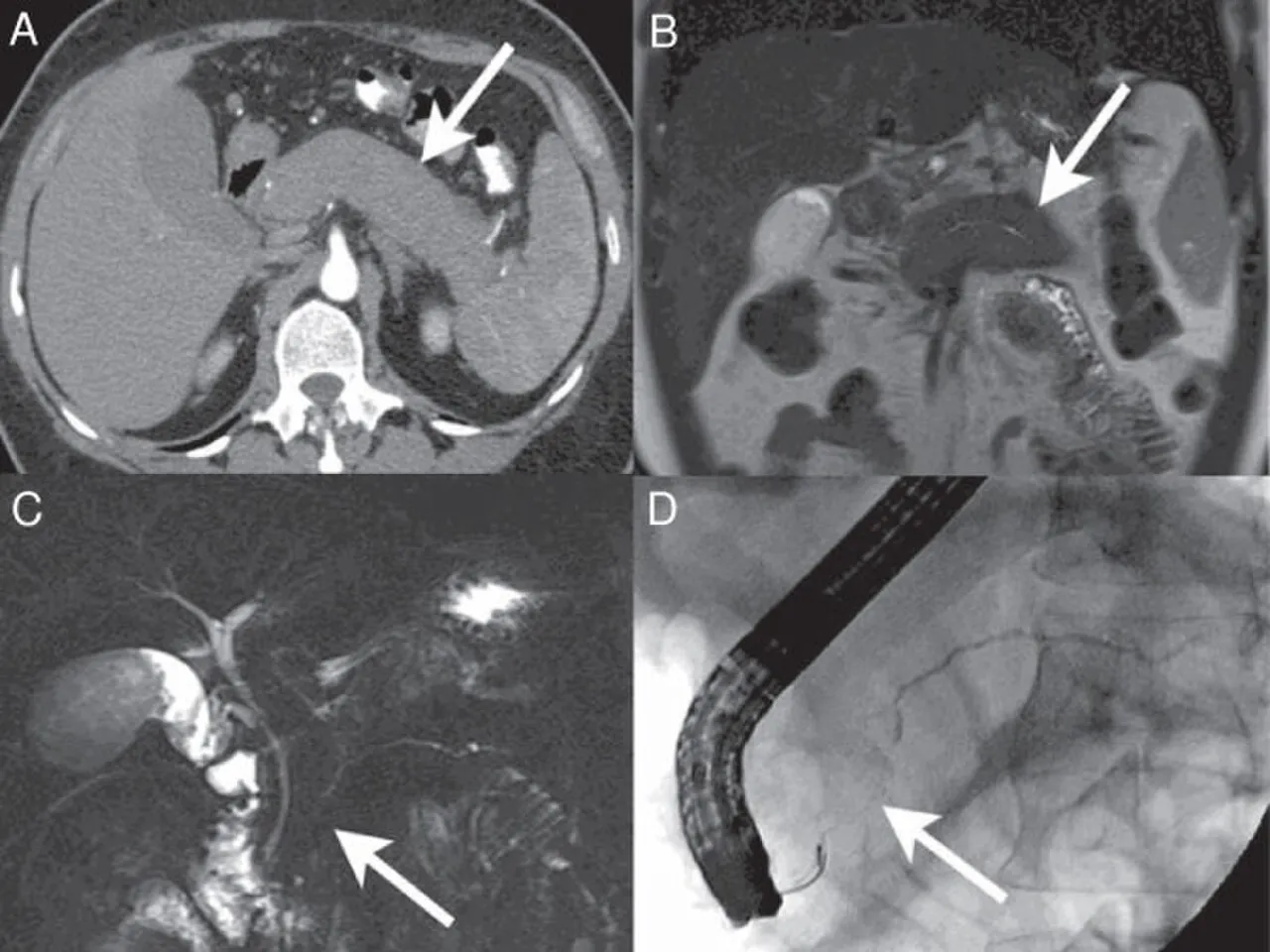
Autoimmune pancreatitis (AIP) is a steroid-responsive form of chronic pancreatitis with two distinct types. Type 1, the commoner worldwide, is the pancreatic manifestation of IgG4-related disease: it typically affects older men, presents with painless obstructive jaundice and a diffusely enlarged 'sausage-shaped' pancreas or a focal mass, with raised serum IgG4 and involvement of bile ducts, salivary glands, retroperitoneum or kidneys. Histology shows storiform fibrosis, obliterative phlebitis and IgG4-positive plasma cells. Type 2 is a duct-centric disease with granulocytic epithelial lesions, affects younger patients of either sex, often coexists with inflammatory bowel disease, has normal IgG4 and rarely relapses. The key clinical challenge is to distinguish AIP from pancreatic cancer, using imaging, serology, other organ involvement and EUS-guided biopsy (International Consensus Diagnostic Criteria). Steroids induce remission in nearly all, but type 1 often relapses; rituximab or immunomodulators are used for relapse, and inebilizumab was approved in the US in 2025 for IgG4-related disease.
Patient case, mechanism, investigations, management, flashcards and exam-style questions.Open the lesson →
Key facts
- Two types: type 1 (IgG4-related, lymphoplasmacytic sclerosing pancreatitis) and type 2 (idiopathic duct-centric pancreatitis with granulocytic epithelial lesions)
- Type 1: older men, painless obstructive jaundice, raised serum IgG4, other organ involvement (IgG4 sclerosing cholangitis, sialadenitis, retroperitoneal fibrosis, nephritis)
- Type 2: younger patients, both sexes, acute pancreatitis-like onset, associated with ulcerative colitis, normal IgG4
- Imaging: diffuse 'sausage-shaped' pancreas with loss of lobulation and a low-density capsule-like rim; focal forms mimic cancer
- Serum IgG4 above twice the upper limit of normal strongly supports type 1 but is neither fully sensitive nor specific
- Always exclude pancreatic cancer: EUS-guided core biopsy, CA19-9 and multidisciplinary review
- Prednisolone 0.6–1 mg/kg/day for 2–4 weeks then taper over about 2–3 months; a response within 2 weeks supports the diagnosis
- Type 1 relapses in roughly 30–50%: maintenance low-dose steroid, azathioprine or rituximab; inebilizumab (anti-CD19) is a newer option
Differential diagnosis
| Condition | Clues | Key test |
|---|---|---|
| Pancreatic ductal adenocarcinoma | Focal hypodense mass, upstream duct dilatation, weight loss, high CA19-9 | Pancreatic-protocol CT, EUS-guided biopsy |
| Primary sclerosing cholangitis | Younger, IBD, beaded intrahepatic ducts, no pancreatic mass | MRCP; IgG4 normal or mildly raised |
| Cholangiocarcinoma | Hilar stricture, weight loss, CA19-9 high | ERCP brushings, cholangioscopy biopsy |
| Alcohol-related chronic pancreatitis | Pain, calcification, alcohol history | CT (calcification), history |
| Pancreatic lymphoma | Bulky mass without duct dilatation, B symptoms | EUS biopsy with flow cytometry |
| Acute pancreatitis of other cause | Severe pain, high lipase, gallstones or alcohol | Ultrasound, lipase, triglycerides |
Exam pearls
Guideline
International Consensus Diagnostic Criteria for AIP (ICDC, 2011), International consensus for the treatment of AIP (2017), UEG/SGF European guideline on IgG4-related digestive disease (2020) and ACR/EULAR IgG4-related disease classification criteria (2019)
References
- Shimosegawa T, Chari ST, Frulloni L, et al.. International consensus diagnostic criteria for autoimmune pancreatitis: guidelines of the International Association of Pancreatology. Pancreas 2011.
- Okazaki K, Chari ST, Frulloni L, et al.. International consensus for the treatment of autoimmune pancreatitis. Pancreatology 2017.
- Löhr JM, Beuers U, Vujasinovic M, et al.. European guideline on IgG4-related digestive disease – UEG and SGF evidence-based recommendations. United European Gastroenterol J 2020.
- Wallace ZS, Naden RP, Chari S, et al.. The 2019 American College of Rheumatology/European League Against Rheumatism classification criteria for IgG4-related disease. Ann Rheum Dis 2020.
- Stone JH, Khosroshahi A, Zhang W, et al.. Inebilizumab for treatment of IgG4-related disease. N Engl J Med 2025.
- Hart PA, Kamisawa T, Brugge WR, et al.. Long-term outcomes of autoimmune pancreatitis: a multicentre, international analysis. Gut 2013.
Related topics
By Dr Khalid Seidi (B.Sc., M.D.) · MedEd World Clinical Knowledge library. Original teaching content checked against current guidelines (November 2026); confirm the latest local guidance before clinical use. Not a substitute for clinical judgement.