Clinical Knowledge › Obstetrics and gynaecology › Normal pregnancy and antenatal care
Antenatal screening for fetal anomalies and aneuploidy
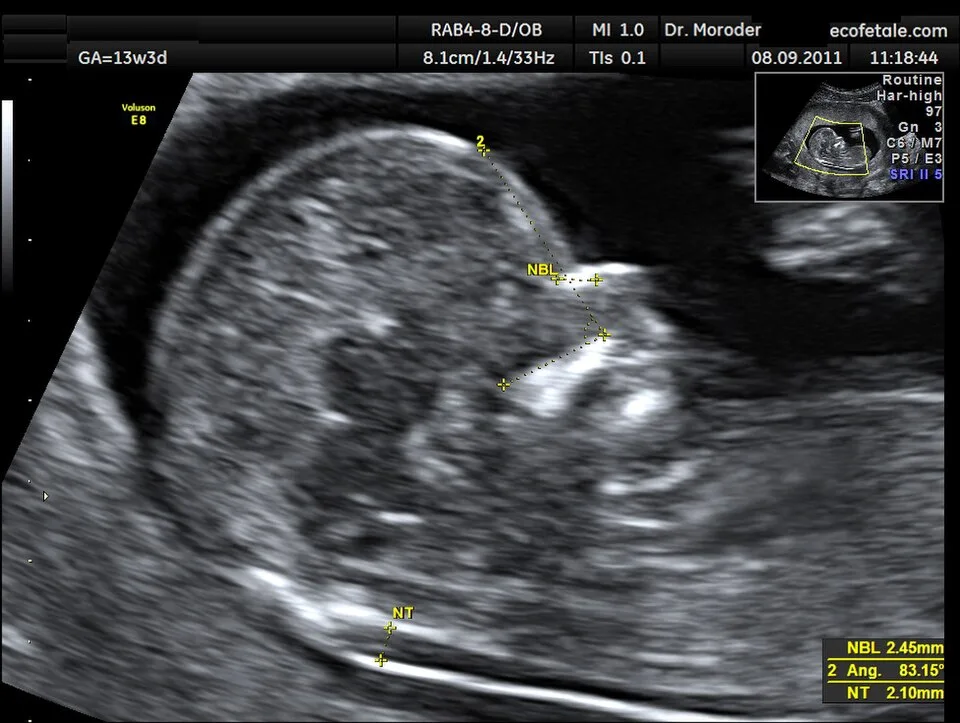
Antenatal screening offers every pregnant woman the choice to find out whether her baby has a higher chance of a chromosomal condition (mainly trisomy 21, 18 and 13) or a structural anomaly. Screening is optional and must follow informed, non-directive counselling. First-trimester combined screening at 11+2 to 14+1 weeks uses maternal age, nuchal translucency, free beta-hCG and PAPP-A and detects about 85–90% of trisomy 21 at a false-positive rate of 2–5%; the second-trimester quadruple test is used when the combined test is missed. Cell-free DNA (cfDNA, NIPT) analysis of placental DNA in maternal blood detects about 99% of trisomy 21 with a false-positive rate near 0.05%, and is used as a first-line or contingent test. All screening results are probabilities: a higher-chance result needs confirmation by chorionic villus sampling or amniocentesis before irreversible decisions. Structural anomalies are sought at the 11–14-week scan and the mid-trimester scan at 18+0 to 20+6 weeks, with fetal medicine referral when an anomaly is suspected.
Patient case, mechanism, investigations, management, flashcards and exam-style questions.Open the lesson →
Key facts
- Screening is offered, not mandatory: informed choice with non-directive counselling before each test
- Combined test (11+2 to 14+1 weeks; CRL 45–84 mm): maternal age + NT + free beta-hCG + PAPP-A; detects about 85–90% of trisomy 21
- Trisomy 21 pattern: raised NT, raised free beta-hCG, low PAPP-A; trisomy 18 and 13: low beta-hCG and low PAPP-A
- Quadruple test (14+2 to 20+0 weeks): trisomy 21 shows low AFP, low unconjugated oestriol, raised hCG and raised inhibin A
- cfDNA/NIPT: detection about 99% (T21), about 98% (T18), about 99% (T13) with false-positive rate about 0.04% each; still a screening test
- NHS higher-chance cut-off 1 in 150 at term: offer NIPT, invasive testing or no further test
- Diagnostic tests: CVS from 11+0 to 13+6 weeks, amniocentesis from 15+0 weeks; additional miscarriage risk probably below 0.5%
- NHS 20-week scan (18+0 to 20+6 weeks) screens for 11 conditions, from anencephaly (about 98% detected) to serious cardiac anomalies (about 50%)
Differential diagnosis
| Condition | Clues | Key test |
|---|---|---|
| Trisomy 21 (Down syndrome) | Raised NT, absent nasal bone, AVSD, duodenal atresia | cfDNA screen; CVS or amniocentesis karyotype/QF-PCR |
| Trisomy 18 (Edwards syndrome) | Growth restriction, clenched hands, cardiac defects, low serum markers | Ultrasound; invasive testing |
| Trisomy 13 (Patau syndrome) | Holoprosencephaly, midline cleft, polydactyly, cardiac defects | Ultrasound; invasive testing |
| Monosomy X (Turner syndrome) | Cystic hygroma, hydrops, coarctation | Ultrasound; invasive testing |
| Triploidy | Early severe FGR, placental changes, very abnormal serum markers | Invasive testing |
| 22q11.2 deletion | Conotruncal cardiac defect, thymic hypoplasia | Chromosomal microarray on CVS or amniotic fluid |
| Confined placental mosaicism | High-chance cfDNA with normal fetus | Amniocentesis (fetal cells) rather than CVS |
| Open neural tube defect | Lemon and banana signs, raised MSAFP | Detailed ultrasound; consider MRI |
Exam pearls
Guideline
ACOG Practice Bulletin 226 Screening for fetal chromosomal abnormalities (2020); ACMG NIPS evidence-based guideline (2022/2023); ISUOG 11–14-week scan (2023) and mid-trimester scan (2022) guidelines; NHS Fetal Anomaly Screening Programme handbook (current online edition); RCOG Green-top Guideline No. 8 (2021)
References
- American College of Obstetricians and Gynecologists. Screening for Fetal Chromosomal Abnormalities: ACOG Practice Bulletin, Number 226. Obstet Gynecol 2020.
- Dungan JS, Klugman S, Darilek S, et al.. Noninvasive prenatal screening (NIPS) for fetal chromosome abnormalities in a general-risk population: An evidence-based clinical guideline of the American College of Medical Genetics and Genomics (ACMG). Genet Med 2023.
- Gil MM, Accurti V, Santacruz B, et al.. Analysis of cell-free DNA in maternal blood in screening for aneuploidies: updated meta-analysis. Ultrasound Obstet Gynecol 2017.
- International Society of Ultrasound in Obstetrics and Gynecology; Bilardo CM, Chaoui R, et al.. ISUOG Practice Guidelines (updated): performance of 11-14-week ultrasound scan. Ultrasound Obstet Gynecol 2023.
- Salomon LJ, Alfirevic Z, Berghella V, et al.. ISUOG Practice Guidelines (updated): performance of the routine mid-trimester fetal ultrasound scan. Ultrasound Obstet Gynecol 2022.
- Norton ME, Jacobsson B, Swamy GK, et al.. Cell-free DNA analysis for noninvasive examination of trisomy. N Engl J Med 2015.
Related topics
By Dr Khalid Seidi (B.Sc., M.D.) · MedEd World Clinical Knowledge library. Original teaching content checked against current guidelines (November 2026); confirm the latest local guidance before clinical use. Not a substitute for clinical judgement.