Clinical Knowledge › Obstetrics and gynaecology › Normal pregnancy and antenatal care
Multiple pregnancy
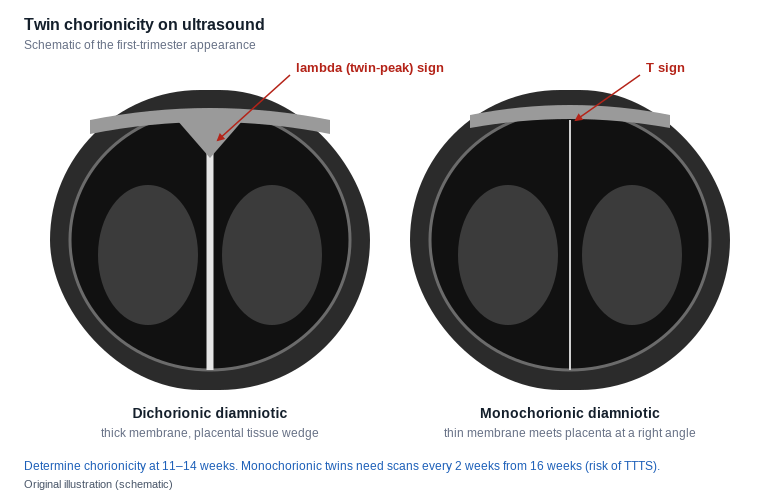
Multiple pregnancy is a pregnancy with two or more fetuses; twins account for about 1.5% of births in high-income countries, with the highest natural twinning rates in West and Central Africa and the lowest in East Asia. Dizygotic twins (two ova) are always dichorionic diamniotic (DCDA); monozygotic twins (one ovum that splits) may be DCDA, monochorionic diamniotic (MCDA), monochorionic monoamniotic (MCMA) or conjoined, depending on the day of division. Chorionicity, not zygosity, drives risk, so it must be determined by ultrasound at 11–14 weeks (lambda or twin-peak sign versus T sign). All multiple pregnancies carry higher risks of preterm birth, pre-eclampsia, anaemia, gestational diabetes, fetal growth restriction, postpartum haemorrhage and perinatal death; monochorionic twins add twin-to-twin transfusion syndrome (TTTS), twin anaemia–polycythaemia sequence (TAPS), selective growth restriction and co-twin injury after a single fetal death. Care is led by a specialist multidisciplinary team with scans every 2 weeks from 16 weeks for monochorionic and every 4 weeks from 20 weeks for dichorionic twins, planned birth at 37 weeks (DCDA), 36 weeks (MCDA), 32–34 weeks (MCMA) or 35 weeks (triplets), and a birth plan that depends on the presentation of the first twin.
Patient case, mechanism, investigations, management, flashcards and exam-style questions.Open the lesson →
Key facts
- Chorionicity is determined at 11+2 to 14+1 weeks: lambda (twin-peak) sign means dichorionic; T sign with a thin dividing membrane means monochorionic
- All dizygotic twins are DCDA; monozygotic twins are DCDA if they split by day 3, MCDA at days 4–8 (most), MCMA at days 8–12 and conjoined after about day 13
- Monochorionic twins share one placenta with vascular anastomoses: TTTS affects about 10–15% of MCDA twins and is staged by Quintero I–V
- NICE NG137 scans: monochorionic every 2 weeks from 16 weeks (TTTS, TAPS, growth); dichorionic every 4 weeks from 20 weeks
- Estimated fetal weight discordance = (larger − smaller) ÷ larger × 100; 20% or more increases surveillance, 25% or more with a twin below the 10th centile needs fetal medicine referral
- NICE 2024: single cervical length scan at 16–20 weeks; vaginal progesterone 200 mg nightly to 34 weeks if cervix is 25 mm or less; no routine cerclage, pessary or bed rest
- Planned birth (NICE): DCDA 37+0 weeks, MCDA 36+0 weeks, MCMA 32+0 to 33+6 weeks by caesarean, trichorionic triplets 35+0 weeks
- Uncomplicated twins over 32 weeks with a cephalic first twin may have planned vaginal birth or caesarean (Twin Birth Study); offer caesarean if twin 1 is non-cephalic
Differential diagnosis
| Condition | Clues | Key test |
|---|---|---|
| Incorrect dates | Uterus large for dates with a single fetus; uncertain last period | Dating ultrasound (crown–rump length) |
| Polyhydramnios in a singleton | Tense, large uterus; fetal parts hard to feel; diabetes or fetal anomaly | Ultrasound amniotic fluid index or deepest pool |
| Fetal macrosomia | Large-for-dates singleton, maternal diabetes or obesity | Growth scan; OGTT |
| Uterine fibroids in pregnancy | Irregular, firm uterus; localised pain if red degeneration | Pelvic ultrasound |
| Molar pregnancy | Large-for-dates uterus, very high hCG, hyperemesis, early pre-eclampsia | Ultrasound (snowstorm/cystic placenta) and serum hCG |
| Adnexal mass with pregnancy | Separate mass beside the uterus, sometimes torsion pain | Pelvic ultrasound |
Exam pearls
Guideline
NICE NG137 Twin and triplet pregnancy (2019, updated April 2024); ISUOG Practice Guidelines (updated): role of ultrasound in twin pregnancy (2025); ACOG Practice Bulletin No. 231 Multifetal gestations (2021)
References
- National Institute for Health and Care Excellence. Twin and triplet pregnancy (NG137). NICE guideline NG137 2019.
- Khalil A, Sotiriadis A, Baschat A, et al.. ISUOG Practice Guidelines (updated): role of ultrasound in twin pregnancy. Ultrasound Obstet Gynecol 2025.
- American College of Obstetricians and Gynecologists. Multifetal gestations: twin, triplet, and higher-order multifetal pregnancies (Practice Bulletin No. 231). Obstet Gynecol 2021.
- Barrett JF, Hannah ME, Hutton EK, et al.. A randomized trial of planned cesarean or vaginal delivery for twin pregnancy. N Engl J Med 2013.
- Senat MV, Deprest J, Boulvain M, et al.. Endoscopic laser surgery versus serial amnioreduction for severe twin-to-twin transfusion syndrome. N Engl J Med 2004.
- National Institute for Health and Care Excellence. Hypertension in pregnancy: diagnosis and management (NG133). NICE guideline NG133 2019.
Related topics
By Dr Khalid Seidi (B.Sc., M.D.) · MedEd World Clinical Knowledge library. Original teaching content checked against current guidelines (November 2026); confirm the latest local guidance before clinical use. Not a substitute for clinical judgement.